Editorial abstract
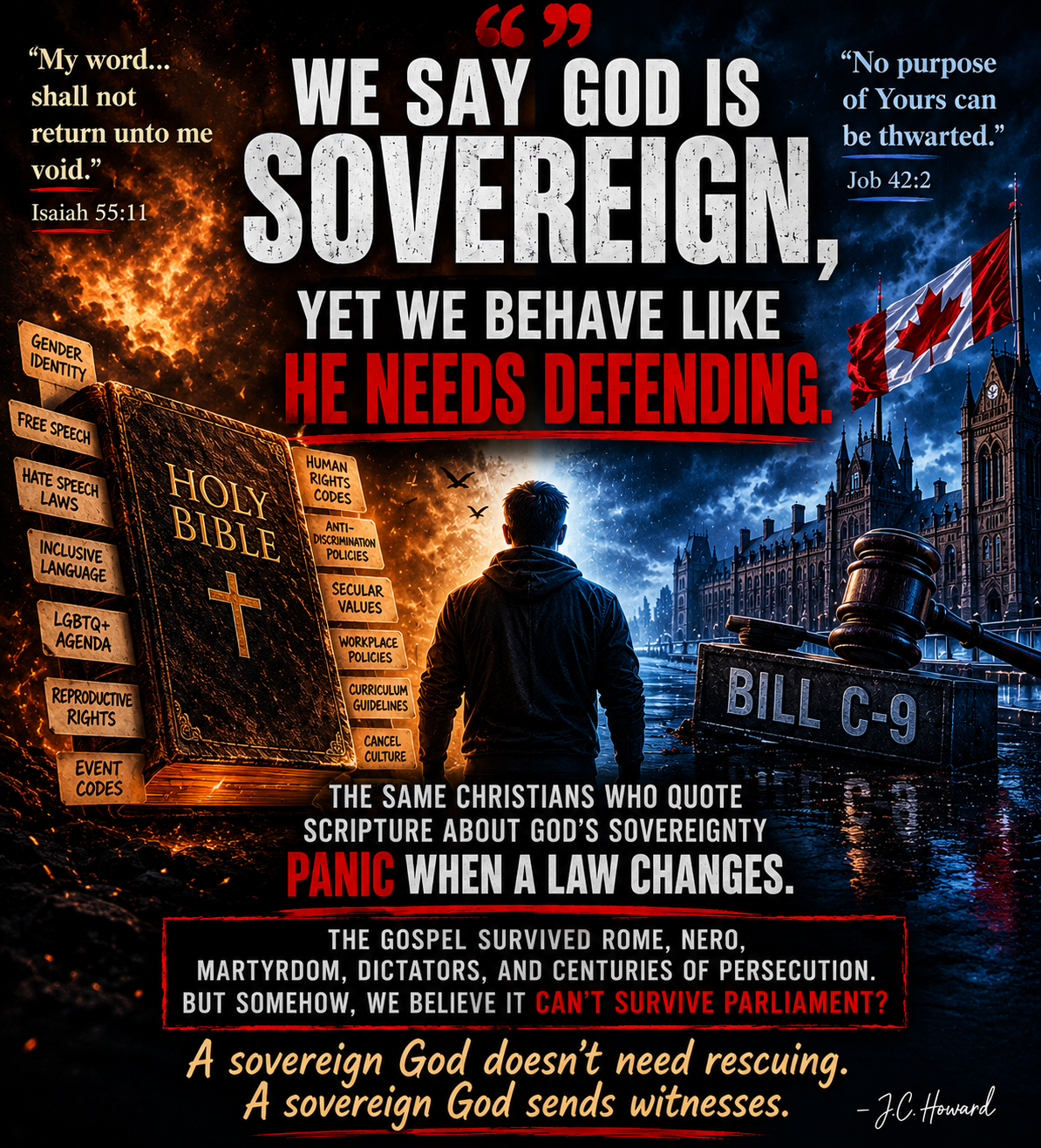
Written amid Canadian debate over Bill C-9, this essay examines a contradiction between Christian claims of divine sovereignty and recurring rhetoric that a law, election, or cultural shift could endanger the Gospel itself. Howard distinguishes civic engagement from panic, invokes Christianity's endurance through political marginality and persecution, and asks whether some institutional alarm reflects perceived identity threat more than theological confidence.
Evidence status: official records establish the bill's stage, enacted scope, and possible engagement of Charter rights. Social-psychological research supports bounded links among perceived threat, intergroup anxiety, uncertainty, identification, and need for closure; it does not diagnose Christians or prove that a particular legal concern is irrational. Historical scholarship supports early Christian geographic expansion under varied Roman conditions but not a simple story of continuous persecution causing growth.
Dated legislative update · editorial
On June 8, 2026, Bill C-9 had passed the House of Commons and the Senate, with the Senate's amendments and message still before the House; it was not yet law. Royal Assent followed on June 18, and the measures came into force July 18. The final Act created offences involving hate-motivated crime, intimidation or obstruction around protected places, and specified hate symbols; it also repealed the prior religious-subject or religious-text defence to certain hate-propaganda charges.
The enacted text continued to require wilful promotion or incitement of hatred for the relevant offences, defined hatred as an extreme emotion associated with detestation or vilification, clarified that merely discrediting, humiliating, hurting, or offending does not by itself meet the threshold, retained Attorney General consent for key prosecutions, and added a public-interest clarification covering good-faith religious and other statements unless they wilfully promote hatred. This summary is contextual, not legal advice.
Canada’s Bill C-9 has sparked concern among many Christians.
Some believe the legislation could limit religious expression. Others argue it is a necessary response to rising hate crimes. Regardless of where one stands politically, the reaction itself reveals something worth examining.
Many Christians speak as though the future of the Gospel now hangs in the balance.
Social media is filled with warnings.
“The Bible will be criminalized.”
“Christianity is under attack.”
“The government is coming for the church.”
Perhaps.
Perhaps not.
But beneath the debate lies a deeper contradiction.
The same Christians expressing panic often profess some of the strongest beliefs in God’s sovereignty.
They quote Isaiah:
“My word... shall not return unto me void.”
They quote Job:
“No purpose of Yours can be thwarted.”
They quote Philippians:
“He who began a good work in you will carry it on to completion.”
They quote Jesus:
“I will build my church, and the gates of hell shall not prevail against it.”
Then a new law is proposed.
A court ruling is issued.
A social movement gains influence.
A cultural trend emerges.
And suddenly many believers begin speaking as though God Himself has become vulnerable.
The contradiction is difficult to ignore.
If God’s plans cannot be thwarted, why do we constantly speak as though they can?
If the Gospel is truly the power of God, why does it appear to require emergency protection every election cycle?
If Christ is building His church, why do so many believers behave as though they are carrying Him on their shoulders?
Historically, Christianity did not spread through favorable laws.
It spread under Rome.
It spread under persecution.
It spread while Christians were imprisoned, exiled, mocked, tortured, and executed.
The early church possessed almost no political influence.
Yet the Gospel expanded across the known world.
Today many believers seem convinced that Christianity can survive Nero but not Parliament.
The Gospel can survive crucifixions but not legislation.
The church can survive martyrdom but not cultural disagreement.
The irony becomes even more striking when Christians use Scripture to defend the very fear Scripture appears to challenge.
Many believers simultaneously affirm:
God is sovereign.
God’s plans cannot fail.
God’s Word accomplishes its purpose.
Christ’s kingdom cannot be stopped.
And:
One law could destroy Christianity.
One election could defeat God’s purposes.
One generation could permanently silence the Gospel.
Both positions cannot comfortably coexist.
This does not mean Christians should be silent.
Scripture calls believers to speak truthfully, contend for the faith, and defend conscience.
The issue is not engagement.
The issue is panic.
There is a difference between standing for truth and acting as though truth is fragile.
There is a difference between defending liberty and believing liberty is what keeps Christianity alive.
Some Christians appear to have more faith in legal protections than in the Gospel they proclaim.
Psychologically, this makes sense.
Human beings crave certainty.
When social influence declines, anxiety rises.
Groups often respond by becoming more reactive, more defensive, and more focused on preserving identity.
Sociologists call this a threat response.
The perceived threat may be real or exaggerated, but the emotional reaction often becomes stronger than the actual danger.
Ironically, the more insecure a group feels, the more loudly it may proclaim confidence.
The result is a strange contradiction.
Christians declare that God reigns over history while behaving as though history has slipped from His hands.
They proclaim divine sovereignty while living in practical fear.
They preach trust while modeling anxiety.
Perhaps the real question is not whether Bill C-9 threatens Christianity.
Perhaps the real question is why so many Christians seem convinced that Christianity cannot survive without governmental approval.
The church has survived emperors.
It has survived dictators.
It has survived persecution, corruption, wars, revolutions, and collapse.
If Christianity is true, it does not need favorable conditions to survive.
And if Christianity depends upon favorable conditions to survive, then perhaps the problem is much larger than Bill C-9.
A sovereign God does not need rescuing.
A sovereign God sends witnesses.
There is a difference.
Editorial counterweight: sovereignty need not mean passivity
A belief in divine sovereignty can coherently coexist with legal advocacy, voting, public argument, conscientious objection, or protection of vulnerable communities. The Department of Justice's own Charter analysis recognized that Bill C-9 could engage religion, expression, assembly, liberty, search, and bail rights while explaining the government's view of the bill's safeguards and public purposes.
The essay's strongest distinction is therefore between engagement and catastrophic rhetoric—not between faith and action. A person may oppose or support the law for reasons that are principled, evidential, and theologically consistent. The relevant question is whether the language of emergency accurately represents the legal text and the speaker's professed confidence.
Scholarly context & references (editorial apparatus)
The sources below separate legislative fact, psychological mechanism, historical context, and theological interpretation. They do not adjudicate the law's constitutionality, infer the motives of all Canadian Christians, or decide whether providence requires political action or restraint.
What the evidence can—and cannot—show
| Question | Evidence can support | Evidence does not establish |
|---|---|---|
| What was Bill C-9 on June 8? | It had passed both chambers with amendments still in the parliamentary message stage; it received Royal Assent June 18. | That the final Act was already in force when the essay appeared. |
| Did the Act criminalize the Bible? | It repealed a religion-or-text defence while retaining offence elements, definitions, consent requirements, and public-interest language. | That religious expression as such became criminal, or that no future Charter dispute is possible. |
| Can perceived threat intensify group response? | Intergroup anxiety and cultural-threat research identifies context-specific links with closure, attitudes, or behavior. | That every concern is irrational, exaggerated, or pathological. |
| Does uncertainty strengthen identification? | A meta-analysis found an overall association whose size varied with how uncertainty was operationalized. | That a specific Christian response was caused by insecurity. |
| Did Christianity endure under Rome? | Christian communities expanded geographically amid varied political conditions and episodes of persecution. | That persecution was continuous, empire-wide, or the sole cause of growth. |
| Does sovereignty require passivity? | Empirical sources can clarify law, history, and human behavior. | A theological rule governing political action; that question remains interpretive. |
- Parliament of Canada. “Bill C-9: Combatting Hate Act.” LEGISinfo, 45th Parliament, 1st session. The official chronology places House third reading on March 25, Senate third reading and a message with amendments on June 4, Royal Assent on June 18, and commencement thirty days later. It anchors the difference between the bill at the essay's publication and the enacted law. Official legislative record.
- Parliament of Canada. Combatting Hate Act, S.C. 2026, c. 15, Royal Assent text. The final Act provides the controlling enacted language: offences and intent elements, the definition of hatred, repeal of the religious-text defence, Attorney General consent, and the public-interest clarification. This record describes the law; it does not predict every application or decide constitutionality. Official Act.
- Department of Justice Canada. “Charter Statement—Bill C-9: An Act to amend the Criminal Code (hate propaganda, hate crime and access to religious or cultural places).” The statement identifies Charter rights potentially engaged and explains the government's rationale and safeguards. By its own terms, it is not a comprehensive legal opinion. Official Charter Statement.
- Stephan, W. G. (2014). “Intergroup Anxiety: Theory, Research, and Practice.” Personality and Social Psychology Review, 18(3), 239–255. This review explains anxiety arising from anticipated intergroup interaction and its possible cognitive, affective, and behavioral consequences. It supplies a more precise construct than a generic group “threat response.” PubMed record. .
- Choi, E. U., & Hogg, M. A. (2020). “Self-Uncertainty and Group Identification: A Meta-Analysis.” Group Processes & Intergroup Relations, 23(4), 483–501. Across 35 studies reported in 30 papers, self-uncertainty was associated with group identification, with effects varying by operationalization. This supports a bounded mechanism, not an inference about a particular believer or controversy. .
- Obaidi, M., Bergh, R., Akrami, N., & Anjum, G. (2023). “Cultural Threat Perceptions Predict Violent Extremism via Need for Cognitive Closure.” Proceedings of the National Academy of Sciences, 120(20), e2213874120. Six studies across several countries linked perceived cultural threat with need for closure and extremist outcomes. Because the outcomes and samples are specific, the study must not be generalized to ordinary legal concern or Christian communities as a whole. Full text. .
- Sheikh, H., Ginges, J., & Atran, S. (2012). “Religion, Group Threat and Sacred Values.” Judgment and Decision Making, 7(2), 110–118. Three studies in American and Palestinian contexts found that perceived in-group threat could amplify the relationship between ritual participation and commitment to sacred values. The settings and measures limit transfer to Canadian legislative debate. .
- Goidel, K., Smentkowski, B., & Freeman, C. M. (2016). “Perceptions of Threat to Religious Liberty.” PS: Political Science & Politics, 49(3), 426–432. In a U.S. observational context, perceived threats to religious liberty were associated with political orientations, issue positions, and attention to news. The study helps separate perception from legal merit but cannot explain Canadian respondents or establish causality. .
- Trombley, F. R. (2008). “Overview: The Geographical Spread of Christianity.” In M. M. Mitchell & F. M. Young (Eds.), The Cambridge History of Christianity, Volume 1: Origins to Constantine, 302–313. The chapter surveys literary, epigraphic, papyrological, and archaeological evidence for early Christian communities across regions. It supports geographic expansion while underscoring uneven evidence and local variation. .
- Pollini, J. (2017). “Burning Rome, Burning Christians.” In S. Bartsch, K. Freudenburg, & C. Littlewood (Eds.), The Cambridge Companion to the Age of Nero, 212–236. The chapter's notes emphasize that treatment of Christians depended on time, place, circumstance, status, and imperial policy, and that even the Great Persecution was piecemeal. Its broader reconstruction of the fire is contested, so this edition relies only on the narrower point about historical variability. .
Publication history
Howard, J. C. “If God Cannot Be Stopped, Why Are We Always Panicking?” Substack, June 8, 2026. Original source: yourpropheticscribe.substack.com/p/if-god-cannot-be-stopped-why-are. The title, subtitle, publication date, prose, and original image were verified from the recovered newsletter record.
What changed for this edition
The original prose and image are preserved. Newsletter subscription and unsubscribe material were removed. The editorial abstract, dated legislative update, four precision notes, historical boundary, counterweight, evidence table, annotated references, display treatments, controlled image placement, and revised alternative text were added for clarity, credibility, accessibility, and archival context.