Editorial abstract
Howard argues that evangelism becomes coercive when witness assumes jurisdiction over another person’s interior life and treats refusal as evidence that more pressure is needed. The essay draws on psychological reactance, unsolicited-advice research, religious internalization, moral self-enhancement, digital moralization, and nonreligious stigma while distinguishing invitation from capture, discomfort from coercion, and public religious speech from role-based pressure. It places the Great Commission beside Gospel scenes of refusal and Christianity’s own ecumenical standards for ethical witness.
Evidence status: No cited study directly tests the essay’s full claim about evangelism. Consumer, workplace, political-social-media, atheist-identity, and psychotherapy findings are used as bounded analogies. Research on religious internalization distinguishes approval-based pressure from more volitional ownership but does not establish the effect of a single evangelistic encounter. The psychotherapy study is self-selected and cannot establish national prevalence; the moral-superiority study is not specific to Christians; and observational diffusion research does not prove platform causation. The theological synthesis is interpretive. This is an independent interdisciplinary essay and has not been peer reviewed.
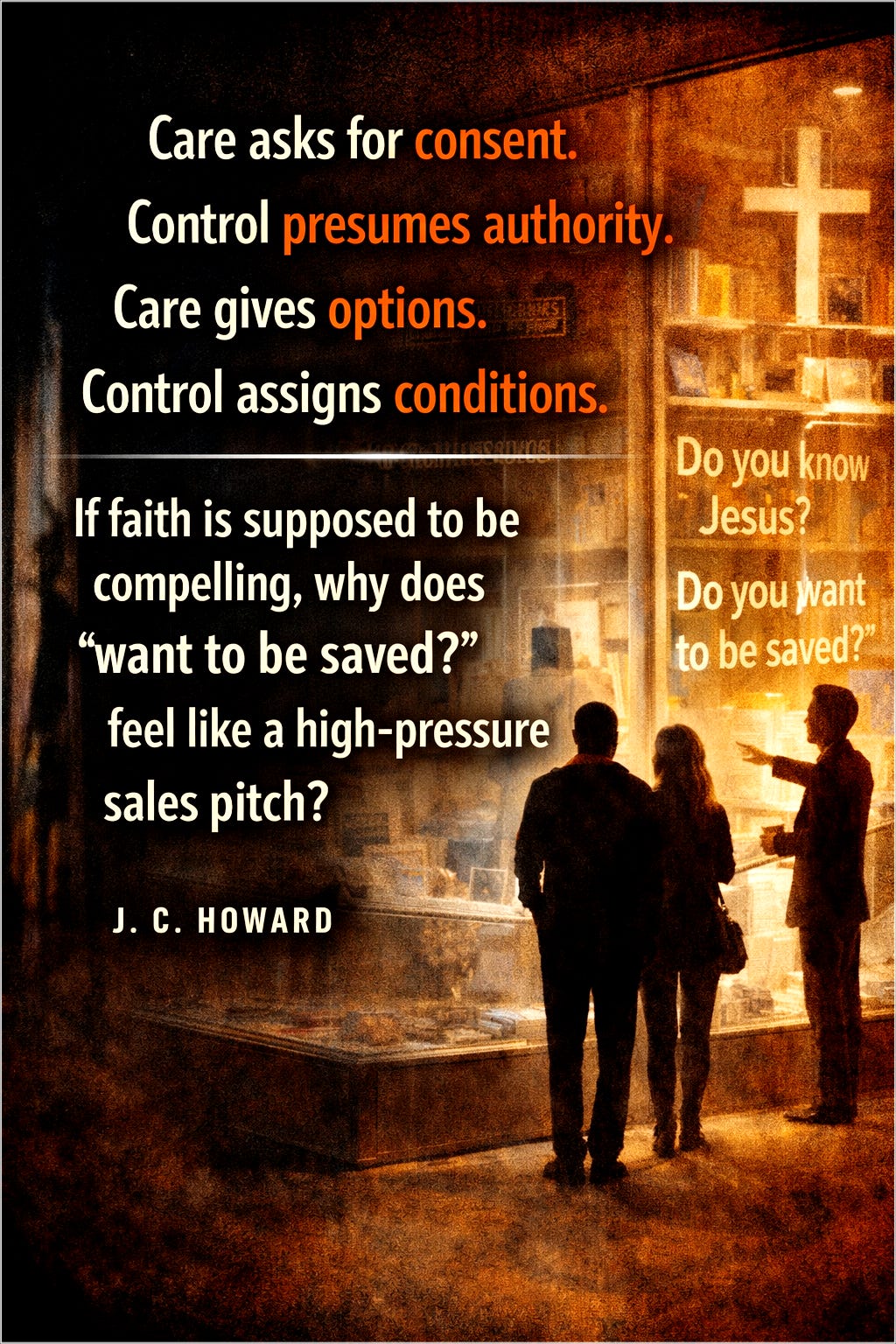
When a Christian says, “Do you know Jesus?” “Do you want to be saved?” or “I’ll pray for you,” the intention may be compassion.
But intention does not control impact.
To someone who does not share the speaker’s framework, the exchange can feel less like sanctuary and more like a sales encounter: a stranger has diagnosed the problem, named the solution, and assigned spiritual meaning before learning anything about the person in front of them.
The problem is not that Christians speak about faith. Religious speech belongs in public life, friendship, family, and honest disagreement. The problem begins when witness stops being an offer and becomes an attempt to seize jurisdiction over another person’s interior life.
The gap between intention and impact
Think about window shopping.
You are browsing. You are not lost. You have not asked for help. Then someone steps into your path with a practiced smile and says, “Let me tell you what you need.” Even if the product is good, the interaction can feel intrusive because it collapses exploration into a transaction.
Many evangelistic one-liners work the same way. They move too quickly from encounter to diagnosis. The listener is no longer a person with a history, a conscience, and reasons. They become a prospect inside someone else’s script.
That does not mean every invitation to prayer is coercive. Context matters. “May I pray for you?” between trusted friends is different from a public official announcing prayer over someone who cannot safely object. A sincere conversation between equals is different from a supervisor, therapist, parent, pastor, or caregiver using spiritual authority where refusal carries a cost.
The moral question is not merely, “Did I mean well?”
It is, “Could the other person decline without penalty, shame, argument, or spiritual diagnosis?”
Reactance is real—and narrower than this argument
Psychological reactance theory describes a motivational response to perceived threats to freedom. Reactance can include anger, counterarguing, source derogation, or efforts to restore a threatened choice. It is not a synonym for rebellion, and it does not prove that the resisted message is false (Rains, 2013; Rosenberg & Siegel, 2018).
Controlled language matters. When persuasion implies that only one response is morally or socially available, resistance becomes more likely. But the evidence does not establish a special law of religious evangelism. Most reactance research examines health messages, recommendations, consumer choice, or other persuasion contexts. Applying it to spiritual encounters is an interpretive extension and should be named as such.
Two studies clarify the boundary.
Fitzsimons and Lehmann found across four consumer studies that unsolicited recommendations contradicting people’s initial impressions could activate reactance and produce deliberate opposition (2004). Landis, Fisher, and Menges found across a workplace network study, an experience-sampling study, and an experiment that recipients tended to attribute more self-serving motives to unsolicited advice than solicited advice, reducing its perceived usefulness (2022).
Neither study tested evangelism. Neither proves that an unrequested statement about faith will always backfire. They do support a more restrained claim: when advice is unsolicited, recipients may attend not only to its content but to what the act of giving it implies about status, motive, and control.
Pressure can produce compliance without producing ownership
Religion-specific research sharpens that distinction. Ryan, Rigby, and King described two forms of religious internalization across four Christian samples. Introjection was organized around pressures such as self-approval and the approval of others; identification involved adopting belief with greater personal volition. Their studies did not test evangelistic encounters, and they do not prove that one unwanted conversation determines how faith is internalized. They do show that outwardly similar religious commitment can be psychologically organized in different ways—one more controlled, another more personally owned (1993).
That matters because a pressured yes can resemble conversion while leaving the person’s agency untouched or buried. Behavioral agreement is not the same thing as inward conviction. A response produced by fear, belonging, family expectation, or the need to satisfy an authority may be religiously visible without being spiritually free.
If faith must be cornered into existence, the corner may become part of the faith.
The believer may hear love.
The listener may hear a verdict.
Why the language lands like a verdict
“Do you want to be saved?” can imply: I already know your spiritual condition.
“I’ll pray for you” can imply: I have assigned you a need you did not name.
“God told me” can imply: my interpretation now outranks your account of your own life.
Those meanings are not inevitable. Tone, relationship, timing, and consent can transform them. But spiritual language carries more than dictionary meaning. It can also carry institutional history, family pressure, prior injury, and the speaker’s social power.
Moral confidence can intensify the problem. In a study of 270 participants, Tappin and McKay found a particularly strong tendency for people to rate their own moral qualities more favorably than those of the average person. The sample and method do not license a claim about all Christians or every population. They do show why moral self-positioning deserves scrutiny: a person can experience themselves as benevolent while communicating superiority (2017).
Good intention is relevant.
It is not self-validating.
Platforms train the pitch
Online environments reward compression, certainty, and emotion.
In a study of messages about three polarizing political issues on Twitter, Brady and colleagues found that moral-emotional language was associated with greater diffusion within ideological networks. The study was observational and political; it did not test Christian posts or establish that moral language always causes sharing. Its value here is narrower: platforms can create incentives for language that is emotionally charged and morally legible (2017).
A later review concluded that social media can accelerate existing moral dynamics, including outrage, status seeking, and intergroup conflict, while also enabling support, prosocial action, and collective mobilization (Van Bavel et al., 2024).
That last clause matters. The algorithm is not a demon with a single appetite. It can amplify compassion as well as condemnation. But it tends to reward what captures attention, and patient relational witness rarely compresses as easily as a verdict.
Christians can therefore learn, without consciously deciding, that the religious content that performs best is declarative, corrective, and emotionally loaded.
That is not necessarily discipleship.
It may be platform training wearing the vocabulary of conviction.
Religious dominance changes the weight
Religious speech does not occur on a flat social field.
Research on atheism as a concealable stigmatized identity found associations among anticipated stigma, concealment, outness, and well-being in a U.S. atheist sample. The findings are correlational and population-specific, but they make one point difficult to dismiss: disclosure and concealment can both carry social costs for people whose nonbelief is distrusted (Abbott & Mollen, 2018).
In psychotherapy, Dabbs, Hutchins, and Kosanovich surveyed 120 U.S. nonreligious participants recruited through Prolific. Forty-five percent endorsed at least one nonreligious microaggression in their most recent therapeutic relationship, and higher microaggression scores were associated with a weaker working alliance. The sample was self-selected, predominantly White, highly educated, and almost entirely irreligious; it cannot establish national prevalence or show that every spiritual reference in therapy is harmful (2025).
It does show why role and setting matter. A prayer offered by a peer is not equivalent to a religious intervention from a clinician. A statement that feels light to the speaker may feel heavy to the listener when the speaker represents a culturally dominant identity or controls access to care, belonging, employment, or family approval.
Power changes the meaning of “no pressure.”
Consent is not a conversion technique
There is a temptation to treat consent as a better persuasion strategy: ask permission because it lowers resistance and improves the odds of conversion.
That still makes the person a prospect.
Consent is not a technique for gaining access. It is recognition that access is not owed.
The Gospels themselves leave room for refusal. Jesus invites rather than mechanically compels, and people sometimes walk away. In Mark 10:21–22, the rich man departs after a difficult summons. In John 6:66–67, disciples leave and the Twelve are asked whether they also wish to go. Those passages do not settle every theology of grace and freedom, but they resist the idea that faithfulness requires eliminating another person’s ability to refuse.
If an invitation is only respected when the answer is yes, it was never an invitation.
The Great Commission does not erase the person
The strongest Christian objection is not trivial. Matthew 28:19–20 commissions disciples to make disciples, and Acts 4:20 portrays witnesses who say they cannot stop speaking about what they have seen and heard. Christianity is not merely a private preference, and asking Christians to treat it as one would misrepresent the tradition.
But a command to witness governs the witness. It does not transfer ownership of the listener’s conscience to the speaker. The Christian may understand proclamation as obedience; the listener is not therefore obligated to provide access, agreement, or gratitude.
Christian institutions have articulated this boundary themselves. In 2011, the World Council of Churches, the Pontifical Council for Interreligious Dialogue, and the World Evangelical Alliance jointly affirmed that Christian witness is essential while insisting that it be practiced with respect for human beings and without deception, coercion, exploitation, or abuse of vulnerability. This is not a secular muzzle placed over Christianity. It is a Christian recognition that the manner of witness can contradict the message being witnessed to (World Council of Churches et al., 2011).
The Great Commission authorizes testimony.
It does not authorize capture.
The strongest counterargument: witness is not automatically intrusion
Any serious critique of coercive evangelism must avoid inventing a new rule in which religious people need permission merely to exist aloud.
Not every mention of Jesus is a boundary violation. Public claims can be challenged publicly. Friends can speak candidly. Strangers can ask meaningful questions. A person may welcome prayer without having requested it in advance. Moral and religious dialogue would become impossible if every unanticipated conviction were treated as harm.
Discomfort is not automatically coercion, and offense is not automatically injury. Serious moral conversation can unsettle people. The argument here is narrower: coercion becomes more plausible as power, persistence, penalty, or the inability to exit replaces reciprocity. Surprise alone is not the boundary. What happens after the other person resists is often more revealing than the fact that the conversation began.
The boundary is not surprise alone.
The better tests are context, reciprocity, and consequence.
Is the encounter a conversation or a capture?
Can the listener question the premise?
Can they say no without being pursued?
Does the speaker remain curious after the script fails?
Is spiritual authority being used to bypass consent, expertise, or accountability?
What happens to the relationship when conversion does not occur?
Evangelism becomes coercive not simply when it is unwanted, but when another person’s refusal is reclassified as rebellion, blindness, offense, or evidence that greater pressure is needed.
Witness without capture
Care asks permission. Control assumes jurisdiction.
Care makes space. Control fills it.
Care can speak clearly. Control cannot tolerate an unconverted answer.
The alternative is not silence. It is speech that preserves the agency of the person being addressed.
“Would you be open to prayer, or would you prefer that I listen?”
“Faith matters to me. Would you like to hear why?”
“I care about you. What would support look like right now?”
“You do not have to agree with me for me to remain present.”
These sentences do not guarantee trust. Consent is not a magic phrase, and relationships cannot be engineered by wording alone. But they disclose something morally important: the other person is not raw material for my obedience story.
Window shoppers do not necessarily hate the product.
They may hate being cornered.
People who do not share Christian belief do not automatically hate Jesus. Some reject the theology. Some carry injury from Christian institutions. Some are indifferent. Some are curious but unwilling to surrender their agency to a stranger’s certainty.
Christians do not have to stop believing.
They do have to stop treating interruption as proof of courage and resistance as proof of persecution.
If the truth is as powerful as Christians claim, it can afford patience. It can afford humility. It can survive a question. It can endure a no.
Because love that cannot honor freedom is not love.
It is conquest dressed as concern.
References & further reading
- Abbott, D. M., & Mollen, D. (2018). Atheism as a concealable stigmatized identity: Outness, anticipated stigma, and well-being. The Counseling Psychologist, 46(6), 685–707. .
- Brady, W. J., Wills, J. A., Jost, J. T., Tucker, J. A., & Van Bavel, J. J. (2017). Emotion shapes the diffusion of moralized content in social networks. Proceedings of the National Academy of Sciences, 114(28), 7313–7318. .
- Dabbs, C. R., Hutchins, C. H., & Kosanovich, S. E. (2025). “I fear coming out as an atheist more than as queer”: Exploring the presence and nature of non-religious microaggressions in U.S. mental health therapy. Religions, 16(12), 1576. .
- Fitzsimons, G. J., & Lehmann, D. R. (2004). Reactance to recommendations: When unsolicited advice yields contrary responses. Marketing Science, 23(1), 82–94. .
- Landis, B., Fisher, C. M., & Menges, J. I. (2022). How employees react to unsolicited and solicited advice in the workplace: Implications for using advice, learning, and performance. Journal of Applied Psychology, 107(3), 408–424. .
- Rains, S. A. (2013). The nature of psychological reactance revisited: A meta-analytic review. Human Communication Research, 39(1), 47–73. .
- Rosenberg, B. D., & Siegel, J. T. (2018). A 50-year review of psychological reactance theory: Do not read this article. Motivation Science, 4(4), 281–300. .
- Ryan, R. M., Rigby, S., & King, K. (1993). Two types of religious internalization and their relations to religious orientations and mental health. Journal of Personality and Social Psychology, 65(3), 586–596. .
- Tappin, B. M., & McKay, R. T. (2017). The illusion of moral superiority. Social Psychological and Personality Science, 8(6), 623–631. .
- Van Bavel, J. J., Robertson, C. E., del Rosario, K., Rasmussen, J., & Rathje, S. (2024). Social media and morality. Annual Review of Psychology, 75, 311–340. .
- World Council of Churches, Pontifical Council for Interreligious Dialogue, & World Evangelical Alliance. (2011). Christian witness in a multi-religious world: Recommendations for conduct. Source.
Revision record (incorporated in this edition)
- Corrected the Brady citation. The source article linked Brady et al. (2017) to an unrelated University of Nebraska page; the DOI and journal record are now correct.
- Corrected the unsolicited-advice study. The original named the wrong coauthors and incomplete title. The article is Landis, Fisher, and Menges (2022),
- Replaced a news citation with primary research. The discussion of concealment and anticipated stigma now cites Abbott and Mollen’s peer-reviewed study directly.
- Bounded reactance. Reactance does not prove the resisted message false, and consumer, workplace, or health-message findings are not direct experiments on evangelism.
- Bounded moral-superiority evidence. Tappin and McKay’s finding is not presented as a special trait of Christians or a universal population estimate.
- Added study limitations. The psychotherapy evidence is described with its sample, correlational design, and limits on prevalence claims.
- Added power and role analysis. Prayer between peers is distinguished from spiritual intervention by clinicians, supervisors, parents, pastors, officials, and others whose roles change the cost of refusal.
- Added theological depth. Gospel scenes in Mark 10 and John 6 establish that Christian invitation can remain meaningful even when the listener walks away.
- Added the strongest counterargument. Religious speech is not automatically intrusion; the clearer tests are context, reciprocity, and the consequences of saying no.
- Clarified consent. Consent is presented as recognition that access is not owed—not as a technique for improving conversion rates.
- Added religion-specific psychology. Ryan, Rigby, and King’s Christian-sample research distinguishes approval-based religious pressure from more volitional internalization without treating it as direct evidence about evangelistic encounters.
- Engaged the Great Commission. Matthew 28 and Acts 4 are addressed directly: the mandate to witness does not make the listener’s agreement, access, or gratitude obligatory.
- Added Christianity’s internal ethical standard. The joint WCC, Vatican, and World Evangelical Alliance recommendations show that opposition to coercive witness also exists inside major Christian traditions.
- Distinguished discomfort from coercion. The revision does not equate surprise, disagreement, or offense with harm; it identifies power, persistence, penalty, and inability to exit as stronger warning signs.
Citation
Cite this essay
Howard, J. C. (2026). “Jesus Is Not a Sales Pitch.” (Version 1.0). The Golden Manifest Journal. .