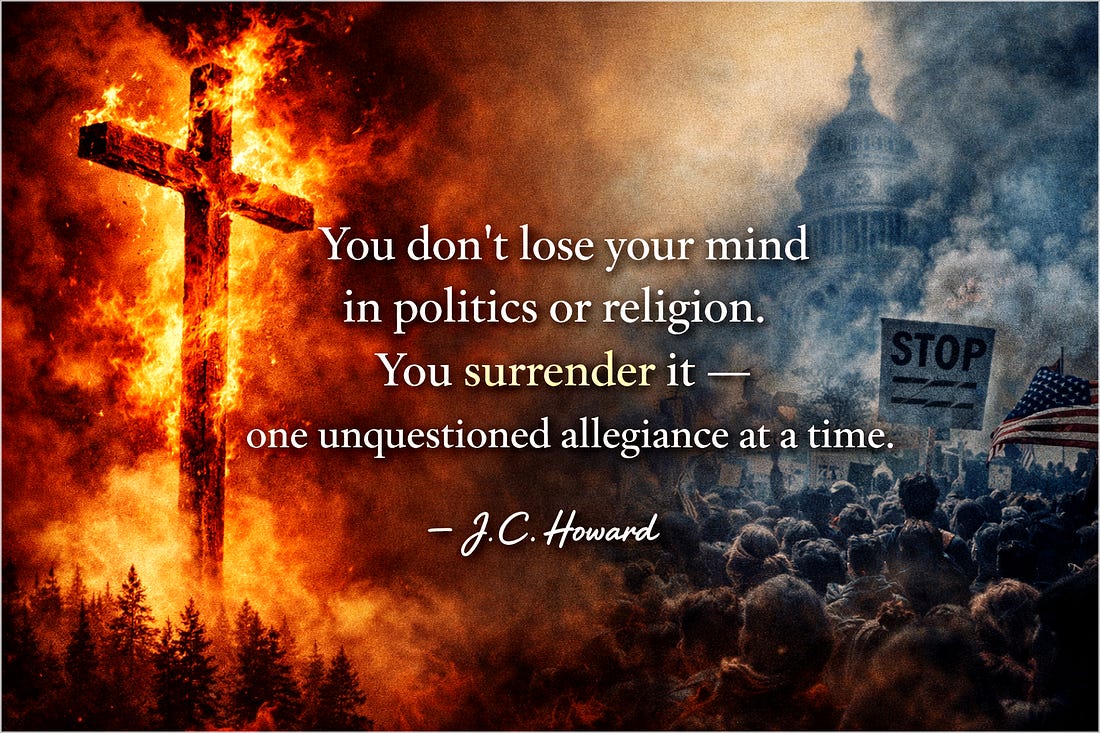
Editorial abstract
Howard argues that political and religious belief often develops within prior structures of belonging. Drawing on social identity theory, motivated reasoning, identity-protective cognition, and affective polarization, the essay describes how affiliation can shape attention, evidence assessment, and emotional responses to dissent. It then proposes the Age of Integration as an author-defined ethic of self-sovereign inquiry in which identity can coexist with revisable belief, pluralism, and dialogue.
Evidence boundary: the broad mechanisms discussed here are grounded in established scholarship, while their synthesis and the Age of Integration remain the author’s interpretive contribution.
I want to make one idea crystal clear before anything else:
Many people do not begin with honest inquiry.
They begin with belonging.
Only afterward—often without realizing it—do they assemble beliefs that protect the place where they feel safe.
This is not a partisan critique. It is a psychological and sociological one.
It is also one of the central barriers to what I call the Age of Integration—my proposed mental and cultural framework in which clarity, self-sovereignty, nuance, humility, and truth-seeking become the primary anchors of collective life.
To understand why politics can feel corrosive, exhausting, and even unhealthy, we have to examine what happens when the human need for belonging meets systems skilled at exploiting it.
Belonging is not the enemy.
Unexamined allegiance is.
1. We Are Social Before We Are Sovereign
Human beings do not construct identity in isolation.
We are born into families, languages, cultures, histories, loyalties, and social categories long before we possess the intellectual tools to examine them.
Social identity theory argues that part of an individual’s self-concept can come from group membership (Tajfel & Turner, 1979). Once we say “we,” the group is no longer merely around us.
It becomes part of how we understand ourselves.
But ordinary group membership is not the same as total psychological fusion. Identity-fusion research uses that language for a particularly strong, visceral sense of oneness between the person and the group (Swann et al., 2012).
That distinction matters.
The more completely a person experiences the group as an extension of the self, the more criticism of the group can feel like criticism of the person.
Not every disagreement becomes a threat.
But under strong identification, some do.
2. Identity Becomes a Psychological Home—and Power Learns the Address
Belonging does not merely feel pleasant.
It can feel safe.
Political movements and religious communities do not always win loyalty by presenting their strongest evidence first. Often they offer recognition, language, purpose, enemies, symbols, and community.
They give people somewhere to stand.
Then they tell them what must be believed to remain standing there.
When belonging becomes psychologically central, attention can bend toward affirmation and away from disconfirming evidence. Scrutiny does not necessarily disappear.
It becomes selective.
The mind may inspect the outsider’s claim like a crime scene while receiving the in-group’s claim like family testimony.
That asymmetry is the lever.
3. Reason Does Not Disappear—It Changes Jobs
Once identity and belief become entangled, the role of reasoning can change.
Instead of:
I evaluate evidence, then choose a belief,
it becomes:
I protect the belief that secures my identity, then search for reasons that justify it.
Kunda’s classic account of motivated reasoning describes how desires can influence which beliefs and strategies people use to access, construct, and evaluate conclusions (Kunda, 1990).
Motivated reasoning is not the absence of intelligence.
It can be intelligence recruited by allegiance.
The person is still reasoning.
But reason is no longer serving discovery.
It is serving defense.
4. Disagreement Can Become an Identity Event
Most of us say we believe disagreement is a normal part of conversation.
But when a belief has become proof of belonging, disagreement can feel like more than intellectual friction.
It can feel like rejection.
Research on identity-protective cognition examines how people may evaluate politically charged evidence in ways aligned with their group commitments (Kahan, 2013). That work is influential, but its mechanisms and reach remain debated. It should not be treated as proof that every partisan, believer, or group member reasons this way in every setting.
The credible claim is narrower—and still unsettling:
When belonging is at stake, people can evaluate evidence partly according to what accepting it would cost them socially and psychologically.
They are not merely asking:
Is this true?
They may also be asking:
What happens to me if my people know I believe it?
A concrete illustration appears in Kahan’s 2013 experiment on politically motivated reasoning. Participants were asked to interpret the same kind of numerical evidence in two different settings: one involving a skin-rash treatment and another involving whether a handgun ban increased or decreased crime. When the calculation carried political meaning, highly numerate participants were not uniformly protected from polarization; their interpretations could divide more sharply along ideological lines.
That experiment does not prove that identity protection explains every disagreement. Later scholars have disputed what the design establishes about motivation itself (Glüer-Pagin & Spectre, 2025).
But the example exposes the deeper possibility:
The numbers did not acquire an identity.
The question surrounding them did.
And once the question signaled allegiance, reasoning could become part of the defense.
5. Emotional Alignment Can Outrun Ideological Debate
People are not divided only by ideas.
They can also be divided by hostility toward those on the other side.
Political scientists describe this as affective polarization—negative feeling and social distance between partisan groups, not merely disagreement over policy (Iyengar, Sood & Lelkes, 2012).
The defining feature is not only what people think.
It is how they feel about those who think differently.
A policy disagreement can be negotiated.
An enemy identity must be defeated.
That is how politics stops functioning like deliberation and begins functioning like moral warfare.
6. Tactics That Exploit Belonging
The need for belonging is human.
The exploitation of that need can be strategic.
But not every identity-enforcing pattern requires a mastermind.
Some movements deliberately manufacture threat, reward conformity, and turn symbols into tests of loyalty. Other dynamics emerge without a single architect. Approval accumulates around one position. Dissent becomes socially expensive. Repetition hardens into expectation. Eventually, the group begins enforcing a boundary no one person had to design.
Power may later exploit what the community first created unintentionally.
The result can still be coercive even when no one can point to the room where the strategy was written.
A. Shared Identity Signals Safety
People can be drawn first to emotional resonance and social comfort rather than evidence. A unified identity offers a psychological home.
Once that home becomes central, evidence that contradicts its governing story may feel less like information and more like eviction.
B. Out-Group Threat Amplifies Group Unity
Frame the group as threatened by an “other,” and reflection can narrow into defense.
Nuance begins to look dangerous.
Certainty begins to look courageous.
Questioning the narrative begins to look like helping the enemy.
C. Rituals and Symbols Become Identity Anchors
Symbols, slogans, chants, gestures, testimonies, flags, and shared language are not merely decoration.
They can make membership visible, repeatable, and emotionally immediate.
They remind the person not only what the group believes, but who the person is supposed to be while standing inside it.
D. Nuance Becomes Betrayal
When identity becomes the priority, nuance may be perceived not as subtlety, but as disloyalty.
Questions become suspicious.
Ambiguity becomes weakness.
Revision becomes surrender.
This helps explain why people sometimes defend claims long after the evidence around them has changed. The defense is not always about the claim alone.
It can be about preserving membership, reputation, relationship, and self-coherence.
This Is Why Politics Often Feels Exhausting and Acidic
When belonging governs belief:
disagreement can feel like rejection
questions can feel like betrayal
nuance can feel like danger
correction can feel like exile
The conversation is no longer only about evidence.
It is about psychological survival inside a social world.
This is not proof of individual weakness.
It is evidence that ideas do not enter minds detached from relationships, incentives, histories, and consequences.
7. Identity Is Not Always the Villain
There is an important counterpoint.
Group identity can preserve memory, build solidarity, protect vulnerable people, and help communities resist institutions that have repeatedly distorted evidence against them.
Distrust is not always irrational.
Sometimes it has a history.
Identity-protective reasoning is therefore not automatically false, immoral, or anti-intellectual. The decisive question is what the identity is protecting.
Is it protecting inquiry from domination?
Or protecting itself from correction?
A community can help people recognize truths that power has concealed.
It can also demand that its own story remain beyond examination.
The difference is whether belonging gives a person the courage to think—or makes thinking the price of remaining loved.
So What Is the Alternative?
This is where the Age of Integration becomes relevant.
The Age of Integration is not neutrality.
It is not indifference.
It is not the fantasy that human beings can become identityless observers floating above culture and history.
It is a discipline.
It is the framework I am proposing, in which:
identity coexists with inquiry
belief serves truth, not defense
clarity does not demand conformity
belonging is chosen without becoming intellectually absolute
disagreement becomes dialogue
cognitive sovereignty replaces tribal servitude
Integration is sovereign thinking.
Integration Begins With Self-Sovereignty
Instead of:
Identity → Belief → Justification
Integration proposes:
Inquiry → Belief → Belonging without surrender
In this sequence:
Belief is informed, not merely inherited.
Belonging is chosen, not imposed.
Truth does not become negotiable.
Belief remains revisable in light of evidence.
You can love a community without making it infallible.
You can inherit a tradition without surrendering your mind to it.
You can stand with people without requiring every question to kneel.
In other words:
You own your ideas instead of letting them own you.
Final Thought
Many people did not form their ideas through detached analysis.
They formed themselves within relationships and communities—and their ideas developed there too.
That is not ignorance.
It is a predictable feature of social life.
But what is predictable can still be examined.
And what is human does not have to remain sovereign over us.
The danger is not that we belong.
The danger is that belonging becomes the authority that decides which truths we are permitted to recognize.
This is why political and religious debates so often become emotional combat instead of intellectual engagement.
Understanding this dynamic—and choosing integration instead of identity first—is not naïve.
It is courageous.
It is uncommon.
And it is exactly what the Age of Integration requires.
References for the journal edition
- Tajfel, H., & Turner, J. C. (1979). “An Integrative Theory of Intergroup Conflict.” In W. G. Austin & S. Worchel (Eds.), The Social Psychology of Intergroup Relations, 33–47.
- Kunda, Z. (1990). “The Case for Motivated Reasoning.” Psychological Bulletin, 108(3), 480–498. .
- Kahan, D. M. (2013). “Ideology, Motivated Reasoning, and Cognitive Reflection.” Judgment and Decision Making, 8(4), 407–424. .
- Iyengar, S., Sood, G., & Lelkes, Y. (2012). “Affect, Not Ideology: A Social Identity Perspective on Polarization.” Public Opinion Quarterly, 76(3), 405–431. .
- Swann, W. B., Jr., Jetten, J., Gómez, A., Whitehouse, H., & Bastian, B. (2012). “When Group Membership Gets Personal: A Theory of Identity Fusion.” Psychological Review, 119(3), 441–456. .
- Glüer-Pagin, K., & Spectre, L. (2025). “Where Is the Motivation in Motivated Numeracy?” Review of Philosophy and Psychology, 16, 481–498. .
- Flores, C. (2025). “Identity-Protective Reasoning: An Epistemic and Political Defense.” Episteme. Publisher record.
Editorial revision and evidence notes
- Changed the universal claim. “Most people” becomes “many people,” preserving the indictment without presenting one chronology as universal.
- Separated evolution from social identity theory. The unsupported claim that Tajfel and Turner established literal survival exclusion and evolutionary encoding has been removed.
- Removed unsupported brain language. The essay now describes selective attention and evidence evaluation without claiming a specific neural process.
- Bound identity fusion. The revised passage distinguishes ordinary group membership from the unusually strong oneness described by identity-fusion research.
- Qualified Kahan’s claim. The essay limits the finding to politically charged evidence in specific contexts and acknowledges continuing scholarly debate.
- Separated rhetoric from empirical fact. The strongest nervous-system, ancient-instinct, and human-wiring formulations have been replaced with defensible psychological language.
- Defined Howard’s contribution. The Age of Integration is explicitly presented as J.C. Howard’s proposed framework.
- Corrected the epistemic line. “Truth remains negotiable” becomes: “Truth does not become negotiable. Belief remains revisable in light of evidence.”
- Sharpened the cadence. The revised opening adds: “Belonging is not the enemy. Unexamined allegiance is.”
- Added the strongest counterargument. A new section recognizes that group identity can preserve solidarity, memory, resistance, and truth under conditions of distortion—then asks whether identity protects inquiry from domination or itself from correction.
- Distinguished strategy from emergence. The revised essay now explains that identity policing may be deliberately cultivated or may arise through accumulated rewards, social costs, repetition, and informal enforcement without a single architect.
- Added a bounded empirical example. Kahan’s skin-rash and handgun-ban experiment shows how the same numerical structure can be interpreted differently once the question carries political identity, while the text also acknowledges later disputes about what the experiment proves.
Additional scholarly context
- American Psychological Association, “Social Identity Theory.” Concise reference definition of how group identification can influence self-concept, self-esteem, and in-group preference. APA Dictionary.
- Gaffney, A. M., & Hogg, M. A. (2023), “Social Identity Theory.” Contemporary overview emphasizing that the salience of personal, relational, and collective identity varies by social context. Oxford Research Encyclopedia.
- Swann, W. B., Jr., Jetten, J., Gómez, A., Whitehouse, H., & Bastian, B. (2012). “When Group Membership Gets Personal: A Theory of Identity Fusion.” Psychological Review, 119(3), 441–456. The theory concerns an unusually strong sense of oneness with a group, not ordinary membership. .
- Glüer-Pagin, K., & Spectre, L. (2025). “Where Is the Motivation in Motivated Numeracy?” Review of Philosophy and Psychology, 16, 481–498. This open-access critique argues that a prominent numeracy result does not by itself establish identity-protective motivated reasoning. .
- Flores, C. (2025). “Identity-Protective Reasoning: An Epistemic and Political Defense.” Episteme. The paper argues that identity protection can sometimes preserve minority truths or resist systematically distorted evidence, qualifying blanket condemnations. Cambridge University Press.
Citation
Cite this essay
Howard, J. C. (2026). “Many Adopt Identity First — Then Fill in Beliefs Later.” (Version 1.0). The Golden Manifest Journal. .