 Premium · Free Sample
I. The Two Civilizations
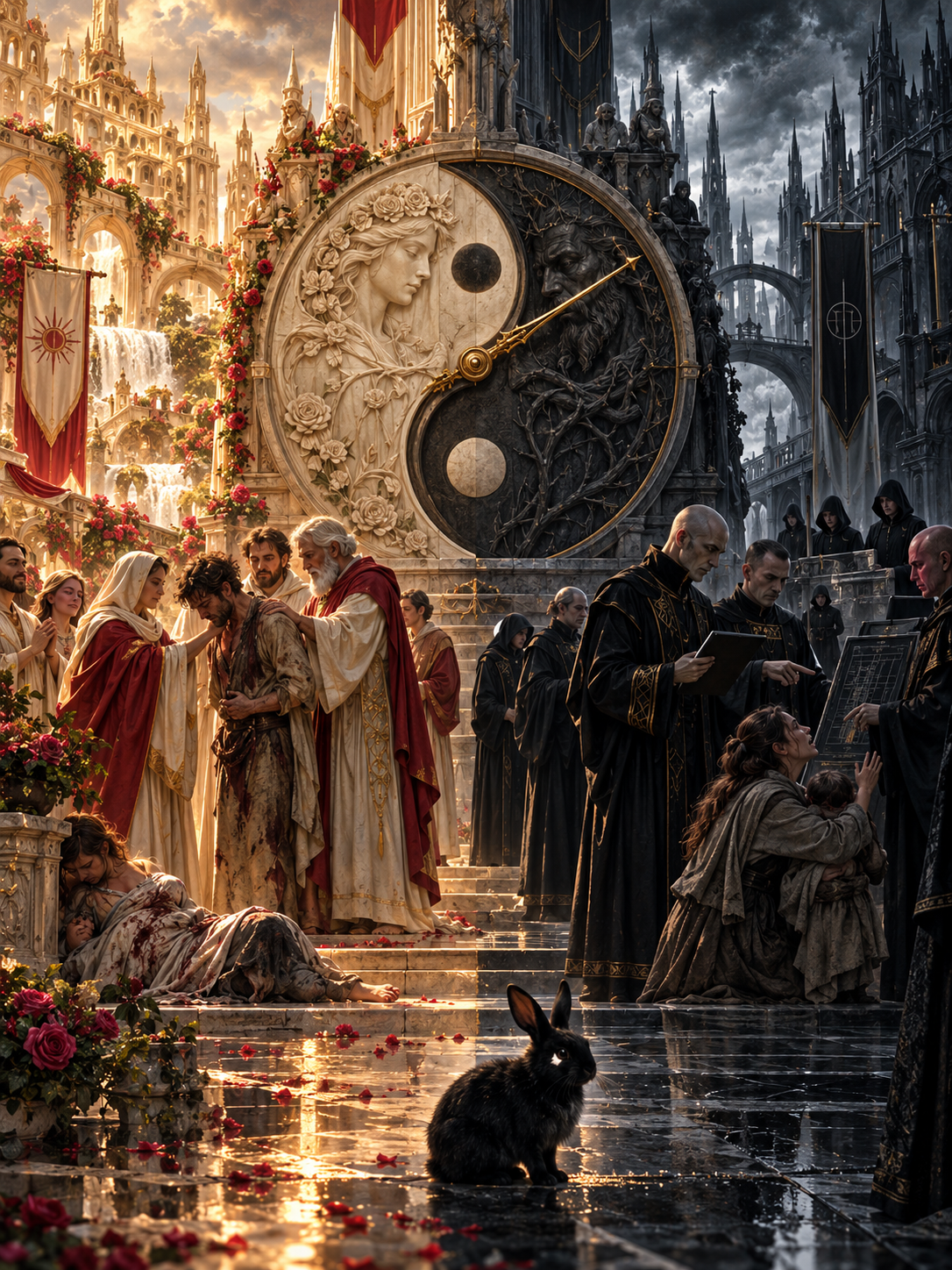
There was once a civilization divided by a single line.
On one side lived those who believed sympathy was the beginning of evil.
On the other lived those who believed the absence of sympathy was evil itself.
Neither civilization considered itself cruel.
In fact, both believed they had discovered the most sophisticated expression of goodness.
The people of the East called themselves the Reasoned.
They had long ago concluded that sympathy corrupted judgment. Compassion, they argued, made exceptions where principles should prevail. It rewarded weakness, excused wrongdoing, and placed individual feelings above collective survival.
Their laws were precise. Their punishments predictable. Their hospitals efficient.
No one received more than the system calculated they deserved.
A mother could plead for her dying child, but if the resources required to save that child would statistically benefit five others, the decision had already been made.
The people did not celebrate such decisions. They simply considered sorrow an insufficient reason to change them.
Across the border lived the Compassionate.
They believed that calculation was the first symptom of moral decay.
To calculate the worth of a human being, they argued, was to reduce life to arithmetic. To withhold kindness because someone had failed was to become indistinguishable from the wrongdoing being condemned.
Their doors remained open. Their forgiveness was abundant. Their generosity knew few conditions.
But generosity without boundaries eventually produced its own victims.
Those who harmed others were repeatedly forgiven. Those who exploited kindness were given further opportunities. And those who suffered from such forgiveness were sometimes accused of lacking compassion.
In the East, the innocent could be sacrificed to preserve a principle.
In the West, the innocent could be sacrificed to preserve sympathy for those who violated it.
Both called their sacrifices necessary.
Both called the other side evil.
And between them stood the Scale.
II. The Measure of Distance
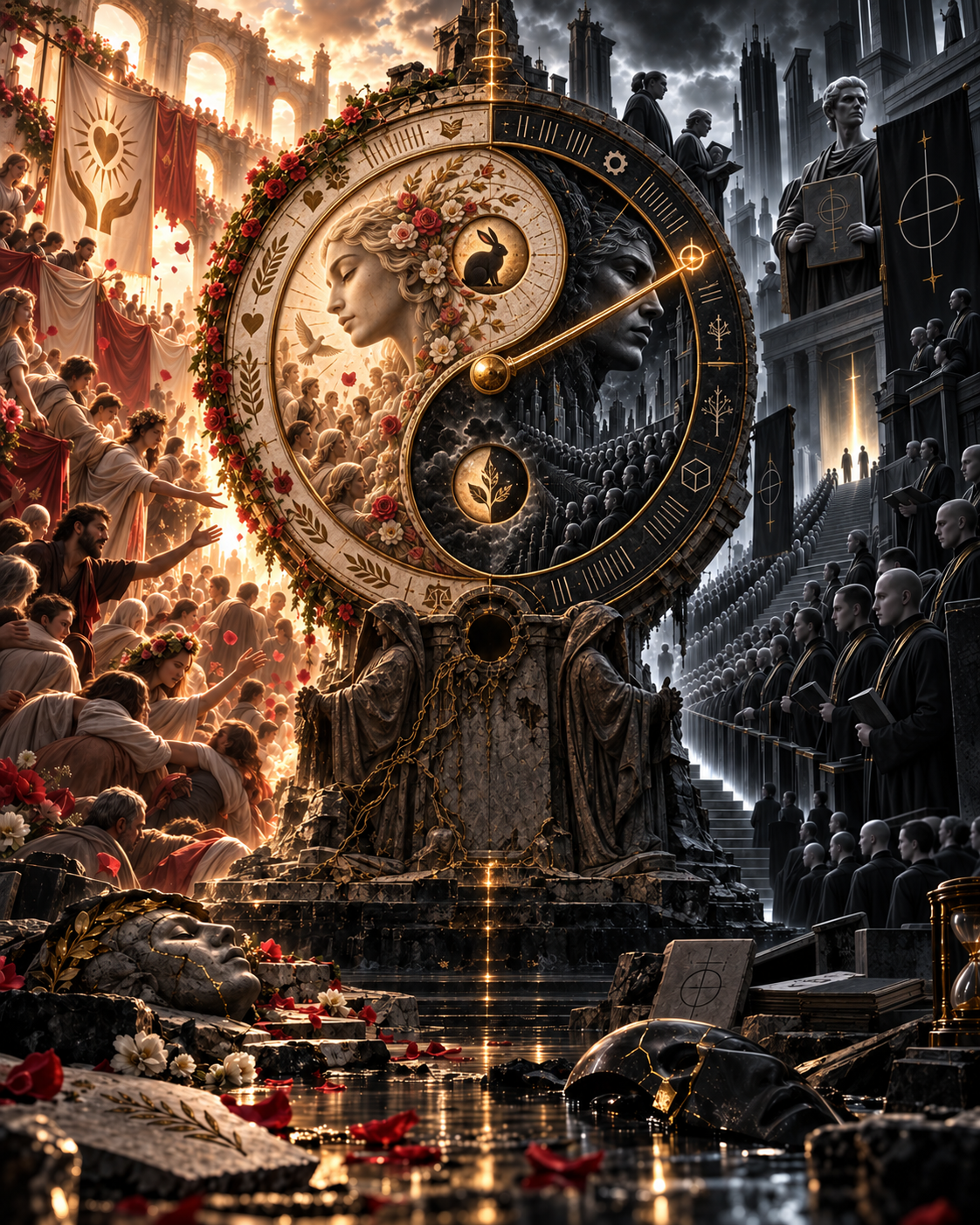
The Scale was an ancient instrument, constructed in the shape of a circle divided into black and white.
It resembled the symbol of Yin and Yang, except that a narrow golden needle extended from its center.
The needle measured the increasing distance between the two civilizations.
Each new law, each moral prohibition, each act of ideological escalation moved the needle farther from its original position.
No one remembered who had built it.
Yet both civilizations claimed it verified their righteousness.
The Reasoned argued that the Compassionate had increased the division first by allowing emotions to interfere with established order.
The Compassionate insisted the Reasoned had moved first by turning human suffering into a mathematical variable.
Generations of historians debated the question.
One ancient record suggested the first deviation had been only one degree. Another claimed it had been three. A third insisted that the Scale had already been tilted before anyone began recording its movement.
But one fact remained undisputed.
Each civilization had spent centuries increasing the distance while claiming merely to be responding to the other.
One degree became two.
Two became four.
Four became sixteen.
Eventually, the needle had traveled so far around the circle that the original position became difficult to distinguish from the latest.
What had begun as a disagreement over goodness had become an entire civilization organized around proving the wickedness of its opposite.
And then came the Black Rabbit.
III. An Innocent on the Border

The rabbit appeared one morning on the border, sitting directly beneath the Scale.
Its fur was black, except for a small white marking beneath its left eye.
Children from both civilizations gathered to look at it.
A young girl from the Compassionate side extended a piece of bread.
The rabbit approached.
Immediately, a Reasoned official warned her that feeding a wild animal would encourage dependency and disrupt its natural survival behavior.
A Compassionate elder rebuked the official.
“Even before a hungry creature, you must turn kindness into a calculation.”
The official replied, “And even before an animal capable of feeding itself, you mistake intervention for virtue.”
The argument attracted a crowd.
Soon there were dozens of people shouting about the moral implications of a rabbit eating bread.
The rabbit, meanwhile, ate the bread.
Then it crossed the border.
For the first time in recorded history, both civilizations agreed on something.
The rabbit had behaved improperly.
The Reasoned condemned its dependency. The Compassionate condemned its apparent ingratitude for leaving the girl who had fed it.
The rabbit became an object of suspicion.
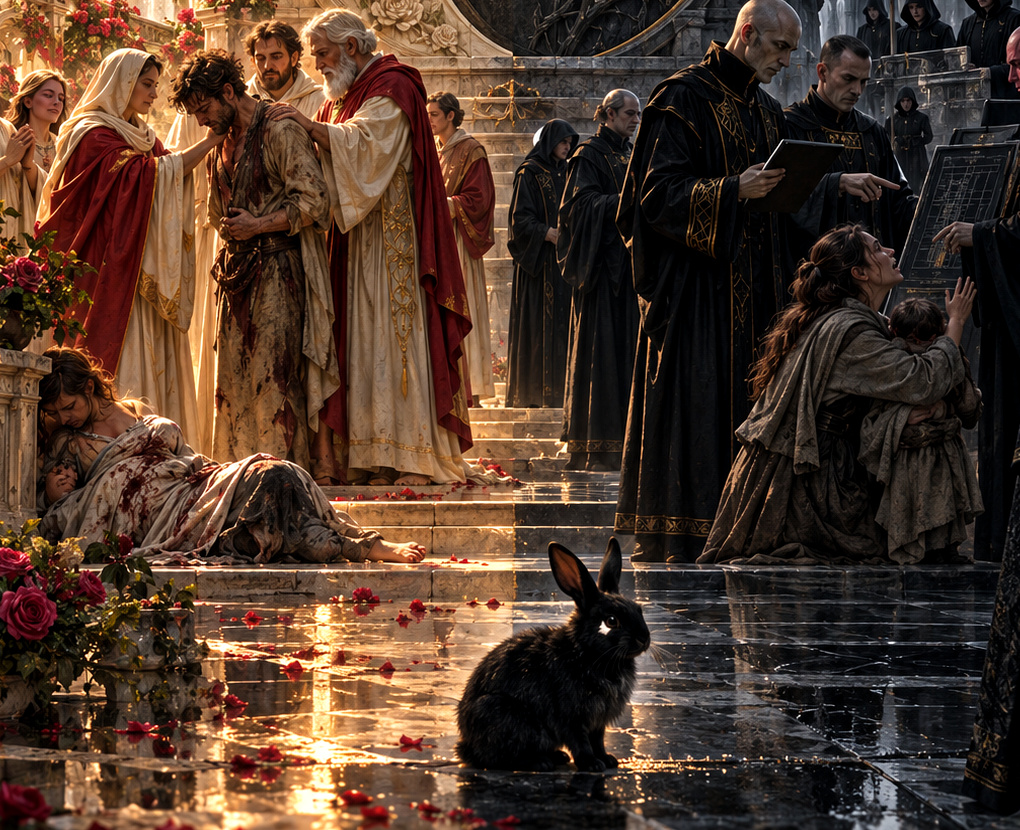
It made no defense. It was, after all, only a rabbit. But its silence was interpreted by one side as proof of indifference and by the other as proof of moral evasion.
Neither side needed to know what the rabbit intended. Each had already supplied an intention that confirmed its own beliefs.
IV. The Bridge
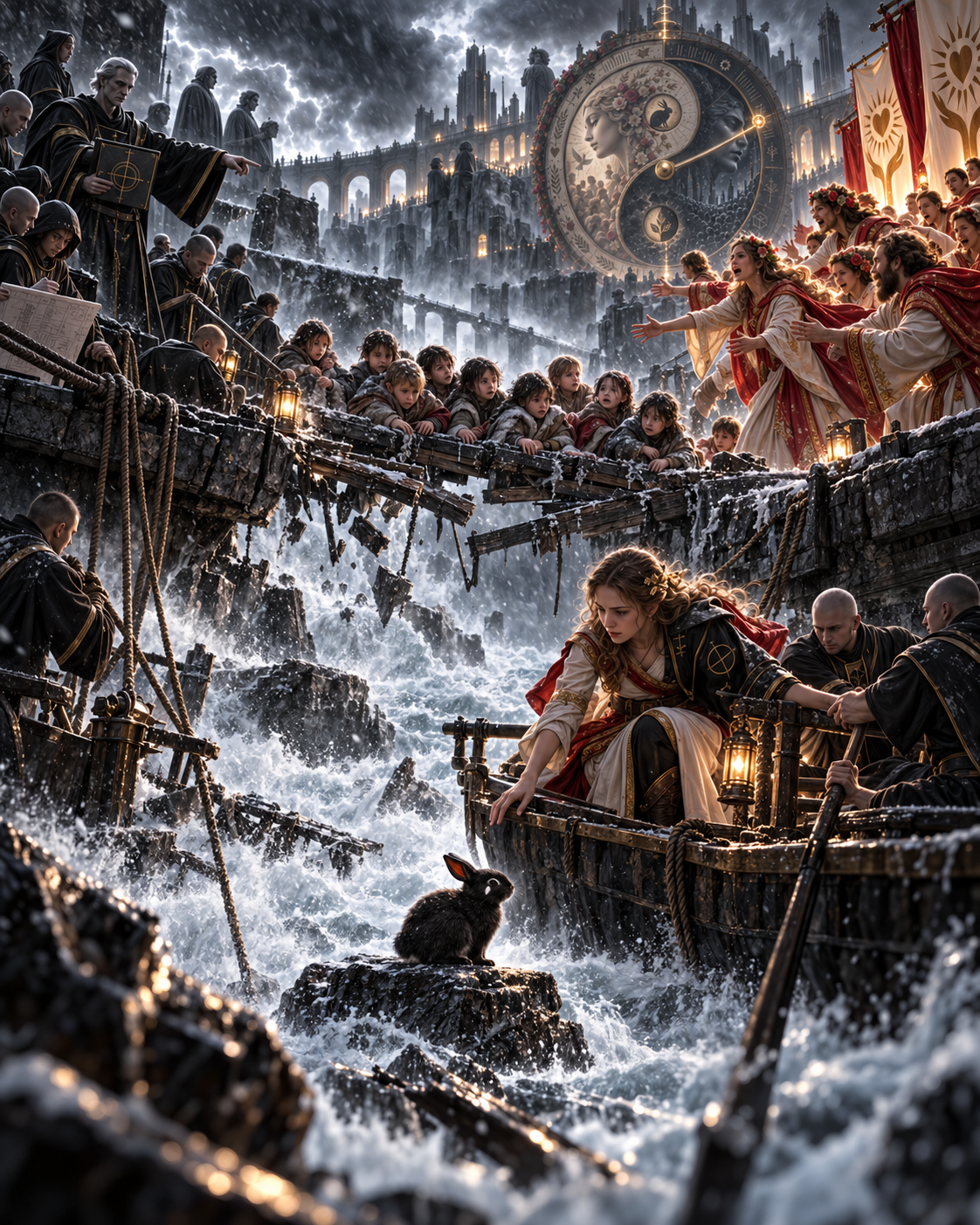
That winter, a violent storm destroyed the old bridge connecting the two civilizations.
Twelve children became trapped on a narrow section of the structure, suspended above a swollen river.
The Reasoned arrived first.
Their engineers assessed the conditions and discovered that a rescue vessel could safely carry six children at a time.
They calculated the probability of the bridge collapsing, the time required for a second crossing, and the likelihood of each child surviving exposure.
Their conclusion was immediate.
Six should be rescued.
The remaining six would be retrieved only if the structure survived long enough.
They began selecting the children according to a system of survival probability.
The Compassionate arrived moments later.
Horrified by the selection process, they demanded that no child be abandoned.
“We cannot decide which life deserves rescue,” they cried.
They insisted that all twelve children be taken together.
The engineers explained that the vessel would likely sink under such weight.
The Compassionate accused them of hiding behind numbers.
The Reasoned accused the Compassionate of allowing their emotions to endanger everyone.
The bridge continued collapsing while both sides defended their morality.
And beneath the rescue vessel sat the Black Rabbit.
A young woman named Elian noticed it.
She had been born in the East but raised in the West. Neither civilization had ever fully accepted her.
To the Reasoned, she was dangerously sentimental.
To the Compassionate, she was disturbingly analytical.
She climbed into the vessel.
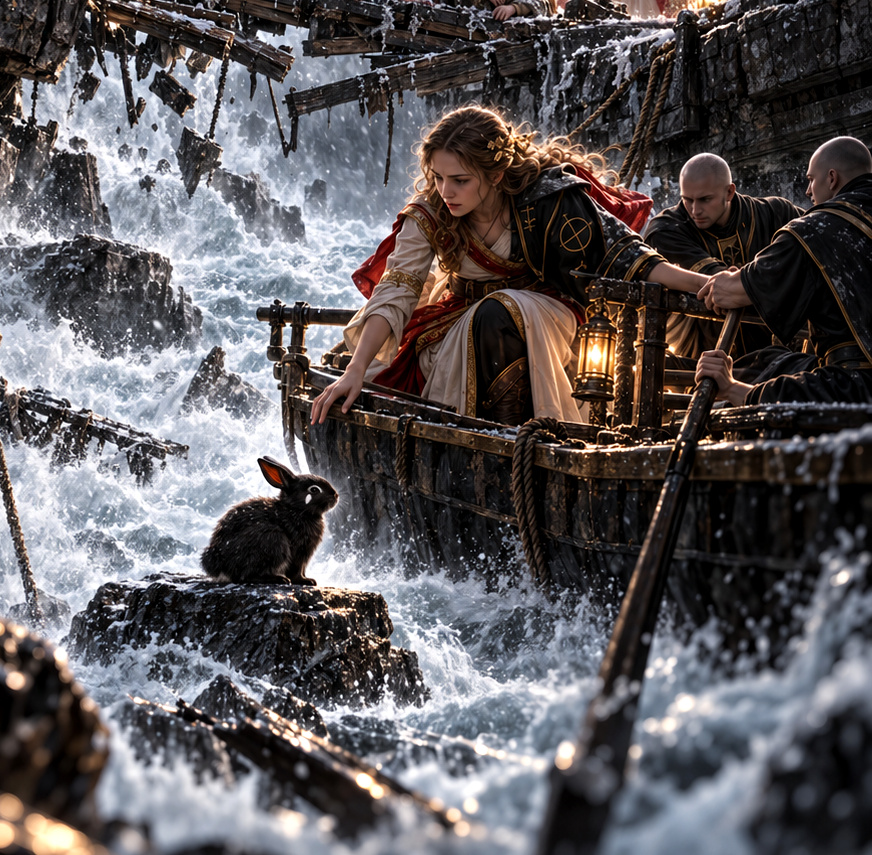
“Six at a time,” she said.
The Compassionate protested.
“All twelve,” she answered. “Two crossings. Use the engineering calculations to determine whether we have enough time.”
The Reasoned engineers objected that a second crossing involved unacceptable uncertainty.
“Then improve the calculation,” Elian replied. “Do not use uncertainty as permission to stop trying.”
She ordered the first six children aboard, prioritizing those least able to endure the cold.
The vessel crossed.
It returned.
The second six were rescued moments before the bridge collapsed.
All twelve survived.
On the riverbank, a boy from the East held fast to the sleeve of a girl from the West. A passing official asked which side had saved them.
“The boat,” said the boy.
“And the people who brought it back,” said the girl.
Neither child understood why the answer displeased the adults.
Neither civilization celebrated Elian.
The Reasoned accused her of allowing sympathy to influence a procedure.
The Compassionate accused her of accepting the temporary abandonment of six children.
Both believed she had endangered the moral foundations of civilization.
Within days, each government introduced new laws to prevent such decisions from occurring again.
The Scale moved another degree.
Then another.
And another.
V. The Peace Neither Side Could Afford
The first appeal for reconciliation came not from a ruler, a philosopher, or an engineer.
It came from the twelve children.
Their families assembled a letter asking the two governments to establish a shared rescue procedure. It did not demand that every vessel carry twelve passengers or that every calculation be trusted. It asked the engineers to design safer boats, the healers to identify those most endangered by the cold, and both societies to train rescuers together before the next storm.
At the bottom, in uneven handwriting, the children had added a single sentence:
“We needed both.”
The Reasoned received the proposal in the Hall of Measures.
Several engineers considered it sensible. A second landing rope, they explained, could reduce the time between crossings. Better preparations could improve the probability of bringing everyone home.
But a magistrate objected. “If we approve this petition, the public will think sympathy corrected our procedure.”
One engineer answered, “It did not replace the procedure. It told us what the procedure ought to protect.”
The magistrate ordered further review. The recommendations disappeared into an archive.
Across the river, the Compassionate Assembly met beneath its banners of open hands.
A healer proposed teaching the vessel's load limit alongside the duty to return for those still waiting. Another proposed storing blankets and ropes at every crossing.
An elder opposed the plan. “The moment we teach a number,” she said, “we teach our children that some lives may be set aside.”
The healer replied, “The number told us what the boat could bear. It did not tell us whom to love.”
The Assembly thanked her for her concern. Her proposal, too, was set aside.
Neither civilization banned rescue. Each rejected the lesson that appeared to have come from its enemy.
Both governments held ceremonies for the twelve children. The Reasoned praised the discipline of their engineers. The Compassionate praised the persistence of their mercy. Neither account explained how the boat had made its second crossing.
And neither printed the sentence the children had written.
When Elian compared the two official replies, she found different seals, different accusations, and the same omission.
She had expected the governments to fear failure. She had not expected them to fear a success they could not claim exclusively.
A failed rescue would have vindicated one side's warning against the other. A successful shared rescue threatened the distinction on which both warnings depended.
Their disagreement was no longer merely about which action was good. It had become a disagreement over who was permitted to be seen doing good.
At the border, the children had begun gathering stones to mark where a new bridge might stand. The adults were still debating which civilization should be allowed to design it.
Elian watched the children placing their stones together. They did not agree about everything. They argued over where the bridge should begin, how high it ought to rise, and which bank had the stronger ground.
Yet they continued building a little path toward one another.
Their disagreement had not disappeared. It had simply ceased to require an enemy.
That was what frightened the governments most.
They knew how to describe surrender. They knew how to celebrate victory. But they had no ceremony for discovering that an adversary possessed a truth their own virtue needed.
Peace might demand something more unsettling than compromise: the admission that goodness had never belonged entirely to either side.
And if that were admitted, what would become of the institutions built to defend goodness against the other?
VI. Zero Must First Be Chosen
That evening, Elian stood before the ancient instrument.
The Black Rabbit appeared beside her.
She studied the needle, now trembling near the outermost marking.
For generations, everyone had asked which civilization was responsible for the first movement.
But Elian noticed something peculiar.
The instrument recorded distance.
It did not record moral responsibility.

It could reveal how far two positions had moved apart, but it could not establish whether the first movement had been justified, whether the second had been proportionate, or whether either society had mistaken a useful principle for an absolute one.
Nor could it explain why the first movement should determine the morality of everything that followed.
She examined the oldest inscription beneath the instrument.
It read:
“All deviations are measured from zero.”
Beneath it, nearly erased by centuries of weather, was a second inscription:
“Zero must first be chosen.”
Elian stared at the words.
The entire history of their moral conflict had been organized around a measurement whose original reference point neither side could establish.
Even if the first deviation were known, its size would not establish the justice of every subsequent response.
One degree of cruelty did not make ten degrees of retaliation righteous.
But neither did ten degrees of departure from tradition necessarily make an action cruel.
Nor did the fact that two positions stood equally far from the center make them equally defensible. A halfway position between protecting a child and abandoning her would not become just simply because it lay at the midpoint. The needle could register movement, but it could not tell whether a movement relieved suffering, imposed it, or concealed it beneath a new name.
Elian thought of the bridge. The engineers had judged a second crossing an unacceptable deviation from their calculations. The Compassionate had judged the first crossing an unacceptable deviation from their demand that no child be left behind. Yet the departure from each side’s purest principle had saved twelve lives.
The first deviation was not necessarily the greatest evil. The greatest deviation might not be evil at all. And the distance between moral positions was not a measurement of their moral worth.
She had spent her life being described as too much like whichever civilization stood opposite her. Now she wondered whether that accusation had ever measured anything about her—or merely revealed the position of the person making it.
VII. The Need for an Enemy
What if the greatest increase in duality had occurred not when one civilization abandoned the other’s principles, but when both began treating their own principles as incapable of becoming evil?
What if sympathy became destructive precisely when it was forbidden to exercise judgment?
What if calculation became monstrous precisely when it was forbidden to recognize suffering?
And what if the escalating distance between the civilizations concealed an increasingly uncomfortable similarity?
For both had learned to sacrifice human beings to preserve their own understanding of goodness.
Both had made obedience more important than consequence.
Both had developed elaborate explanations for why the suffering produced by their virtues could not be their responsibility.
Elian looked again at the circular Scale.
The black half contained a small white circle. The white half contained a small black circle.
Neither was pure.
Neither was complete.
Yet both civilizations had spent centuries attempting to eliminate the very qualities represented by the opposite half.
The Black Rabbit approached the white section of the monument.
Against the pale stone, its body appeared as a small dark interruption.
Then it crossed onto the black stone, where the tiny white marking beneath its eye became visible.
The rabbit had not changed.
Only the background had.

For the first time, Elian understood that the appearance of opposition could increase without either object’s essential nature changing.
And she understood something more disturbing.
The farther the civilizations moved toward ideological purity, the more they required the existence of the other to explain their own failures.
The Reasoned needed the Compassionate to demonstrate the dangers of weakness.
The Compassionate needed the Reasoned to demonstrate the horrors of indifference.
Each had become the other’s indispensable witness. If the other civilization vanished, there would be no convenient contrast against which to declare oneself righteous. Failures would have to be named as failures rather than blamed on the contagion of an opposing virtue.
In a strange way, both societies had begun protecting the enemy they claimed they wished to defeat.
The accusation had become more useful than the cure.
Elian remembered the children's letter. A shared rescue procedure had threatened neither city's survival. It had threatened the certainty with which each city explained its survival. The proposal had failed not because its consequences were unknown, but because one of its consequences was already clear: the other side might deserve some credit.
For centuries, the children of the East had been taught to recognize goodness by its freedom from sentiment. The children of the West had learned to recognize goodness by its freedom from calculation. To accept that mercy required judgment, or that judgment required mercy, would not merely revise a law. It would unsettle the lessons through which generations had learned whom to trust, whom to fear, and who they were.
There was no need for a secret agreement between the governments. Each had independently discovered that a visible enemy made every disappointment easier to explain. The same dependence could perpetuate the conflict without either side admitting it wanted the conflict to continue.
They had begun to treat the preservation of an enemy as the preservation of a moral identity. If either civilization finally vanquished its opposite, who would remain to prove it right? Their opposition had become a kind of inheritance that neither could afford to surrender.
Without an enemy, each would have to examine the suffering produced by its own virtue.
That did not mean there was no wrongdoing to resist, or that every boundary was an injustice. It meant that an opposition could begin as a necessary refusal and survive long after the original question had changed. The Scale counted the distance with perfect indifference to the reasons. The civilizations called the growing number proof that their resistance remained necessary.
The first deviation had become an origin story. The latest retaliation had become a duty. In between, both had ceased asking whether the next degree would protect anyone.
Elian asked herself the question neither side had dared ask aloud:
If your definition of goodness requires someone else to remain evil, are you attempting to eliminate evil—or preserving the contrast that allows you to call yourself good?
The Scale trembled again.
Far away, both governments were preparing another round of restrictions in response to Elian’s rescue. The Reasoned would prohibit unapproved appeals to feeling. The Compassionate would prohibit any rescue method that assigned different priorities to different lives.
Each measure was announced as protection against the other’s cruelty.
Each would make the next rescue harder.
Elian looked down at the rabbit.
“Tell me,” she whispered, “which one of them became evil first?”
The animal continued washing its face.
And Elian began to laugh.
Not because the question was foolish.
But because she finally understood why neither civilization had ever been able to answer it.
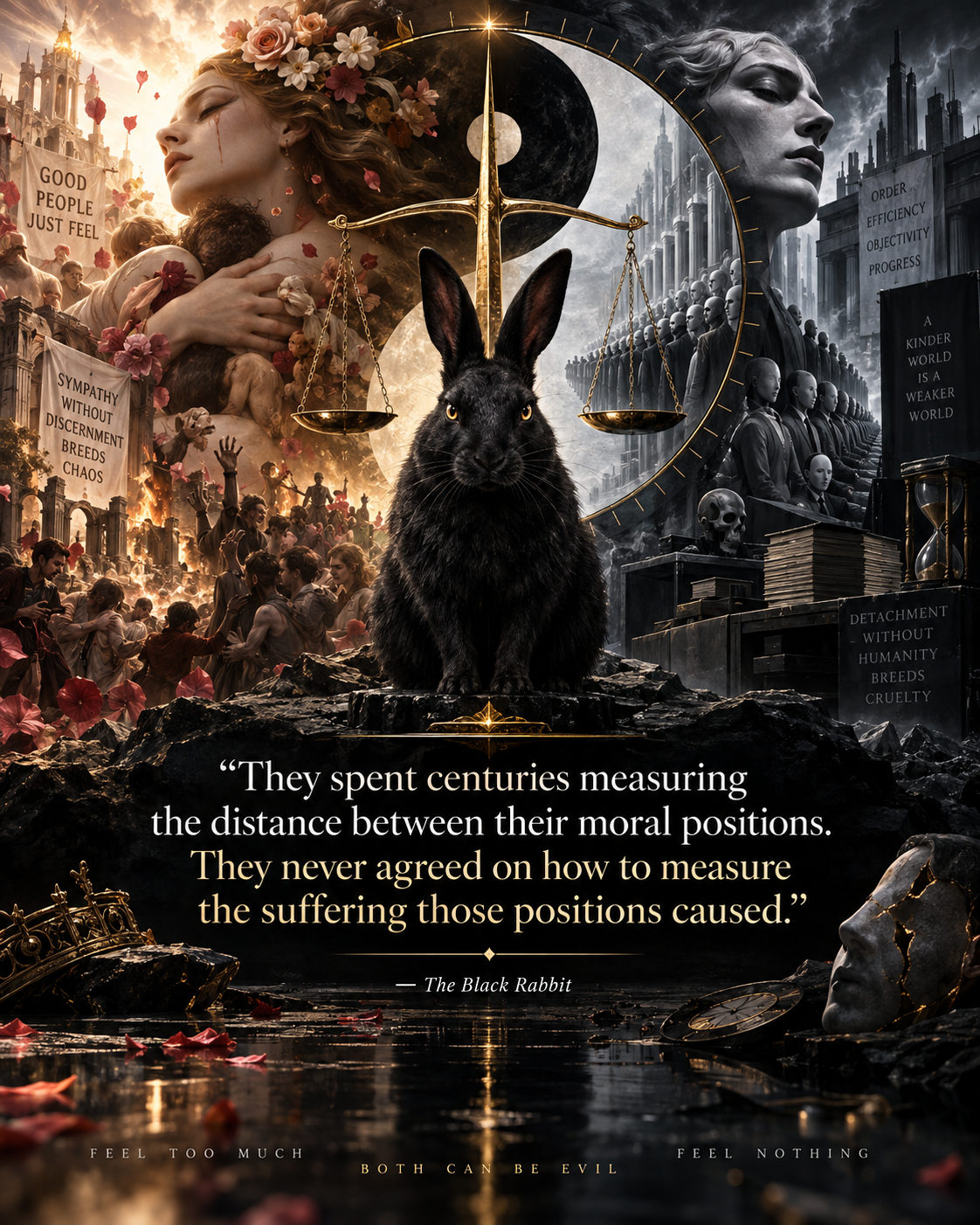
They had spent centuries measuring the distance between their moral positions.
They had never agreed on how to measure the suffering those positions caused.
By morning, both civilizations had declared Elian dangerous.
For once, their judgments were unanimous.
The Scale registered another increase.
And the Black Rabbit disappeared into the space between them.
— END —