Editorial abstract
Howard examines the asymmetry by which communities recognize identity in outsiders while treating their own identities as neutral, biblical, or invisible. Using Christian criticism of gay identity as the central case, the essay asks why sexuality receives exceptional scrutiny while denominational, national, political, familial, and ministerial identities are celebrated. Gay people function in the argument as a mirror: not as a morally superior group, but as an encounter that exposes the difference between opposing identity itself and opposing identities a community has not approved.
Evidence status: social-identity research supports the importance of group membership, multiple identities, ingroup boundaries, moralized attitudes, and contact in intergroup judgment. Research on sexual stigma documents the social conditions surrounding negative attitudes toward sexual minorities. It does not prove that every religious objection is prejudicial, that every LGBTQ identification is psychologically equivalent, or that heightened attention to sexuality always reveals insecurity.
Why the Church Needs Gay People
The church often speaks about homosexuality as though gay people are a problem to be solved.
A temptation.
A rebellion.
A social issue.
A threat.
But what if gay people serve a purpose the church desperately needs?
What if they reveal things about Christians that Christians cannot see for themselves?
One of the most common phrases in modern Christianity is:
“Your identity should be in Christ.”
It sounds spiritual.
It sounds biblical.
It sounds profound.
Until you pay attention.
The same Christian who says, “Don’t make being gay your identity,” may introduce himself as a husband, father, pastor, elder, patriot, conservative, veteran, entrepreneur, church leader, prophet, or minister before he ever tells you his name.
Identity is not the problem.
Everyone has identities.
The real question is whose identities are considered acceptable.
For decades, Christians have pointed at gay people and said:
“You have made your sexuality your identity.”
Sometimes that criticism is fair.
But why does the same scrutiny disappear when Christians build entire ministries around being men, women, fathers, mothers, pastors, leaders, patriots, conservatives, or members of a particular denomination?
The truth is uncomfortable.
Many Christians do not oppose identity.
They oppose unapproved identities.
That is why gay people are necessary.
Not because they are morally superior.
Not because they are always right.
But because their existence exposes a contradiction.
They force Christians to confront questions they would rather avoid.
What exactly is an identity?
Why are some identities celebrated while others are condemned?
When does identity become idolatry?
When does belonging become pride?
When does conviction become tribalism?
The irony is that many Christians condemn Pride Month while participating in forms of pride every day.
Denominational pride.
National pride.
Political pride.
Spiritual pride.
The pride of being right.
The pride of being chosen.
The pride of belonging to the “correct” group.
Psychologists call this social identity.
People derive meaning, worth, and belonging from the groups to which they belong.
Christians are not immune.
Churches do it.
Denominations do it.
Ministries do it.
Entire religious cultures are built upon it.
The identity symmetry test editorial synthesis
Name the identity
Which group membership or role is being treated as unusually defining?
Reverse the lens
Would the same level of visibility be criticized if the identity were approved by the community?
Separate salience from totality
A visible identity may be important in one context without exhausting the whole person.
Trace the social history
Is visibility an assertion of dominance, or a response to prior exclusion and enforced invisibility?
Inspect the ingroup
Which religious, political, national, gendered, or institutional identities have become too normal to notice?
Return to conduct
Evaluate specific actions and harms instead of converting a category into a verdict.
Calibration: this is an editorial reasoning aid derived from the essay and adjacent scholarship. It is not a validated psychometric instrument, and symmetrical scrutiny does not require concluding that all identities, histories, or moral claims are identical.
Perhaps this is why conversations about homosexuality become so emotional.
Because the debate was never only about sexuality.
It was about identity.
Gay people did not create that problem.
They exposed it.
And exposure is often the first step toward truth.
The church may continue debating homosexuality for generations.
But one thing is already clear.
The existence of gay people has revealed that many Christians worship identities they cannot see.
And sometimes the people we call the problem are actually exposing one.

Some readers will object to the comparison.
They will insist that the LGBTQ community is not a mirror of the church.
Perhaps they are right.
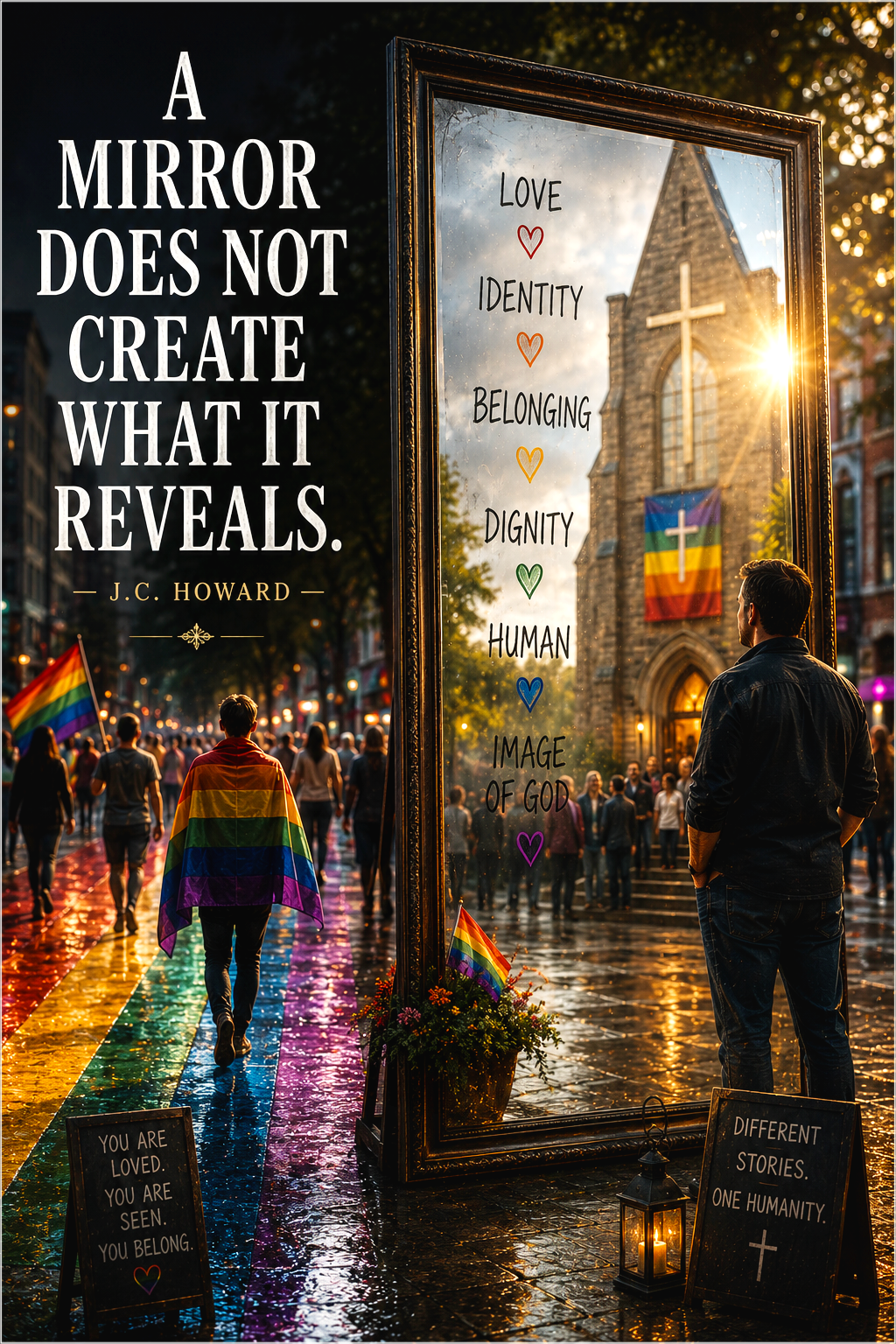
A mirror does not reflect identical things.
A mirror reveals things.
The Pharisees were not tax collectors.
The older brother was not the prodigal son.
The crowd that wanted Barabbas was not Pilate.
Yet each revealed something about the other.
The question is not whether Christians and gay people are the same.
The question is why the subject provokes such extraordinary attention.
Why does sexuality occupy so much space in the Christian imagination?
Why do some identities receive endless scrutiny while others receive blessing?
Why are Christians so skilled at recognizing identity in others while remaining blind to the identities they have baptized within themselves?
Perhaps the strongest reactions are not always produced by the greatest differences.
Sometimes they are produced by uncomfortable similarities.
Scholarly context & references (editorial apparatus)
The literature below supports bounded parts of the essay: how Christian identity may be understood theologically; how group membership becomes part of self-understanding; how multiple identities may be represented; how religious and national identities can fuse; how moralization affects interpersonal distance; how sexual stigma operates; and how contact relates to prejudice. It does not empirically validate the essay's entire mirror metaphor or determine Christian doctrine.
Where the essay sits
| Established construct or record | What it supports | What it does not establish |
|---|---|---|
| Religious identity | Religion can function as a consequential social identity, offering worldview, belonging, coping, and continuity. | That religious identification is inherently tribal, false, or psychologically unhealthy. |
| Biblical theology of identity | A serious Christian account can treat being “in Christ” and being known by God as the governing center that orders other roles and affiliations. | One required Christian conclusion about sexuality, or immunity for approved identities from moral examination. |
| Multiple social identities | People belong to several ingroups whose perceived overlap can vary; greater identity complexity has been associated with broader outgroup tolerance. | That holding many labels automatically produces humility or inclusion. |
| Christian nationalism | Religious and national identity can combine into an empirically consequential ideology associated with political behavior. | That Christian faith, patriotism, or religious identity is necessarily nationalist or idolatrous. |
| Moral conviction | Strongly moralized attitudes can carry distinctive interpersonal consequences, including greater social distance from attitudinally dissimilar others. | That moral conviction is irrational, or that disagreement must be abandoned. |
| Sexual stigma and prejudice | Negative attitudes toward sexual minorities exist within cultural and institutional contexts and can serve psychological and social functions. | That every theological conclusion is reducible to prejudice or threat. |
| Religiosity–attitude association | A meta-analysis found that measured forms of religiosity were associated with attitudes toward lesbians and gay men, with differences among religious orientations and constructs. | That all religions, congregations, or believers have the same attitudes or motives. |
| Minority stress | Stigma, prejudice, concealment pressures, and discrimination create added social stress for sexual-minority populations. | That every LGBTQ person has the same experience or mental-health outcome. |
| Intergroup contact | Across many groups, contact typically relates to lower prejudice; closer contact with gay men and lesbians has shown the same pattern. | That mere exposure always helps, or that stigmatized people owe others access to themselves. |
| Pride history | U.S. Pride observance emerged from Stonewall-era resistance, commemoration, visibility, and equal-rights advocacy. | That every present Pride expression has one meaning or is beyond ethical evaluation. |
| Howard's mirror thesis | Asks whether unequal scrutiny of approved and disapproved identities exposes an ingroup blind spot. | A validated psychological construct, universal causal law, or judgment about every Christian or LGBTQ person. |
- Ysseldyk, R., Matheson, K., & Anisman, H. (2010). “Religiosity as Identity: Toward an Understanding of Religion From a Social Identity Perspective.” Personality and Social Psychology Review, 14(1), 60–71. The review treats religious identification as a distinctive social identity that can provide worldview, belonging, coping resources, and perceived continuity. It supports the essay's inclusion of Christian identity within social identity without treating religion as merely defensive or harmful. PubMed record. . Citation and abstract verified September 7, 2026.
- Roccas, S., & Brewer, M. B. (2002). “Social Identity Complexity.” Personality and Social Psychology Review, 6(2), 88–106. The authors define differences in how people subjectively represent overlap among their multiple ingroup memberships. This supports the essay's premise that a person can be Christian, familial, political, national, occupational, and more at once; it does not imply that any specific identity is inauthentic. . Citation and abstract verified September 7, 2026.
- Brewer, M. B., & Pierce, K. P. (2005). “Social Identity Complexity and Outgroup Tolerance.” Personality and Social Psychology Bulletin, 31(3), 428–437. In an Ohio adult survey, lower perceived overlap among national, religious, occupational, political, and recreational ingroups was associated with greater outgroup inclusiveness and tolerance. This supports complexity as one possible corrective to identity enclosure; the correlational design does not establish inevitability or universal causation. PubMed record. . Citation and abstract verified September 7, 2026.
- Skitka, L. J., Bauman, C. W., & Sargis, E. G. (2005). “Moral Conviction: Another Contributor to Attitude Strength or Something More?” Journal of Personality and Social Psychology, 88(6), 895–917. Across four studies, moralized attitudes had distinctive interpersonal consequences, including greater social distance from attitudinally dissimilar others. This supports the essay's question about conviction becoming a boundary, not the conclusion that moral conviction is inherently prejudicial. PubMed record. . Citation and abstract verified September 7, 2026.
- Herek, G. M., & McLemore, K. A. (2013). “Sexual Prejudice.” Annual Review of Psychology, 64, 309–333. This review defines sexual prejudice as negative attitudes toward sexual minorities and situates it within culture, institutions, religion, gender, sexuality, social acceptance, value affirmation, and threat-related emotion. It supports a multi-level account of attention and hostility rather than diagnosing individual Christians. PubMed record. . Citation and abstract verified September 7, 2026.
- Whitley, B. E., Jr. (2009). “Religiosity and Attitudes Toward Lesbians and Gay Men: A Meta-Analysis.” The International Journal for the Psychology of Religion, 19(1), 21–38. The meta-analysis examined seven forms of religiosity and their relationships with attitudes toward lesbians and gay men. It supports the relevance of religious orientation and belief structure while preserving variation among constructs, samples, and individuals. . Citation and abstract verified September 7, 2026.
- Meyer, I. H. (2003). “Prejudice, Social Stress, and Mental Health in Lesbian, Gay, and Bisexual Populations: Conceptual Issues and Research Evidence.” Psychological Bulletin, 129(5), 674–697. The review integrates evidence that stigma, prejudice, discrimination, expectations of rejection, concealment, and internalized stigma can create minority stress. It supplies the social asymmetry missing from any simple equation of LGBTQ Pride with dominant-group pride. PubMed record. . Citation and abstract verified September 7, 2026.
- Pettigrew, T. F., & Tropp, L. R. (2006). “A Meta-Analytic Test of Intergroup Contact Theory.” Journal of Personality and Social Psychology, 90(5), 751–783. Across 713 independent samples from 515 studies, intergroup contact typically reduced prejudice, with stronger effects under supportive conditions. This supports encounter as a possible route to changed judgment; it does not make every contact positive or impose responsibility on outgroup members. PubMed record. . Citation and abstract verified September 7, 2026.
- Herek, G. M., & Capitanio, J. P. (1996). “Some of My Best Friends: Intergroup Contact, Concealable Stigma, and Heterosexuals' Attitudes Toward Gay Men and Lesbians.” Personality and Social Psychology Bulletin, 22(4), 412–424. A two-wave national survey found more favorable attitudes among heterosexual respondents reporting interpersonal contact, especially with more numerous, closer relationships and direct disclosure. The design supports association and temporal replication, not a universal causal claim. ERIC record. . Citation and abstract verified September 7, 2026.
- Library of Congress. “About: Lesbian, Gay, Bisexual and Transgender Pride Month.” The institutional history connects June observance to the 1969 Stonewall Uprising and the first New York Pride march on June 28, 1970. Planning records describe resistance to government hostility, discrimination, anti-gay laws, and public humiliation. This supports the historical distinction between LGBTQ Pride and generic self-exaltation. Official record. Page and cited historical context verified September 7, 2026.
- Rosner, B. S. (2017). Known by God: A Biblical Theology of Personal Identity. Zondervan Academic. Rosner frames personal identity through being made in God's image, being known by God, and being in Christ. The book supplies the strongest theological version of the claim that Christian identity can govern other roles; it does not decide a church's doctrine of sexuality or remove other identities from ethical scrutiny. Publisher record. ISBN 978-0-310-49983-1. Book details verified September 7, 2026.
- Whitehead, A. L., Perry, S. L., & Baker, J. O. (2018). “Make America Christian Again: Christian Nationalism and Voting for Donald Trump in the 2016 Presidential Election.” Sociology of Religion, 79(2), 147–171. The peer-reviewed study distinguishes Christian nationalism from ordinary religiosity and reports its association with 2016 voting behavior. It supports the narrower claim that religious and national identity can fuse into a socially consequential ideology; it is not a generalization about all Christians or all patriotism. Oxford Academic record. . Citation and abstract verified September 7, 2026.
Publication history
Howard, J. C. “The Blind Spot Between the Cross and the Rainbow.” Substack, June 8, 2026. Original source: yourpropheticscribe.substack.com/p/the-blind-spot-between-the-cross. The title, subtitle, publication date, prose, and two original images were verified from the recovered newsletter record.
What changed for this edition
The original prose and two images are preserved. Newsletter subscription and unsubscribe material were removed. The editorial abstract, evidence-status statement, identity-symmetry test, comparison table, historical, ethical, evidentiary, contact, and hermeneutical notes, source annotations, display treatments, adapted image placement, and corrected image alternative text were added for clarity, credibility, accessibility, and archival context. Version 1.1 adds the labeled theological counterargument and two supporting sources; the source essay itself remains unchanged.
Version history: Version 1.0 · Version 1.1 (current).
Journal citation: Howard, J. C. (2026). “The Blind Spot Between the Cross and the Rainbow.” The Golden Manifest Journal, 1, Essay 16. Version 1.1. .
This is an independent interdisciplinary essay and has not undergone peer review.