Editorial abstract
Beginning with a search for unremarkable possessions from an earlier life, Howard argues that some objects matter because they give material form to remembered relationships, places, and versions of the self. The essay develops the image of possessions as physical bookmarks and asks how people preserve continuity when homes, careers, relationships, and generations pass away. Its closing paradox holds impermanence and meaning together: an object need not last forever to have carried a human story.
Evidence status: research supports possessions as extensions and symbols of self, cues for reminiscence, carriers of family meaning, and resources during relocation, bereavement, or identity transition. It also documents forms of deliberate divestment and “liquid” nonattachment. The literature does not show that every cherished possession is psychologically necessary, that objects contain memory, or that preserving more objects necessarily preserves more continuity.
Recently, I found myself searching for objects I owned more than a decade ago.
Not expensive things.
Not rare collectibles.
Just ordinary things.
A particular piece of furniture. An old household item. Things that, by any rational measure, should have been forgotten long ago.
At first, I assumed it was nostalgia.
But the more I reflected on it, the more I realized I wasn’t looking for the object itself.
I was looking for the story attached to it.
Humans like to believe we become attached to things because of their utility. A table is a table. A chair is a chair. A lamp is a lamp.
Yet anyone who has ever stood in an empty house knows that is not true.
A chair is never just a chair.
It is where a loved one sat.
A table is where conversations happened.
A couch witnessed years of laughter, arguments, dreams, disappointments, and ordinary evenings that seemed insignificant until they were gone.
Objects become repositories for memory.
Over time, they absorb pieces of our lives.
Not literally, of course.
But psychologically.
We place fragments of ourselves inside them.
That is why losing certain possessions can trigger emotions that seem wildly disproportionate to their actual value.
We tell ourselves:
“It was just a piece of furniture.”
But another part of us knows better.
It was evidence.
Evidence that a chapter of our life existed.
Evidence that a version of ourselves once lived, hoped, struggled, and survived.
The object becomes a physical bookmark in the story of our lives.
Modern psychology suggests that human beings do not experience themselves as isolated minds floating through space. We weave pieces of ourselves into people, places, routines, and objects. A photograph becomes more than paper. A wedding ring becomes more than metal. A worn-out chair becomes more than furniture. These objects function as containers of memory, identity, and meaning. Behavioral researchers have found that possessions often serve as cues for autobiographical memory, helping individuals maintain a sense of continuity across time. Perhaps this explains why losing certain objects can feel strangely similar to grief. We are not mourning wood, fabric, or metal. We are mourning the chapter of ourselves that lived within them.
When the object disappears, it can feel as though a page has been torn from the book.
What fascinates me is how often people mistake this reaction for materialism.
It isn’t always about wanting more things.
Sometimes it is about wanting continuity.
The human mind is constantly constructing a narrative.
Who am I?
Where have I been?
How did I become this person?
When life is relatively stable, that narrative flows naturally.
But trauma has a way of disrupting continuity.
Losses pile up.
Homes are left behind.
Relationships end.
Careers change.
People die.
Dreams collapse.
Entire chapters close without warning.
After enough disruption, the mind begins searching for anchors.
Sometimes those anchors are photographs.
Sometimes they are songs.
Sometimes they are old neighborhoods.
And sometimes they are objects.
The object itself becomes less important than what it represents.
A bridge.
A connection.
A thread tying one version of ourselves to another.
Perhaps this is why I keep finding myself drawn to things from ten years ago.
Not because I need them.
Not because they would change my life.
But because they remind me that the person who existed then and the person writing these words now are part of the same story.
The object is merely the breadcrumb.
The story is what I am really searching for.
And perhaps that is true for many of us.
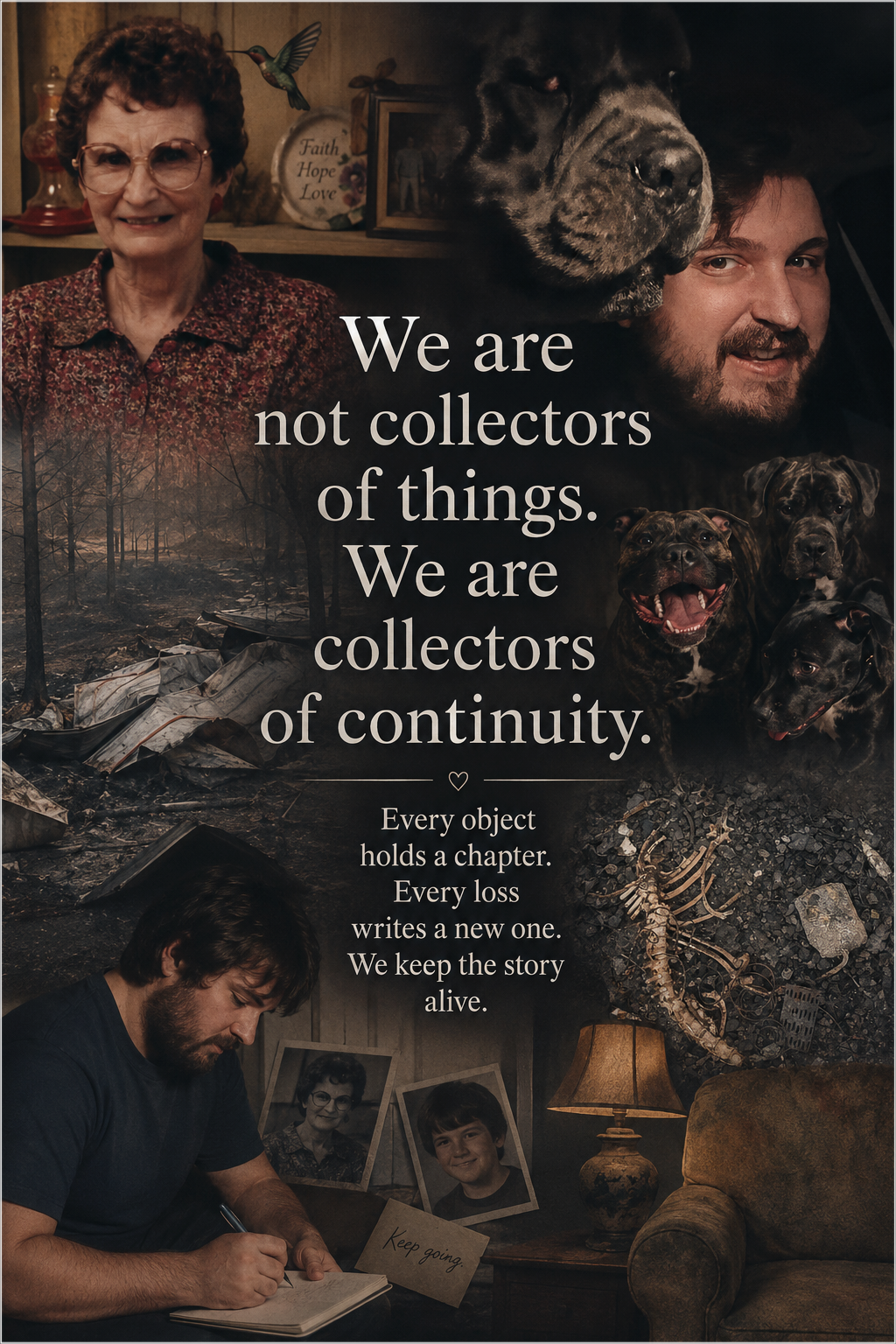
We are not collectors of things.
We are collectors of continuity.
How an object can call a life chapter forward editorial synthesis
Object
A familiar possession is encountered, remembered, lost, or searched for.
Association
The object is linked with a person, place, routine, role, or period of life.
Retrieval cue
Its presence or image prompts autobiographical scenes, feelings, and knowledge.
Continuity claim
The remembered chapter is interpreted as part of the present self's story.
Action
The person may keep, search for, give away, document, ritualize, or release the object.
Calibration: this is an editorial pathway assembled from adjacent research, not an inevitable sequence. Meaning can be preserved through people, stories, rituals, places, and records as well as objects.
Yet there is another thought that lingers beneath all of this.
If objects are merely bookmarks, if chapters inevitably close, and if every possession eventually disappears, what exactly are we trying to preserve?
Perhaps this is why our attachment to things feels so complicated.
Part of us knows they matter.
Part of us knows they do not last.
A favorite chair eventually ends up at a thrift store.
A home changes owners.
Photographs fade.
Entire generations disappear, taking their stories with them.
When viewed from enough distance, the things we cling to can seem almost meaningless.
And yet, somehow, they are not.
Not because the object itself possesses lasting significance, but because for a brief moment in time it became woven into a human life.
Perhaps the value was never in the thing.
Perhaps the value was in the experience, the memory, and the story it carried.
Maybe that is the paradox of being human.
Everything passes.
Nothing stays.
And yet we spend our lives creating meaning from things that were never meant to last.
Not because permanence gives something value.
But because for a brief moment, it was part of our story.
And sometimes that is enough.
Scholarly context & references (editorial apparatus)
The literature below supports component processes through which possessions acquire identity, memory, relational, and transitional meaning. It does not prove that a specific object is psychologically necessary, that attachment is always adaptive, or that Howard's “collectors of continuity” phrase names an established scientific construct.
Where the essay sits
| Established construct or finding | What it explains | Relation to the essay |
|---|---|---|
| Extended self | Possessions can symbolically support identity, mastery, relationships, and continuity. | Supports the claim that an ordinary object can become more than its utility. |
| Loved objects and identity narratives | People use valued objects within stories that reconcile aspects of who they are. | Supports the essay's shift from looking for a thing to looking for its story. |
| Special and cherished possessions | Meaningful objects can carry reminiscence, family history, and an owner's desired legacy. | Supports the bookmark and intergenerational continuity metaphors. |
| Autobiographical memory cue | Objects and images can prompt reconstructed personal memories and self-relevant knowledge. | Supports “breadcrumb” while correcting the idea that memory is stored in the object. |
| Nostalgia and self-continuity | Nostalgic reflection can restore subjective connection across past and present selves. | Supports the thread connecting the person from ten years ago with the present writer. |
| Material culture in bereavement | Goods associated with someone who died can evoke presence, memory, and continuing bonds. | Supports grief-adjacent meaning without equating object loss with human loss. |
| Relocation and the material convoy | Selected possessions can help carry identity and social history through residential transition. | Supports objects as anchors when homes or life settings change. |
| Divestment rituals | Giving away or disposing of possessions can transfer, distance, or preserve meanings. | Shows that continuity may survive release rather than require permanent retention. |
| Liquid relationship to possessions | Some highly mobile people prefer temporary access and instrumental use over attachment. | Provides a counterexample to any universal claim about durable object attachment. |
| Howard's “collectors of continuity” | Frames cherished objects as material prompts through which people preserve a life narrative. | A philosophical-psychological synthesis, not a distinct validated construct. |
- Belk, R. W. (1988). “Possessions and the Extended Self.” Journal of Consumer Research, 15(2), 139–168. Belk's review argues that possessions can contribute to identity at individual, family, group, and collective levels. It supports the essay's symbolic account without making every possession part of the self. . Citation verified September 7, 2026.
- Price, L. L., Arnould, E. J., & Curasi, C. F. (2000). “Older Consumers' Disposition of Special Possessions.” Journal of Consumer Research, 27(2), 179–201. The study examines how older adults distribute meaningful possessions and negotiate identity, memory, and legacy. It supports continuity through transfer as well as retention. . Citation verified September 7, 2026.
- Curasi, C. F., Price, L. L., & Arnould, E. J. (2004). “How Individuals' Cherished Possessions Become Families' Inalienable Wealth.” Journal of Consumer Research, 31(3), 609–622. The authors explain how some cherished objects acquire intergenerational family meaning. This supports the essay's chapter and inheritance imagery, not the claim that such meaning is automatic. . Citation verified September 7, 2026.
- Ahuvia, A. C. (2005). “Beyond the Extended Self: Loved Objects and Consumers' Identity Narratives.” Journal of Consumer Research, 32(1), 171–184. Ahuvia relates loved objects to identity narratives and the reconciliation of identity conflicts. It supports the essay's focus on stories attached to things. . Citation verified September 7, 2026.
- Lastovicka, J. L., & Fernandez, K. V. (2005). “Three Paths to Disposition: The Movement of Meaningful Possessions to Strangers.” Journal of Consumer Research, 31(4), 813–823. The article examines how owners divest meaningful possessions and manage identity-linked meanings. It supplies a counterweight to the idea that continuity requires keeping the object. . Citation verified September 7, 2026.
- Belk, R. W. (1992). “Moving Possessions: An Analysis Based on Personal Documents from the 1847–1869 Mormon Migration.” Journal of Consumer Research, 19(3), 339–361. This historical analysis connects decisions about moving possessions with identity, values, and cultural transition. It supports the importance of objects amid displacement without generalizing to all migrations. . Citation verified September 7, 2026.
- Bardhi, F., Eckhardt, G. M., & Arnould, E. J. (2012). “Liquid Relationship to Possessions.” Journal of Consumer Research, 39(3), 510–529. Research with global nomads documents situational value and detachment from durable possessions. It demonstrates that stable object attachment is not universal. . Citation verified September 7, 2026.
- Sedikides, C., Wildschut, T., Routledge, C., & Arndt, J. (2015). “Nostalgia Counteracts Self-Discontinuity and Restores Self-Continuity.” European Journal of Social Psychology, 45(1), 52–61. Across studies, nostalgia was associated with restored subjective continuity when discontinuity was salient. This supports the essay's thread across temporal selves, not a claim that all nostalgia is beneficial. . Citation verified September 7, 2026.
- Camia, C., & Zafar, R. (2021). “Autobiographical Meaning Making Protects the Sense of Self-Continuity Past Forced Migration.” Frontiers in Psychology, 12, 618343. The study links autobiographical meaning-making with self-continuity following forced migration. It supports careful claims about continuity under disruption, not a universal trauma pathway. . Citation verified September 7, 2026.
- Hallford, D. J., Rusanov, D., Yeow, J. J. E., & Barry, T. J. (2021). “Perceived Autobiographical Coherence Predicts Depressive Symptoms Over Time Through Positive Self-Concept.” Frontiers in Psychology, 12, 625429. The findings connect perceived coherence of autobiographical memory with self-concept and later depressive symptoms. They support the importance of narrative coherence without showing that possessions are required to maintain it. . Citation verified September 7, 2026.
- Turley, D., & O'Donohoe, S. (2012). “Goods as Evocative Objects in Bereavement.” Journal of Marketing Management, 28(11–12), 1331–1353. The authors examine how objects associated with the deceased can evoke memories and mediate continuing bonds. The work supports the essay's grief-adjacent language but does not equate losing goods with bereavement. . Citation verified September 7, 2026.
- Ekerdt, D. J., Luborsky, M., & Lysack, C. (2012). “Safe Passage of Goods and Self During Residential Relocation in Later Life.” Ageing & Society, 32(5), 833–850. The study examines how selected goods and identity move together during later-life relocation. It supports possessions as continuity resources in transition without implying that retaining everything is necessary. . Citation verified September 7, 2026.
Publication history
Howard, J. C. “The Objects That Refuse to Leave Us.” Substack, June 24, 2026. Original source: yourpropheticscribe.substack.com/p/the-objects-that-refuse-to-leave. The title, subtitle, publication date, prose, and two original images were verified from the recovered newsletter record.
What changed for this edition
The original prose and two images are preserved. Newsletter subscription and unsubscribe material were removed. The editorial abstract, evidence-status statement, continuity pathway, comparison table, scholarly positioning, precision, grief-boundary and counterweight notes, source annotations, display treatments, adapted image placement, and expanded image alternative text were added for clarity, credibility, accessibility, and archival context.
Journal citation: Howard, J. C. (2026). “The Objects That Refuse to Leave Us.” The Golden Manifest Journal, 1, Essay 12, Version 1.0. .
+