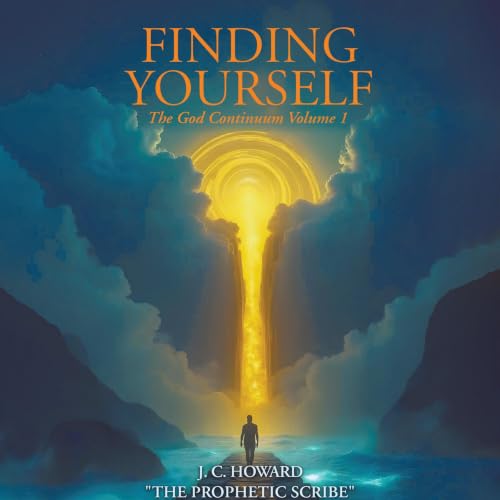
DALLAS-FORT WORTH, Texas - Finding Yourself: The God Continuum, Volume 1, the ambitious 774-page work by J.C. Howard, is inviting readers into a spiritual inquiry that refuses to separate the search for God from the search for identity. Published by Covenant Books and now available in print, digital, and audiobook formats, the book examines what happens when inherited religious categories meet psychology, history, consciousness, science, and lived spiritual experience.
Howard's project is neither a conventional devotional nor a simple defense of the law of attraction. It asks readers to test what they have inherited, distinguish belief from knowledge, and consider how memory, perception, group identity, intuition, and reflective thought shape religious certainty. Its central concern is not the destruction of faith, but the possibility of a faith mature enough to survive examination.
The book moves across an unusually broad field: the movement from charis to chesed in the language of grace; the tensions between law, covenant, fulfillment, and divine intention; the historical forces that shaped early Christianity; prophecy as both spiritual communication and human interpretation; the psychology of groupthink and echo chambers; and the relationship among sound, consciousness, creation, and the presence of God.
“Thoughts are like fingerprints,” Howard writes. “You are the only one that thinks like you.” That conviction animates the work's argument that spiritual formation cannot be reduced to conformity.
A spiritual work built for questioning readers
Organized in three major movements - Unveiling the God Continuum, Issues of the Heart, and The Heart of God - the volume develops a framework in which skepticism and spirituality are not automatic enemies. Howard writes from an agnostic-omnist posture: open to the possibility that traditions preserve partial truth, unwilling to claim that any one human interpretation possesses the whole of God, and equally unwilling to dismiss spiritual experience merely because it resists easy measurement.
That posture allows the book to engage Christian Scripture while also entering comparative and interfaith territory. It considers Plato's cave alongside Proverbs, pantheistic ideas alongside Trinitarian thought, salvation and eternal destiny across traditions, and scientific questions alongside accounts of prophecy and spiritual perception. The result is deliberately resistant to a narrow category: theological but not confined to doctrine, psychological but not reductionist, speculative but repeatedly concerned with evidence and ethical consequence.
Grace, law, and the architecture of identity
Among the book's most persistent questions is whether people encounter God directly or encounter the accumulated interpretations through which God has been presented to them. Howard examines how law can provide moral structure while also becoming a boundary that prevents growth; how grace can be misunderstood as exemption rather than transformation; and how religious communities may mistake inherited certainty for complete knowledge.
The God Continuum is therefore both a theological proposal and an argument about identity formation. It suggests that people often confuse the exterior bottle with the water it contains: race, denomination, culture, and social category become evidence of separation even when a deeper human and spiritual continuity remains. For Howard, finding oneself requires learning which distinctions reveal truth and which merely preserve conditioning.
Written from lived spiritual conflict
Howard began the book after years of wrestling with spiritual trauma, unexplained experiences, institutional religion, and questions that conventional answers did not resolve. The manuscript grew from a desire to spare other readers the isolation that can accompany serious religious doubt. Rather than instructing readers what they must conclude, the work extends an invitation: question without surrendering wonder, examine without becoming cynical, and remain open to the possibility that truth may be larger than the system used to contain it.
Its scale reflects that intention. The book is designed less as a quick argument than as a landscape readers can enter at different points. A reader drawn to grace, prophecy, consciousness, psychology, early Christian history, interfaith dialogue, or the ethics of spiritual authority can begin with a particular intersection and then follow its connections across the larger work.
Available in print, digital, and audio editions
Finding Yourself: The God Continuum, Volume 1 is published by Covenant Books. The paperback edition carries ISBN 9798888517987; the hardcover edition carries ISBN 9798891121041. The audiobook is narrated by Fentriss O'Moore and is available through Audible. Print and digital editions are available through Amazon and participating booksellers.
About The Golden Manifest Journal
The Golden Manifest Journal publishes interdisciplinary essays by J.C. Howard. It treats disagreement as a starting point for inquiry and makes complex ideas accessible without flattening their nuance.
Media and interview inquiries: Your Prophetic Scribe
###