Editorial abstract
This essay challenges a categorical social-media claim that Christianity is “better for the nervous system than any drug.” Howard distinguishes certainty and adaptation from flourishing, then examines how fear-based theology may interact with guilt, shame, vigilance, scrupulosity, authority dependence, existential anxiety, and diminished agency. The argument is deliberately conditional: faith may help some people through meaning, hope, community, and coping while psychologically destabilizing others when threat, punishment, surveillance, and distrust of self become organizing principles.
Evidence status: longitudinal and clinical research supports meaningful differences between positive and negative religious coping, links religious or spiritual struggles with small later increases in negative adjustment, and recognizes scrupulosity within OCD. Trials and reviews also find potential benefits from some religious or spiritual interventions. These findings do not establish that a theology directly dysregulates the autonomic nervous system, that religion causes OCD, or that ordinary religious commitment is equivalent to captivity.
Reading boundary
This essay is interpretive and critical, not a substitute for assessment or treatment. Anxiety, obsessive-compulsive symptoms, trauma responses, and substance-use problems have multiple possible contributors. A person's spiritual framework may be supportive, distressing, both, or neither, and that relationship can change over time.
A recent social media post caught my attention. The central claim was simple: Christianity is better for the nervous system than any drug. The argument was that faith provides peace, purpose, stability, and emotional regulation in ways that substances never can.
At first glance, the statement sounds reasonable. Many people can point to periods in their lives where faith brought comfort during grief, hope during despair, or structure during chaos. I have no interest in denying those experiences. The reality is that religion has helped countless people navigate suffering, addiction, loss, and uncertainty.
What interested me, however, was not the claim itself, but the assumptions beneath it.
When we say something is “good for the nervous system,” what exactly do we mean? Are we referring to reduced anxiety, emotional resilience, psychological flexibility, secure attachment, and an increased ability to tolerate uncertainty? Or are we simply describing a system that has adapted to a particular set of beliefs, regardless of whether those beliefs are ultimately healthy?
The distinction matters.
Psychology has spent decades studying fear, trauma, dependency, conditioning, identity formation, and the ways human beings construct meaning. Viewed through that lens, the relationship between Christianity and psychological well-being becomes far more complicated than the simple assertion that faith regulates the nervous system while drugs destroy it.
In fact, some of the very emotional states that drive people toward drugs—guilt, shame, fear, loneliness, inadequacy, anxiety, and existential distress—can also be intensified by certain religious environments. That does not mean Christianity is inherently harmful any more than it means it is inherently healing. It means the conversation is more nuanced than either side often admits.
The following reflections emerged from that question.
I think that depends entirely on the version of Christianity being practiced. While some people find peace through faith, others experience significant psychological distress from it. Psychology has long recognized concepts such as religious trauma, scrupulosity (religious OCD), chronic guilt, shame-based identity formation, fear conditioning, hypervigilance, existential anxiety, and learned helplessness.
We are told Christianity regulates the nervous system because it provides certainty, purpose, and hope. But certainty is not the same thing as health.
A nervous system can become highly regulated around captivity as well. Hostages adapt. Prisoners adapt. Members of high-control groups adapt. Adaptation is not proof of flourishing.
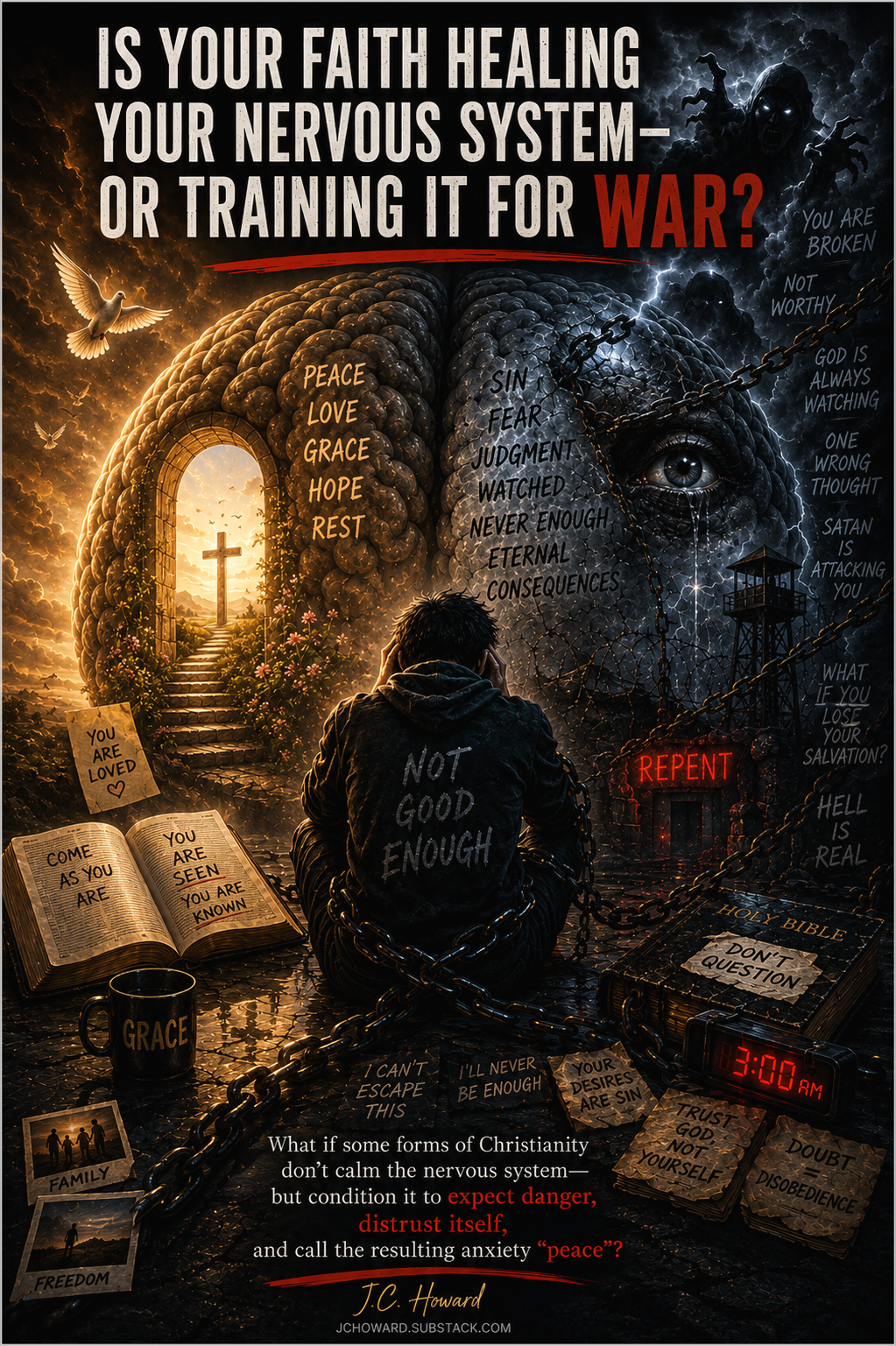
Consider the psychological demands often placed on believers: you are born broken, your natural desires are suspect, your thoughts are monitored, an invisible enemy is targeting you, questioning authority may be rebellion, suffering has cosmic meaning, and the consequences of being wrong can be eternal. If a secular institution taught those same principles, many would immediately recognize the potential for anxiety, dependency, hypervigilance, and trauma.
A person who believes they are under constant attack from demons, being watched by an all-knowing authority, judged for their thoughts, and facing eternal consequences for being wrong is not necessarily operating from a regulated nervous system. Many believers spend years wrestling with anxiety, self-monitoring, fear of punishment, and the expectation that an invisible enemy is constantly influencing their lives. That can create a state of perpetual threat detection rather than peace.
There is also the existential burden. Christianity often asks people to interpret suffering, death, morality, relationships, sexuality, identity, and even everyday setbacks through a cosmic battle between God and Satan. For some, that framework provides meaning. For others, it creates chronic psychological tension and a feeling that every decision carries eternal consequences.
Psychology has names for some of these patterns: fear conditioning, learned helplessness, scrupulosity, shame-based identity formation, black-and-white thinking, authority dependency, and religious trauma. A person can spend decades monitoring their thoughts, suppressing doubts, fearing punishment, and interpreting ordinary life events as evidence of spiritual warfare. That is not necessarily peace. Sometimes it is chronic vigilance wearing a spiritual mask.
Learned helplessness is another concern. When people are repeatedly taught that their hearts are deceitful, their understanding cannot be trusted, and that solutions must come from an external spiritual authority, some begin to lose confidence in their own judgment and ability to navigate life independently. Over time, this can reduce self-efficacy and personal agency, both of which are important factors in psychological resilience.
Add in us-versus-them thinking, black-and-white moral frameworks, fear of questioning doctrine, and circular reasoning such as “if you doubt, your doubt proves you need more faith,” and you have a system that can discourage critical examination while reinforcing conformity. In some religious communities, normal human emotions and struggles are attributed to sin, demons, spiritual attacks, or lack of faith rather than being understood through psychological, biological, or social factors.
This is where the comparison to drugs becomes interesting. Many of the emotional states that drive people toward alcohol, drugs, or other forms of escape are the very things that fear-based religious systems can amplify: guilt, shame, anxiety, loneliness, fear, inadequacy, uncertainty, and existential dread. People often self-medicate because they are trying to numb overwhelming emotional distress. If a belief system contributes to those feelings, then it becomes difficult to argue that it is automatically healthier for the nervous system than every drug.
The irony is that many of the emotional states that contribute to substance abuse—guilt, shame, anxiety, loneliness, inadequacy, fear, and existential distress—can be intensified by certain forms of religion. People often reach for drugs because they are trying to escape unbearable psychological pressure. If a belief system contributes to that pressure, then comparing it favorably to drugs becomes more complicated than it first appears.
The deeper question is this: If someone can never feel safe unless they believe they are protected, never feel worthy unless they are forgiven, never trust themselves without external validation, and never stop fighting an invisible enemy, is that a regulated nervous system—or a dependent one?
A regulated nervous system is generally associated with psychological safety, secure attachment, emotional flexibility, resilience, self-efficacy, curiosity, and the ability to tolerate uncertainty without becoming overwhelmed. It is not measured by how convinced someone is that they are right, how effectively they identify enemies, or how much fear they can endure.
A healthy nervous system is not characterized by certainty. It is characterized by resilience. It can tolerate ambiguity, uncertainty, disagreement, and difficult emotions without collapsing. It does not require an enemy to justify its vigilance or a threat of punishment to maintain its behavior.
Christianity may help some people develop those qualities. But for others, particularly those exposed to fear-based theology, it can produce chronic guilt, shame, dependency, hypervigilance, existential anxiety, learned helplessness, and a perpetual sense of being in a battle that never ends. Some spend years deconstructing or recovering from those effects.
Christianity has undoubtedly helped many people. But it is worth asking whether some forms of it heal anxiety—or simply provide a theological framework that keeps anxiety alive while giving it a sacred name. That’s a question many people never allow themselves to ask.
So I would argue that the effects are not universally regulating. Faith can be healing, but it can also be psychologically destabilizing depending on how it is taught and internalized. The claim that Christianity is inherently better for the nervous system than any drug overlooks the reality that some of the very fears and emotional burdens created within certain religious environments are the same factors that lead people to seek relief through drugs in the first place
Editorial counterweight: faith can function differently
Research does not support treating religion as uniformly protective or uniformly harmful. Positive religious coping can involve meaning, benevolent spiritual appraisal, connection, and collaborative problem-solving; negative religious coping can involve punishment appraisals, spiritual discontent, alienation, or conflict. Outcomes vary by person, community, culture, practice, stressor, measurement, and time.
Reviews of randomized trials also report benefits from some religious or spiritual interventions in mental-health and substance-use contexts. Those findings do not validate every doctrine or intervention, but they prevent the evidence from being reduced to a one-directional story.
Scholarly context & references (editorial apparatus)
The sources below establish component constructs and bounded associations. They do not prove that a specific church caused a specific symptom, that every distressing spiritual experience is traumatic, or that the original social-media claim can be tested without defining “Christianity,” “drug,” “better,” and “nervous system.”
What the evidence can—and cannot—show
| Question | Evidence can support | Evidence does not establish |
|---|---|---|
| Can faith support well-being? | Positive religious coping and some spiritually integrated interventions are associated with or can improve selected outcomes in some populations. | That Christianity is universally beneficial, superior to all medication, or sufficient treatment for every condition. |
| Can religion-related struggle accompany distress? | Longitudinal evidence links religious or spiritual struggles with small later increases in negative psychological adjustment. | That religion alone caused the distress or that every period of doubt is pathological. |
| Is scrupulosity real? | Scrupulosity is a clinically studied OCD presentation involving religious or moral content. | That religious commitment itself is OCD or that religion necessarily causes obsessive-compulsive disorder. |
| Does uncertainty matter? | Intolerance of uncertainty is a transdiagnostic risk factor across anxiety-related problems. | That theological certainty is inherently disordered or that ambiguity is always healthy. |
| Does perceived control matter? | Controllability is central to the learned-helplessness literature, whose original theory has been revised by later neuroscience. | That deference to spiritual authority automatically produces helplessness in a particular person. |
| Does threat perception matter? | Persistent perception of current threat is central to influential models of PTSD. | That spiritual-warfare language alone proves trauma or PTSD. |
| Can faith aid recovery from substance problems? | A meta-analysis of randomized trials found benefits for some spiritual or religious interventions, with important variation by intervention and comparator. | That faith replaces medical care, that every substance has the same effects, or that all religious programs are effective. |
- Koenig, H. G. (2012). “Religion, Spirituality, and Health: The Research and Clinical Implications.” ISRN Psychiatry, 2012, 278730. This broad review surveys beneficial and adverse associations across mental and physical health. It supports treating religion and spirituality as multidimensional rather than uniformly protective or harmful; the underlying literature varies substantially in design and quality. .
- Park, C. L., Holt, C. L., Le, D., Christie, J., & Williams, B. R. (2018). “Positive and Negative Religious Coping Styles as Prospective Predictors of Well-Being in African Americans.” Psychology of Religion and Spirituality, 10(4), 318–326. In a national sample followed for 2.5 years, positive and negative religious coping predicted well-being in different directions, with attenuated effects after baseline adjustment. The population and observational design limit generalization and causal inference. .
- Bockrath, M. F., Pargament, K. I., Wong, S., et al. (2022). “Religious and Spiritual Struggles and Their Links to Psychological Adjustment: A Meta-Analysis of Longitudinal Studies.” Psychology of Religion and Spirituality, 14(3), 283–299. Across 32 longitudinal studies, struggles predicted a small increase in negative psychological adjustment; effects on positive adjustment were nonsignificant. This supports a modest prospective association, not a universal or single-cause account. .
- Buchholz, J. L., Abramowitz, J. S., Riemann, B. C., et al. (2019). “Scrupulosity, Religious Affiliation and Symptom Presentation in Obsessive Compulsive Disorder.” Behavioural and Cognitive Psychotherapy, 47(4), 478–492. The study of 180 treatment-seeking adults with OCD examined scrupulosity, affiliation, and symptom presentation. It supports scrupulosity as an OCD-relevant construct while cautioning against treating religiosity itself as disorder. PubMed record. .
- Carleton, R. N. (2012). “The Intolerance of Uncertainty Construct in the Context of Anxiety Disorders: Theoretical and Practical Perspectives.” Expert Review of Neurotherapeutics, 12(8), 937–947. This review positions intolerance of uncertainty as a transdiagnostic risk factor. It supports the essay's focus on tolerating uncertainty, but it is not evidence that religious certainty is inherently unhealthy. PubMed record. .
- Kashdan, T. B., & Rottenberg, J. (2010). “Psychological Flexibility as a Fundamental Aspect of Health.” Clinical Psychology Review, 30(7), 865–878. The review presents psychological flexibility as adaptive across changing situational demands. It supports flexibility as a health-relevant construct without reducing health to one trait or directly measuring theology's effect on the autonomic nervous system. PubMed record. .
- Maier, S. F., & Seligman, M. E. P. (2016). “Learned Helplessness at Fifty: Insights from Neuroscience.” Psychological Review, 123(4), 349–367. The authors review the neuroscience of controllability and explain how later evidence revised the original learned-helplessness theory. The construct cannot be transferred to a religious setting without direct evidence. PubMed record. .
- Ehlers, A., & Clark, D. M. (2000). “A Cognitive Model of Posttraumatic Stress Disorder.” Behaviour Research and Therapy, 38(4), 319–345. The model describes persistent PTSD in terms of processing that produces a sense of serious current threat. It clarifies why threat perception matters clinically, but it does not show that religious teaching by itself creates PTSD. PubMed record. .
- Gonçalves, J. P. B., Lucchetti, G., Menezes, P. R., & Vallada, H. (2015). “Religious and Spiritual Interventions in Mental Health Care: A Systematic Review and Meta-Analysis of Randomized Controlled Clinical Trials.” Psychological Medicine, 45(14), 2937–2949. The review found benefits on selected mental-health outcomes in trials of religious or spiritual interventions, while methods and interventions varied. It supplies an empirical counterweight to a harm-only account. PubMed record. .
- Hai, A. H., Franklin, C., Park, S., DiNitto, D. M., & Aurelio, N. (2019). “The Efficacy of Spiritual/Religious Interventions for Substance Use Problems: A Systematic Review and Meta-Analysis of Randomized Controlled Trials.” Drug and Alcohol Dependence, 202, 134–148. This meta-analysis found that some spiritual or religious interventions improved substance-use outcomes, with results varying by intervention and comparator. It rejects a categorical faith-versus-drugs framing without treating faith as a replacement for individualized care. PubMed record. .
Publication history
Howard, J. C. “Is Your Faith Healing Your Nervous System—or Training It for War?” Substack, June 21, 2026. Original source: yourpropheticscribe.substack.com/p/is-your-faith-healing-your-nervous. The title, subtitle, publication date, prose, and original image were verified from the recovered newsletter record.
What changed for this edition
The original prose and image are preserved. Newsletter subscription and unsubscribe material were removed. The editorial abstract, evidence-status statement, clinical reading boundary, four precision notes, counterweight, evidence table, annotated references, display treatments, adapted image placement, and revised alternative text were added for clarity, credibility, accessibility, and archival context.