Editorial abstract
Howard argues that some forms of contemporary Christian identity have become emotionally and socially organized around antagonism. Drawing on the psychology of intergroup schadenfreude, moral outrage, dehumanization, and social-media reinforcement, the essay asks what happens when provoking or humiliating an out-group supplies belonging and moral status that reconciliation cannot provide.
Evidence status: research supports the existence of intergroup schadenfreude, the enhanced diffusion of moral-emotional language, the association between out-group hostility and engagement, and reinforcement of outrage expression through social feedback. It does not establish that the brain becomes clinically addicted to enemies, that all platforms intentionally cultivate hatred, that all Christian conflict has one cause, or that every atrocity begins through an identical psychological sequence.
One of the most alarming developments in modern Christianity is not that believers argue.
Christians have always argued.
The apostles argued.
Churches argued.
Theologians argued.
Reformers argued.
The problem is not conflict.
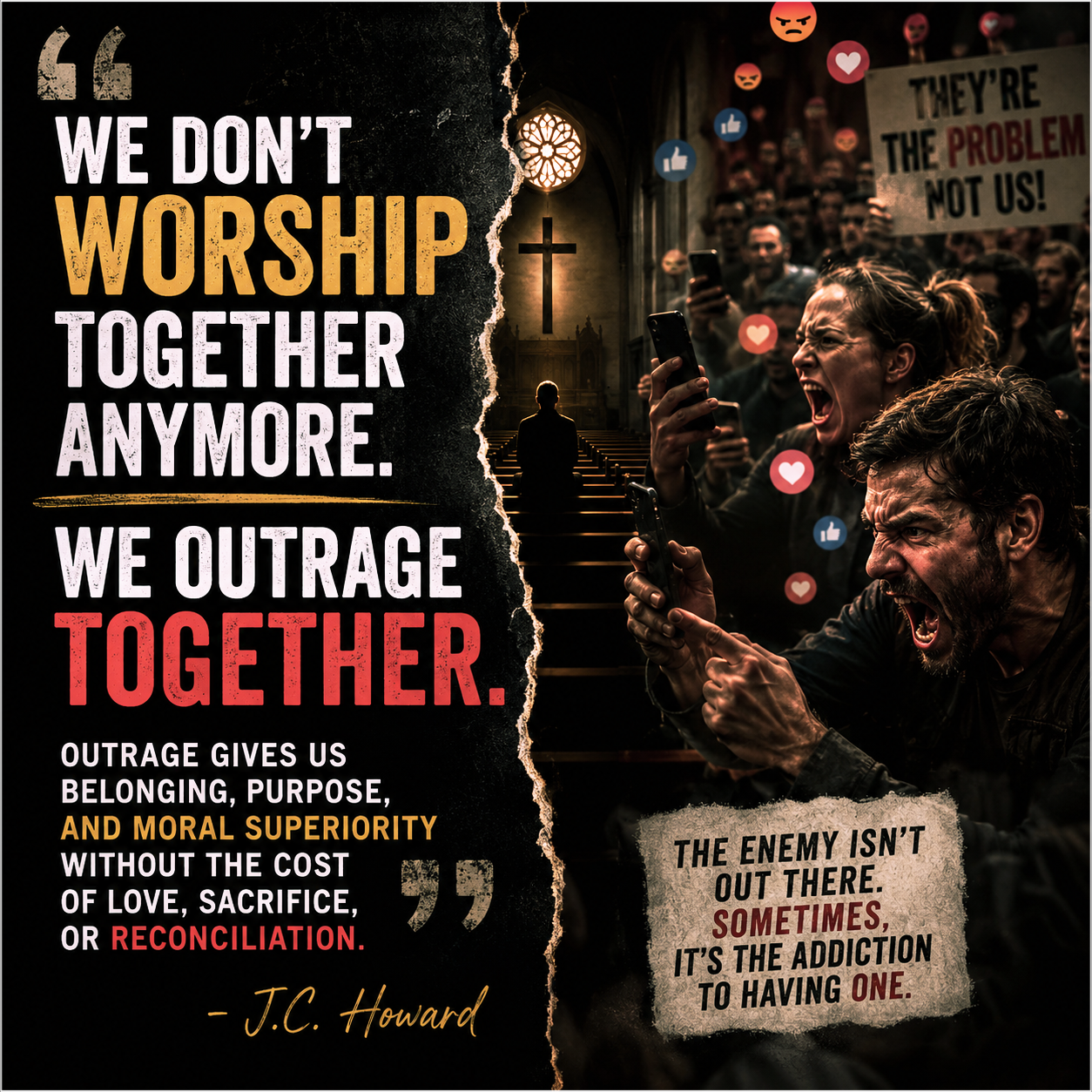
The problem is that many Christians have begun to enjoy it.
Somewhere along the way, we stopped seeing division as a tragedy and started experiencing it as a source of emotional gratification.
We no longer merely disagree with our enemies.
We need them.
We need someone to mock.
Someone to expose.
Someone to trigger.
Someone to blame.
Someone to hate.
And if an enemy does not exist, we create one.
The internet has rewarded this behavior so effectively that many people no longer recognize what is happening.
Psychologists call part of this phenomenon schadenfreude—the pleasure derived from another person’s suffering.
Research consistently shows that people experience measurable satisfaction when members of rival groups experience humiliation, failure, or distress.
The stronger the tribal identity, the stronger the reward.1, 2
In other words, the human brain can literally become addicted to the downfall of its enemies.
Social media monetizes this weakness.
Every outrage post.
Every rage bait headline.
Every “look how stupid these people are” meme.
Every viral public humiliation.
Every comment section piled high with mockery.
The platforms profit from keeping people emotionally activated.
Anger drives engagement.
Contempt drives engagement.
Humiliation drives engagement.
Forgiveness does not.
Reconciliation does not.
Nuance does not.
The algorithms have discovered something ancient about human nature:
People will pay attention to the people they hate longer than the people they love.3, 4, 5
And Christians are not immune.
Many believers claim to follow the Prince of Peace while secretly enjoying warfare.
Not spiritual warfare.
Cultural warfare.
Political warfare.
Racial warfare.
Denominational warfare.
The enemy changes.
The emotional reward remains the same.
Watch what happens when someone posts a statement that angers a rival group.
The comments fill with applause.
Not because minds were changed.
Not because reconciliation occurred.
Not because truth prevailed.
But because the “right people” became angry.
Outrage itself becomes evidence of success.
The goal is no longer persuasion.
The goal is reaction.
The enemy’s anger becomes a trophy.
The enemy’s frustration becomes entertainment.
The enemy’s humiliation becomes social currency.
And Christians clap.
This should terrify us.
Because Scripture never commands believers to enjoy the suffering of their enemies.
In fact, it explicitly warns against it.
“Do not rejoice when your enemy falls, and let not your heart be glad when he stumbles.” (Proverbs 24:17)
Notice the warning.
God does not merely prohibit the action.
He prohibits the enjoyment.
The problem is not only what we do.
The problem is what secretly delights us.
History offers countless examples of this corruption.
Every atrocity begins with the same psychological shift.
People stop seeing opponents as neighbors and start seeing them as symbols.
Once people become symbols, empathy collapses.
Once empathy collapses, cruelty becomes easy.
The road to every witch hunt, every segregation law, every ethnic conflict, every political purge, and every public shaming campaign begins with the same thought:
“They deserve it.”
Not every act of outrage leads to an atrocity.
But every atrocity begins with the moral permission structure that outrage creates.
The permission to stop seeing people as people.
The permission to enjoy their humiliation.
The permission to celebrate their suffering.6, 7
This is why Jesus commanded believers to love their enemies.
Not because enemies are lovable.
But because hatred is addictive.
Contempt is addictive.
Self-righteousness is addictive.
And once a person discovers the pleasure of feeling morally superior, they will often sacrifice truth itself to keep the feeling alive.
That is the danger facing the modern church.
Not that Christians have enemies.
But that many Christians have become emotionally dependent upon them.
We no longer merely oppose our enemies.
We consume them.
And in the process, we are becoming exactly what we claim to resist.
Psychological & scholarly context (editorial apparatus)
These sources support bounded empirical claims. They do not convert the essay's criticism of contemporary Christianity into a diagnosis of all Christians or a scholarly consensus about religious motivation.
- Mina Cikara, Matthew M. Botvinick, and Susan T. Fiske, “Us Versus Them: Social Identity Shapes Neural Responses to Intergroup Competition and Harm.” Experimental study of how group competition shaped self-reported pleasure and neural responses when rivals experienced negative outcomes. . Psychological Science 22, no. 3 (2011): 306–313.
- Mina Cikara and Susan T. Fiske, “Their Pain, Our Pleasure: Stereotype Content and Schadenfreude.” Research examining pleasure at another group's misfortune and the role of perceived competition and status. . Annals of the New York Academy of Sciences 1299 (2013): 52–59.
- Steve Rathje, Jay J. Van Bavel, and Sander van der Linden, “Out-group Animosity Drives Engagement on Social Media.” Large-scale analysis finding that posts about political out-groups were shared or engaged with more frequently than comparable in-group language in the studied datasets. . Proceedings of the National Academy of Sciences 118, no. 26 (2021).
- William J. Brady et al., “Emotion Shapes the Diffusion of Moralized Content in Social Networks.” Observational research finding that moral-emotional language was associated with greater diffusion within ideological networks. . Proceedings of the National Academy of Sciences 114, no. 28 (2017): 7313–7318.
- William J. Brady et al., “How Social Learning Amplifies Moral Outrage Expression in Online Social Networks.” Analysis of approximately 12.7 million posts showing that positive social feedback predicted a higher probability of future outrage expression; the authors frame this as social reinforcement, not clinical addiction. . Science Advances 7, no. 33 (2021).
- Nick Haslam, “Dehumanization: An Integrative Review.” Foundational review distinguishing forms of dehumanization and synthesizing their social and moral consequences. . Personality and Social Psychology Review 10, no. 3 (2006): 252–264.
- Nour Kteily et al., “The Ascent of Man: Theoretical and Empirical Evidence for Blatant Dehumanization.” Multi-study investigation connecting blatant dehumanization with hostile intergroup attitudes and support for aggressive policies. . Journal of Personality and Social Psychology 109, no. 5 (2015): 901–931.
Citation
Cite this essay
Howard, J. C. (2026). “The Christians Who Need Enemies.” (Version 1.0). The Golden Manifest Journal. .