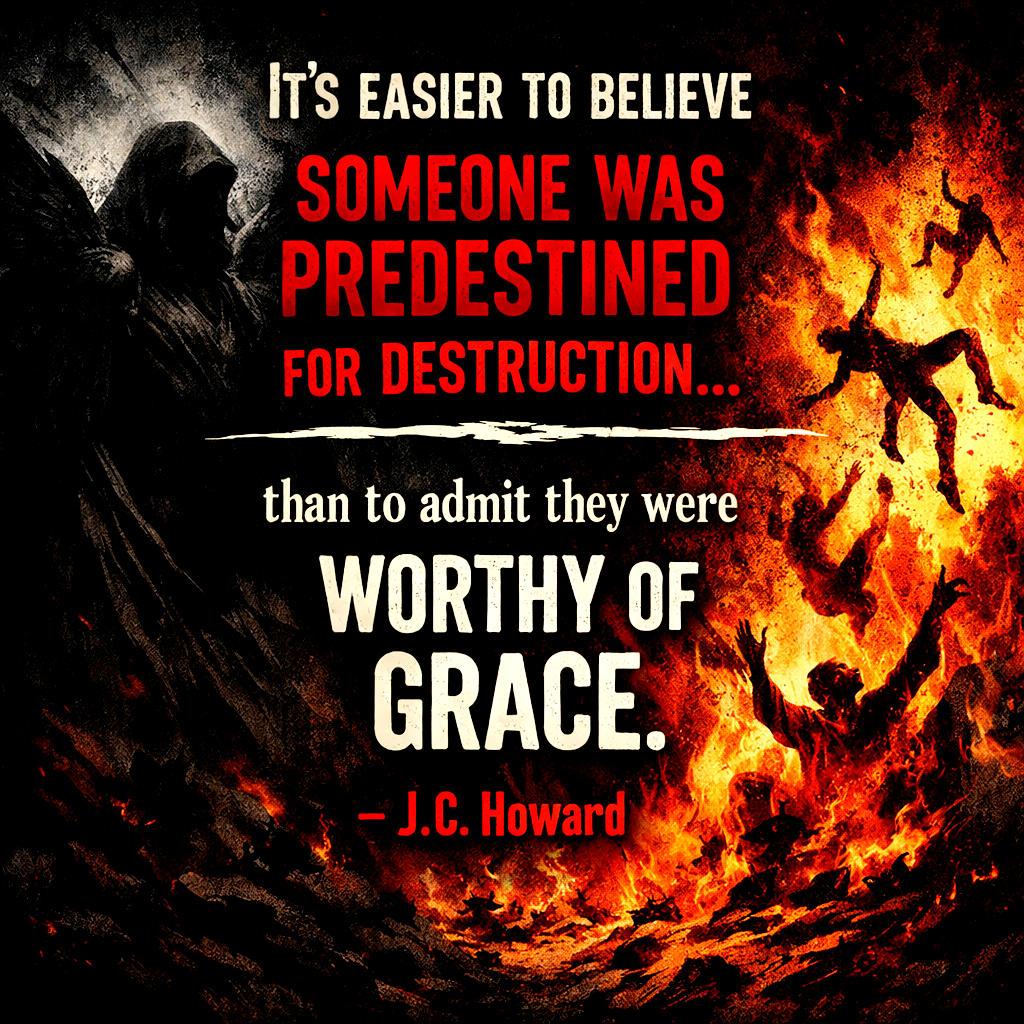
Editorial abstract
Howard examines how “reprobate” and “chosen” can move from contested theological terms into fixed social identities. He argues that the resulting boundary can offer the person inside it certainty, hierarchy, and psychological security while reducing people outside it to predetermined conclusions.
Evidence status: the cited biblical and historical sources establish that election, reprobation, judgment, and restoration have long been interpreted in divergent ways. Social identity, cognitive dissonance, and prejudice research supply adjacent mechanisms for understanding categorization and worldview protection. They do not prove why a particular believer uses these terms, that universal grace necessarily collapses hierarchy, or that one interpretation is theologically correct. Those remain Howard’s interpretive claims.
There’s a pattern most people don’t notice at first. It doesn’t show up in formal doctrine as much as it reveals itself in conversation—when certain words get used to close the case on a person.
“Reprobate.”
That word is rarely used with caution. It’s used as a verdict. You’ll hear Romans 1:28 quoted as if it defines a category of people rather than describing a condition the mind can enter into. The shift is subtle, but it changes everything. What was written as a progression becomes interpreted as a permanent identity.1
And once that label is applied, the conversation is over.
It rarely stops there. The language tightens. “Some are chosen.” Now Romans 8:29–30 and Ephesians 1:4–5 are introduced—not as theological tension or mystery, but as confirmation. The conclusion becomes simple: I’m in, and they’re not.
If that still feels unresolved, another layer is added—one that most people don’t examine closely enough. Proverbs 16:4: “The Lord has made everything for Himself, even the wicked for the day of evil.” That verse often sits quietly beneath the surface, reinforcing a conclusion people hesitate to say out loud: not everyone was meant to be saved. Some were made for destruction.1
You don’t always hear it stated directly, but you can feel it in how people are spoken about. A person is no longer navigating complexity; they’re categorized. A group is no longer human in its nuance; it’s reduced to a conclusion. Someone is no longer in process; they’re already decided.
And the one making that judgment often feels secure—not because they’ve wrestled deeply with the tension of the text, but because the system has already resolved it for them.
There are also passages that quietly reinforce this structure—the idea that few will find the way (Matthew 7:13–14), that some are cut off and cast aside (John 15:6), that believers are called to remain separate (2 Corinthians 6:17), even described as a chosen people (1 Peter 2:9). None of these ideas are inherently problematic on their own, but when combined and interpreted without tension, they can form a system where exclusion feels not only justified… but expected.
This is where the issue stops being about scripture itself and starts being about how scripture is used.
Because those same texts contain disruption. Romans 2:4 states that kindness leads to repentance. That idea doesn’t reinforce boundaries—it softens them. It doesn’t support hierarchy—it undermines it. And because of that, it’s often overlooked in favor of verses that feel more structurally stable.
The same happens with passages like Romans 9:22, where “vessels of wrath” are mentioned. The verse is often used to justify separation, but rarely examined for what it reveals about the interpreter. What happens to a mindset that requires someone else to be a vessel of destruction in order to feel like a vessel of mercy?
This tension isn’t new. It has existed within Christian thought for centuries. Figures like John Calvin emphasized divine selection and sovereignty, while others like Origen explored the possibility of restoration beyond what many were comfortable accepting. The divide was never fully resolved—it was inherited.2, 3
At that point, the conversation moves beyond theology and into psychology.
The human mind seeks clarity and stability. It wants to know where it stands, so it creates categories: in-group and out-group, saved and unsaved, chosen and rejected. This aligns with what psychologists describe as social identity theory, where individuals stabilize their sense of self by distinguishing themselves from others (Tajfel & Turner, 1979). Once those distinctions are established, they are protected—often at all costs.4, 5, 7
Even when they contradict the broader system of belief.
Because if grace, mercy, or transformation applies universally, then hierarchy begins to collapse. The subtle advantage of being “set apart” loses its structure. The unspoken comparison—the sense of being different in a way that elevates—starts to dissolve.
And that creates tension.
So the mind resolves it the only way it knows how: by reinforcing the boundary.
When someone says, “They’re reprobate,” it may sound like a theological conclusion, but psychologically it functions as something else. It stabilizes identity. It resolves internal dissonance. It protects a framework that might otherwise feel uncertain.6, 8
But stability is not the same as truth. Sometimes it’s simply belief that has not been challenged deeply enough.
If everything is stripped back—doctrine, tradition, inherited interpretations—the conversation changes. It is no longer centered on who is reprobate, who is chosen, or who was made for destruction.
It becomes a more uncomfortable question:
Why do we feel the need to exclude others in order to feel secure in where we stand?
That question is rarely addressed directly. It doesn’t get preached. It doesn’t get resolved quickly.
It lingers.
And most people don’t stay with it long enough to hear what it reveals.
Scriptural, historical & psychological context (editorial apparatus)
These sources clarify the traditions and constructs invoked by Howard. They neither diagnose individual believers nor settle the theological questions the essay raises.
- The Holy Bible. Passages discussed include Romans 1:28; Romans 2:4; Romans 8:29–30; Romans 9:22; Ephesians 1:4–5; Proverbs 16:4; Matthew 7:13–14; John 15:6; 2 Corinthians 6:17; and 1 Peter 2:9. Translation and theological differences should be considered before turning a verse into a fixed psychological category.
- John Calvin, Institutes of the Christian Religion, Book III, chapters 21–24. Calvin’s mature treatment of eternal election, divine sovereignty, and reprobation. The citation establishes the historical position, not the truth of the doctrine.
- Origen, On First Principles, especially Books I and III. A primary source for Origen’s account of rational creatures, judgment, freedom, and restoration. Because the work survives through a complex transmission history, claims about universal restoration require interpretive caution.
- Henri Tajfel, “Social Identity and Intergroup Behaviour.” Develops a social-identity approach to group membership and intergroup differentiation. . Social Science Information 13, no. 2 (1974): 65–93.
- Henri Tajfel and John C. Turner, “An Integrative Theory of Intergroup Conflict.” In William G. Austin and Stephen Worchel, eds., The Social Psychology of Intergroup Relations, 33–47. Brooks/Cole, 1979.
- Leon Festinger, A Theory of Cognitive Dissonance. Develops a theory of pressure arising from inconsistency among cognitions and efforts to reduce that pressure. Stanford University Press, 1957.
- Marilynn B. Brewer, “The Psychology of Prejudice: Ingroup Love and Outgroup Hate?” Distinguishes attachment to an in-group from hostility toward outsiders and examines conditions connecting them. . Journal of Social Issues 55, no. 3 (1999): 429–444.
- Gordon W. Allport, The Nature of Prejudice. A foundational study of categorization, stereotyping, and prejudice. Addison-Wesley, 1954.
Citation
Cite this essay
Howard, J. C. (2026). “Reprobate, Chosen, and the Authoritarian Mindset in Faith.” (Version 1.0). The Golden Manifest Journal. .