Editorial abstract
Howard argues that Christian communities can transform grace from an unearned gift into a credential when visible moral change becomes the test of spiritual legitimacy. Distinguishing necessary accountability from spiritual authentication, the essay moves among Pauline theology, historical controversies, contingent self-worth, self-enhancement, and communal judgment to ask whether externally verified transformation quietly replaces assurance with probation.
Evidence boundary: historical and psychological material is presented as bounded comparison rather than causal proof. This is an independent interdisciplinary essay and has not been peer reviewed.
“If grace hasn’t changed you, it isn’t grace.”
The sentence sounds clean.
Almost surgical.
But it performs a move most people do not notice.
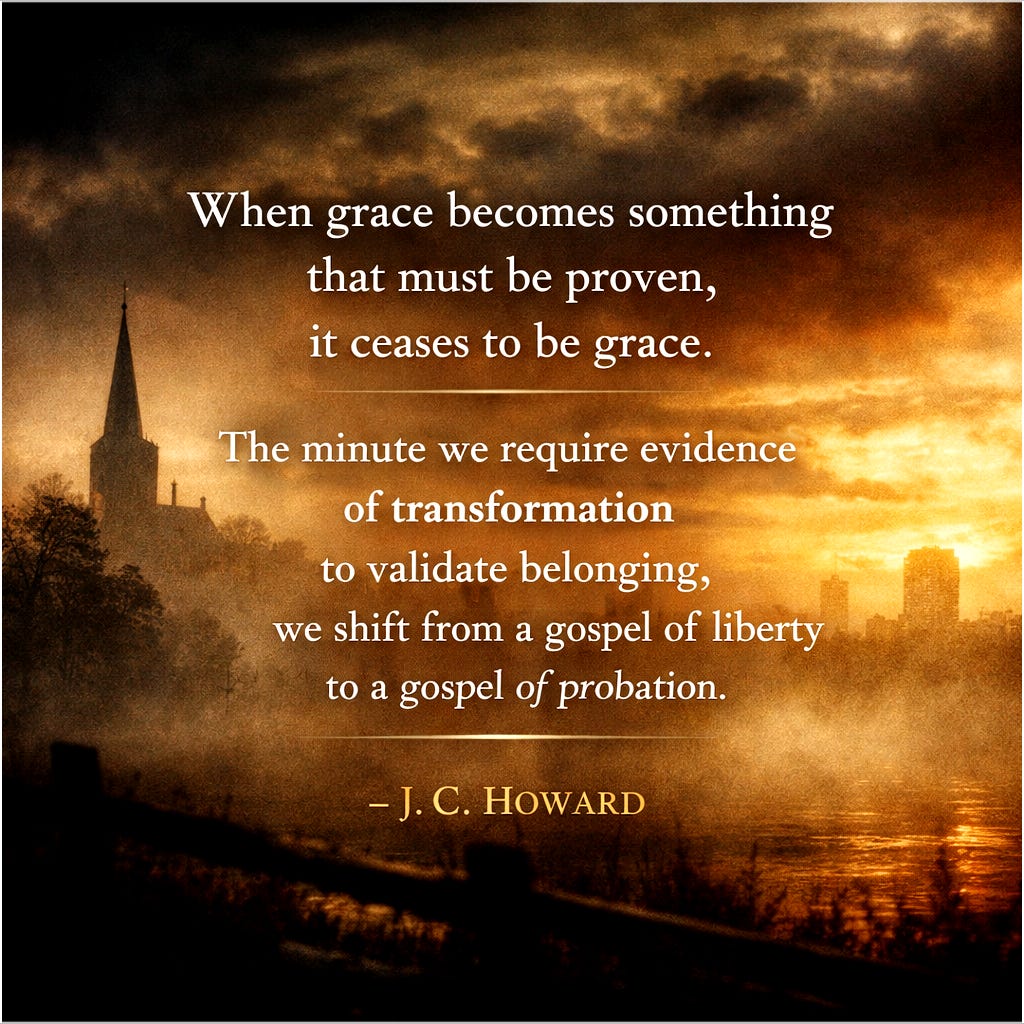
It shifts grace from something received
to something verified.
And verification always raises a second question:
Verified by whom?
Paul says that God “justifies the ungodly” and credits faith as righteousness (Romans 4:5). Romans 5:6–8 adds that Christ died for the ungodly and for sinners—before reform could become evidence.
That order matters.
The declaration does not wait for a finished life.
The slogan reverses the pressure.
It implies that visible modification confirms spiritual legitimacy.
That move may seem minor.
It isn’t.
In psychology, Crocker and Wolfe’s framework of contingent self-worth describes how self-esteem rises or falls with success in the domains on which people stake their worth. Applying that framework to a church’s tests of “authentic conversion” is an analogy, not a direct finding about congregations.
But the analogy exposes the mechanism.
When belonging becomes tied to visible moral performance, members have reason to monitor themselves, manage appearances, and compare progress.
Grace becomes less an anchor
and more an evaluation.
Theologically, this creates compression.
Within many Protestant frameworks, justification names God’s declaration, sanctification names gradual renewal, and glorification names future completion. Other Christian traditions configure grace, cooperation, assurance, and transformation differently. The categories are not a universal Christian flowchart.
The deeper problem crosses those differences.
Visible transformation can become a social credential whenever a community treats it as jurisdiction over belonging.
Then grace begins to function as probation.
Transformation Is Not Authentication
A community is not cruel merely because it expects conduct.
Grace without accountability can become cover for injury, manipulation, or abuse. Churches must be able to name harm, protect people, establish boundaries, require repair, and sometimes remove someone from leadership or fellowship.
But accountability and authentication are not the same act.
Accountability asks:
What happened?
Who was harmed?
What do safety, truth, and repair require?
Authentication asks:
Does this person’s visible progress prove that grace ever reached them?
One governs conduct.
The other claims authority over spiritual legitimacy.
Confusing them does not make a community holier. It makes every imperfect life submit evidence for its right to belong.
History shows why the distinction matters.
The Donatist controversy was not a general referendum on every moral failure. It emerged after persecution and centered, in part, on clergy accused of surrendering sacred texts or collaborating with imperial authorities—and on whether sacraments administered by compromised clergy were valid. The controversy reveals the recurring temptation to make a minister’s visible legitimacy carry the weight of grace itself.
Some Puritan cultures of assurance also looked to good works, affections, and love of piety as possible signs of election. But Puritan thought was diverse, and its theologians also directed anxious believers toward God’s promises. The point is not that “the Puritans” shared one crude test. The point is that a search for signs can become a machinery of inspection when a community mistakes evidence for verdict.
The same social logic can appear in modern high-control religious environments, but that comparison requires case-specific evidence. It should not be used as a universal label for demanding communities.
In each setting, the danger is the same:
grace becomes something that must be authenticated.
And authentication invites comparison.
The better-than-average effect describes a common form of comparative self-enhancement: people often judge themselves more favorably than the average peer on valued qualities. It does not prove that people overestimate their actual spiritual development.
It does explain why a visible-maturity hierarchy is so seductive.
Once transformation becomes proof of legitimacy, the environment rewards moral distinction—or at least the appearance of it.
The slogan no longer merely calls for growth.
It creates a ladder.
And ladders require someone beneath you.
Scripture itself resists this instinct.
In Luke 18:9–14, the Pharisee presents measurable moral distinction. The tax collector presents no spiritual résumé, only humility. Jesus says the latter went home justified.
The point is not that transformation is irrelevant.
The point is that visible distinction is unreliable as a final spiritual metric.
Even Paul’s account of inner conflict in Romans 7 complicates formulas that make struggle itself proof of fraud. Christians interpret that chapter differently, but no serious reading of formation permits the fantasy that human change is always linear, public, and easy to certify.
The problem is not affirming change.
The problem is relocating assurance from God’s declaration to communal observation.
Once a community becomes the evaluator of spiritual legitimacy, its cultural norms inevitably shape the test.
What one denomination treats as a sign of maturity, another may call compromise. What one generation condemns, another may regard as conscience, custom, or control.
So “transformation” can quietly begin to mirror the moral temperament of the group enforcing it.
That is why the slogan is more severe than it appears.
It feels like a defense of holiness.
But structurally, it can shift grace from gift to credential.
And credentials are ranked.
This does not mean conduct is meaningless.
Fruit matters.
Repair matters.
Discipline matters.
The lives of other people matter.
But none of those realities gives a crowd infallible access to the hidden architecture of another person’s redemption.
A church may preach grace with its mouth
and administer probation with its eyes.
The question is not whether grace changes people.
The question is whether our ability to see, measure, and approve that change determines whether grace was ever present.
If external verification becomes the condition of belonging, then grace is functioning socially as conditional—even when doctrine continues to call it free.
And once that happens, comparison fills the vacuum.
That is where the fracture begins.
References supporting the journal edition
- Romans 4:5; Romans 5:6–8; Luke 18:9–14; Romans 7. Read the cited passages.
- Crocker, J., & Wolfe, C. T. (2001). “Contingencies of Self-Worth.” Psychological Review, 108(3), 593–623. .
- Crocker, J., & Knight, K. M. (2005). “Contingencies of Self-Worth.” Current Directions in Psychological Science, 14(4), 200–203. .
- Alicke, M. D., & Govorun, O. (2005). “The Better-Than-Average Effect.” In The Self in Social Judgment. Publisher record.
- Abramowitz, J. S., & Jacoby, R. J. (2014). “Scrupulosity: A Cognitive-Behavioral Analysis.” Clinical Psychology Review, 34(3), 214–226. .
- Exline, J. J., Pargament, K. I., Grubbs, J. B., & Yali, A. M. (2014). “The Religious and Spiritual Struggles Scale.” Psychology of Religion and Spirituality, 6(3), 208–222. .
- Ferguson, S. B. (2010). The Whole Christ: Legalism, Antinomianism, and Gospel Assurance. Crossway. Publisher record.
- Frend, W. H. C. (1985). The Donatist Church: A Movement of Protest in Roman North Africa. Oxford University Press. Publisher record.
- Noll, M. A. (2002). America’s God: From Jonathan Edwards to Abraham Lincoln. Oxford University Press. Publisher record.
- McGrath, A. E. (2005). Iustitia Dei: A History of the Christian Doctrine of Justification (3rd ed.). Cambridge University Press. Publisher record.
Revision record (incorporated in this edition)
- Restored the opening premise. The slogan now opens the prose, so “The sentence” has a visible referent.
- Corrected the Pauline reference. Romans 4:5 now supports credited righteousness; Romans 5:6–8 supports Christ’s death for the ungodly and sinners.
- Named the interpretive lens. The justification–sanctification–glorification sequence is identified as common in Protestant frameworks rather than imposed on every Christian tradition.
- Bound the psychology. Contingent self-worth is explicitly used as an analogy, and the better-than-average effect is described as comparative self-enhancement rather than proof of moral overestimation.
- Narrowed the history. The Donatist discussion now identifies the post-persecution dispute over compromised clergy and sacramental validity; the Puritan comparison now acknowledges internal diversity.
- Qualified the modern comparison. The essay now says claims about high-control religious environments require case-specific evidence.
- Added the strongest counterargument. A new section distinguishes necessary accountability, safety, boundaries, and repair from a community’s claim to authenticate another person’s spiritual legitimacy.
Citation
Cite this essay
Howard, J. C. (2026). “When Grace Becomes Authentication.” (Version 1.0). The Golden Manifest Journal. .