Editorial abstract
This essay argues that a visible reaction cannot be interpreted responsibly apart from the biological, psychological, relational, and environmental conditions in which it occurred. Using an “Everyday Decision Flow” as an aspirational model, Howard distinguishes agency from equal capacity: the ability to pause, inhibit an impulse, reinterpret an event, and choose a response can vary across people and situations. The essay preserves responsibility while insisting that explanation is not justification and that compassionate judgment requires context.
Conceptual status: the decision flow is a practical heuristic, not a comprehensive clinical model. “Choice” is treated as a graded capacity shaped by executive control, arousal, health, learning, and circumstance—not as an all-or-nothing property. The essay does not claim that a diagnosis predicts any particular act or removes accountability.
The Decision Flow Is True—But Not Complete
Why wisdom requires more than judging someone’s reaction.
Every day we make thousands of decisions.
That process is real.
It is one of the most fundamental psychological truths about being human.
But it is not the entire truth.
One of the greatest mistakes we make is assuming that every person’s decision-making process functions under the same conditions.
It doesn’t.
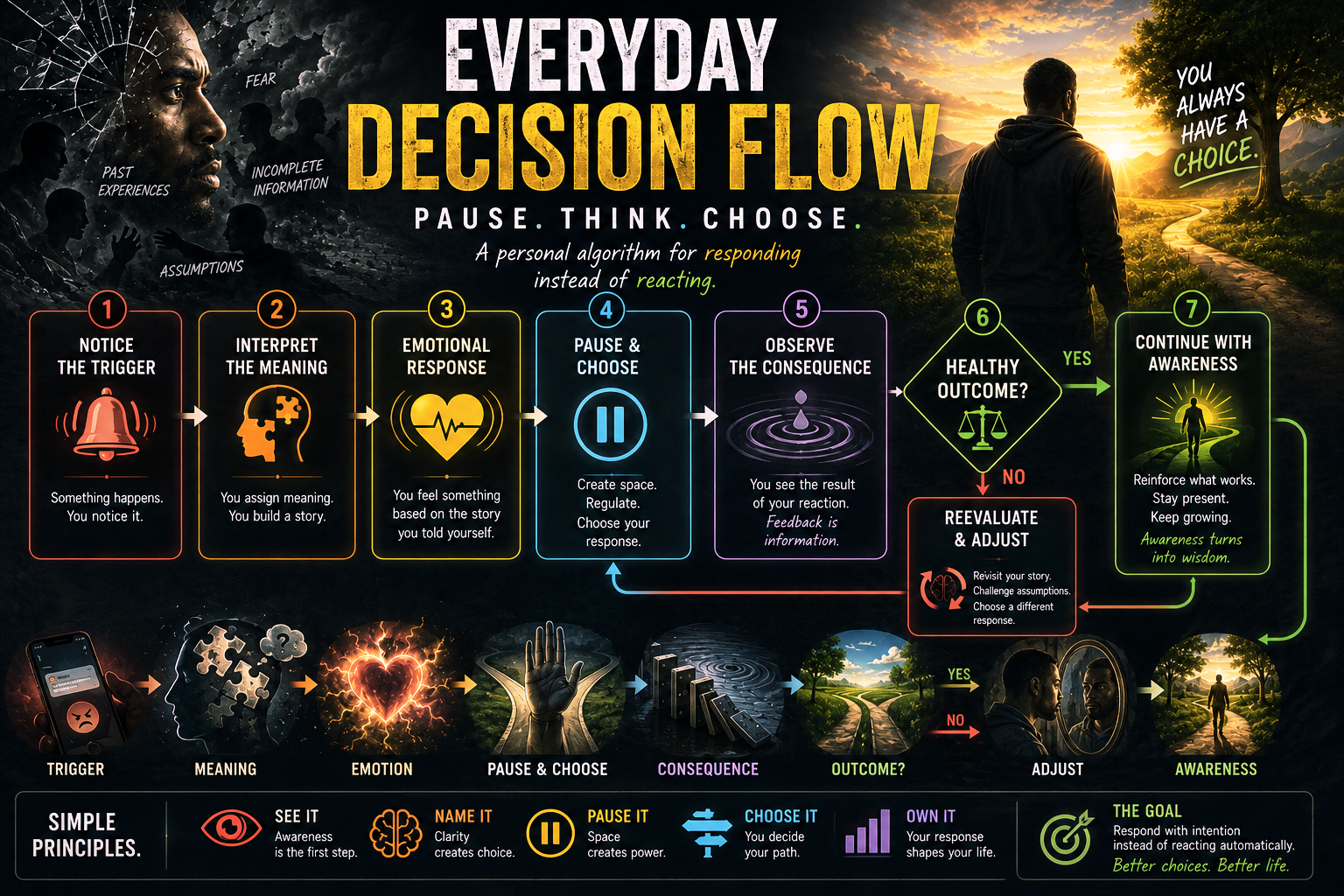
The flowchart illustrates an ideal cognitive process—a pattern we should strive toward—not necessarily one every individual is capable of executing equally in every circumstance.
The difference matters.
The Space Between Stimulus and Response
Most psychological growth involves expanding the space between what happens to us and how we respond.
The larger that space becomes, the more freedom we possess.
The smaller that space becomes, the more automatic our behavior becomes.
That is why practices like mindfulness, emotional regulation, therapy, reflection, and spiritual disciplines are valuable.
They increase our ability to pause.
But that ability is not equally available to everyone at every moment.
Inhibition
Executive functions include the abilities to resist a dominant response, hold relevant information in mind, and shift perspective before acting.
Variation
These capacities are not fixed. Sleep, stress, brain injury, symptoms, development, and immediate demands can change how effectively they operate.
Practice
Deliberate regulation practices can support awareness and choice, but evidence varies by practice, population, duration, and outcome.
Responsibility
Reduced capacity can be morally and clinically relevant without making all behavior involuntary or all consequences inappropriate.
Biology Matters
Sometimes a person’s reaction is less about character than physiology.
- A traumatic brain injury.
- PTSD.
- Complex trauma.
- Sleep deprivation.
- Autism.
- ADHD.
- Substance withdrawal.
- Depression.
- Anxiety disorders.
- Psychosis.
- Dementia.
- Hormonal disturbances.
- Even severe hypoglycemia.
These conditions can dramatically reduce someone’s ability to slow the decision process.
The pause may become milliseconds instead of seconds.
Sometimes it disappears altogether.
That does not remove responsibility.
But it changes how we understand it.
Context Matters
Behavior never occurs in a vacuum.
Imagine watching someone scream at another person in public.
Without context, we naturally assume they are the aggressor.
Then imagine learning they have endured months of manipulation, intimidation, gaslighting, isolation, and psychological abuse.
Suddenly the exact same behavior is interpreted differently.
This is why reactive abuse is so difficult to recognize.
The abuser carefully creates conditions that eventually provoke an emotional explosion.
Observers see only the reaction.
They never witness the hundreds of smaller events that produced it.
The victim appears irrational.
The aggressor appears calm.
The truth is often the opposite.
The visible reaction may simply be the final domino.
Feedback Can Be Distorted
The flowchart suggests we observe the consequence of our response and learn from it.
Usually that’s true.
But even feedback can be misleading.
Manipulative people distort feedback.
Echo chambers distort feedback.
Abusive relationships distort feedback.
Certain religious environments distort feedback.
Political tribes distort feedback.
Sometimes society rewards unhealthy behavior while punishing healthy behavior.
The consequence we observe is not always evidence that our decision was correct.
It may only reveal the nature of the environment.
Judgment Requires Humility
This is why judging people solely by their reactions is dangerous.
A reaction tells us something.
It rarely tells us everything.
Before asking,
“Why did they react like that?”
we should also ask,
“What happened before I arrived?”
“What pressures are invisible?”
“What biological, psychological, or environmental factors might I not see?”
Those questions do not excuse harmful behavior.
But they often explain it.
Explanation and justification are not the same thing.
A Better Framework
The Everyday Decision Flow remains valuable because it gives us something to practice.
It reminds us that awareness creates options.
But wisdom requires adding one more principle.
Before evaluating someone’s response, evaluate the conditions under which the response occurred.
Sometimes the healthiest response is to encourage greater self-control.
Sometimes the healthiest response is trauma treatment.
Sometimes it is medication.
Sometimes it is removing someone from an abusive environment.
Sometimes it is simply extending compassion until more of the story becomes visible.
The goal is not merely to become slower in our reactions.
The goal is to become wiser in our judgments—both of ourselves and of others.
It is also important to recognize that not every immediate reaction is inherently irrational or unhealthy. Some reactions are adaptive. Pulling your hand away from a hot stove, responding instinctively to protect a child, or reacting quickly to genuine danger are examples of responses that require little deliberation. The issue is not that reactions exist, but that we often evaluate them without considering the circumstances, purpose, or conditions under which they occurred.
This principle is reflected beyond psychology. Several countries have adopted the PEACE model of investigative interviewing, which emphasizes gathering information before reaching conclusions rather than relying on accusation-driven interrogation. While developed for criminal investigations, the underlying principle has broader application: wise judgment often requires slowing the process, seeking context, and resisting premature conclusions. The same discipline should inform how we evaluate the behavior of others in everyday life.
— J.C. Howard
Scholarly context & references (editorial apparatus)
These sources support the essay's discussion of executive control, variable capacity, selected examples, and information-gathering before judgment. They do not establish that every reaction is involuntary, that a diagnosis explains a particular event, or that contextual understanding eliminates accountability.
Brief scholarly positioning
- Agency is implemented through capacities
- Inhibitory control, working memory, and cognitive flexibility help people interrupt dominant responses, retain goals, and change course. Their operation is measurable but not perfectly captured by a single flowchart.
- Capacity varies
- Sleep deprivation, PTSD, moderate or severe traumatic brain injury, acute severe hypoglycemia, and some neurodevelopmental conditions can affect attention, inhibition, cognition, behavior, or self-regulation. Effects remain individual and context-dependent.
- Context changes interpretation
- Chronology and surrounding conditions can change the meaning of a visible act. Context should widen inquiry, not predetermine who is innocent, responsible, truthful, or dangerous.
- PEACE is an analogy, not a clinical protocol
- The PEACE framework belongs to investigative interviewing. The essay draws a broader ethical lesson from its information-gathering orientation; it does not propose using police interviewing procedures in ordinary relationships.
- Diamond, A. (2013). “Executive Functions.” Annual Review of Psychology, 64, 135–168. This major review identifies inhibition, working memory, and cognitive flexibility as core executive functions and explains their role in thinking before acting and resisting dominant responses. PubMed record. . Link and abstract verified September 6, 2026.
- Choong, S. Y., Byrne, J. E. M., Drummond, S. P. A., Rispoli-Yovanovic, M., Jones, A., Lum, J. A. G., & Staiger, P. K. (2025). “A Meta-Analytic Investigation of the Effect of Sleep Deprivation on Inhibitory Control.” Sleep Medicine Reviews, 80, 102042. Across 24 studies involving 712 healthy adults, sleep deprivation had a moderate negative effect on two widely used inhibitory-control tasks; the authors also noted study-level limitations and the need for clinical-population research. PubMed record. . Link and abstract verified September 6, 2026.
- Olff, M., Polak, A. R., Witteveen, A. B., & Denys, D. (2014). “Executive Function in Posttraumatic Stress Disorder (PTSD) and the Influence of Comorbid Depression.” Neurobiology of Learning and Memory, 112, 114–121. This review found lower executive-function performance in PTSD groups than trauma-exposed controls across assessed domains while examining the complicating role of symptom clusters and comorbid depression. PubMed record. . Link and abstract verified September 6, 2026.
- Townes, P., Liu, C., Panesar, P., et al. (2023). “Do ASD and ADHD Have Distinct Executive Function Deficits? A Systematic Review and Meta-Analysis of Direct Comparison Studies.” Journal of Attention Disorders, 27(14), 1571–1582. In children and adolescents, the review found group-level differences from typically developing peers across multiple executive-function domains, including response inhibition, while emphasizing overlap and the need to examine comorbidity. It does not predict any individual's behavior. PubMed record. . Link and abstract verified September 6, 2026.
- Centers for Disease Control and Prevention. (2024). “About Potential Effects of a Moderate or Severe TBI.” The CDC notes that effects differ by person and may include trouble thinking clearly, difficulty concentrating, increased emotionality, impulsivity, and trouble controlling behavior. The page concerns moderate or severe TBI and should not be generalized to every head injury. CDC guidance. Link and content verified September 6, 2026.
- National Institute of Diabetes and Digestive and Kidney Diseases. (2024). “Islet Transplantation for Treating Difficult-to-Manage Type 1 Diabetes in Adults.” In explaining severe hypoglycemia, NIDDK identifies possible memory loss, confusion, altered or irrational behavior, seizures, and loss of consciousness. This supports the essay's acute physiological example, not a general inference about people with diabetes. NIDDK research update. Link and content verified September 6, 2026.
- United Nations Office on Drugs and Crime. “Investigative Interviewing for Criminal Investigation.” UNODC describes an evidence-based methodology founded on the PEACE model, developed in the United Kingdom in response to documented forced confessions and focused on obtaining accurate, reliable information without coercion. UNODC overview. Link and content verified September 6, 2026.
- United Nations Office on Drugs and Crime. Basic Training Manual on Investigating and Prosecuting the Smuggling of Migrants. The interviewing module states that the PEACE model is used in a number of countries and applies to interviews with suspects, witnesses, and victims. It supports the essay's international-adoption statement while also showing that implementation occurs in specific professional and legal settings. UNODC training manual. PDF link and content verified September 6, 2026.
Publication history
Howard, J. C. “Not Every Reaction Is a Choice !” Substack, July 11, 2026. Original source: yourpropheticscribe.substack.com/p/not-every-reaction-is-a-choice. The title, subtitle, publication date, prose, and image were verified from the recovered newsletter record.
What changed for this journal edition
The original prose and image are preserved. Newsletter subscription and unsubscribe material were removed. The display title normalizes the space before the exclamation point. The editorial abstract, conceptual-status note, research mechanism brief, three scope and safety notes, scholarly positioning, source annotations, display headings, and expanded image alternative text were added for clarity, credibility, accessibility, and archival context. Journal version 1.0 is archived under DOI .