Origin of the parable
A dream without a forced interpretation
J.C. Howard developed “The Woman Who Laughed” from a dream. The resulting parable preserves the uncertainty at its center: the laughter may represent abundance, detachment, refusal, unawareness, or something unrelated to the conflict. The narrative does not settle that question, and this journal framing does not impose a single answer.1
Editorial abstract
The final plate
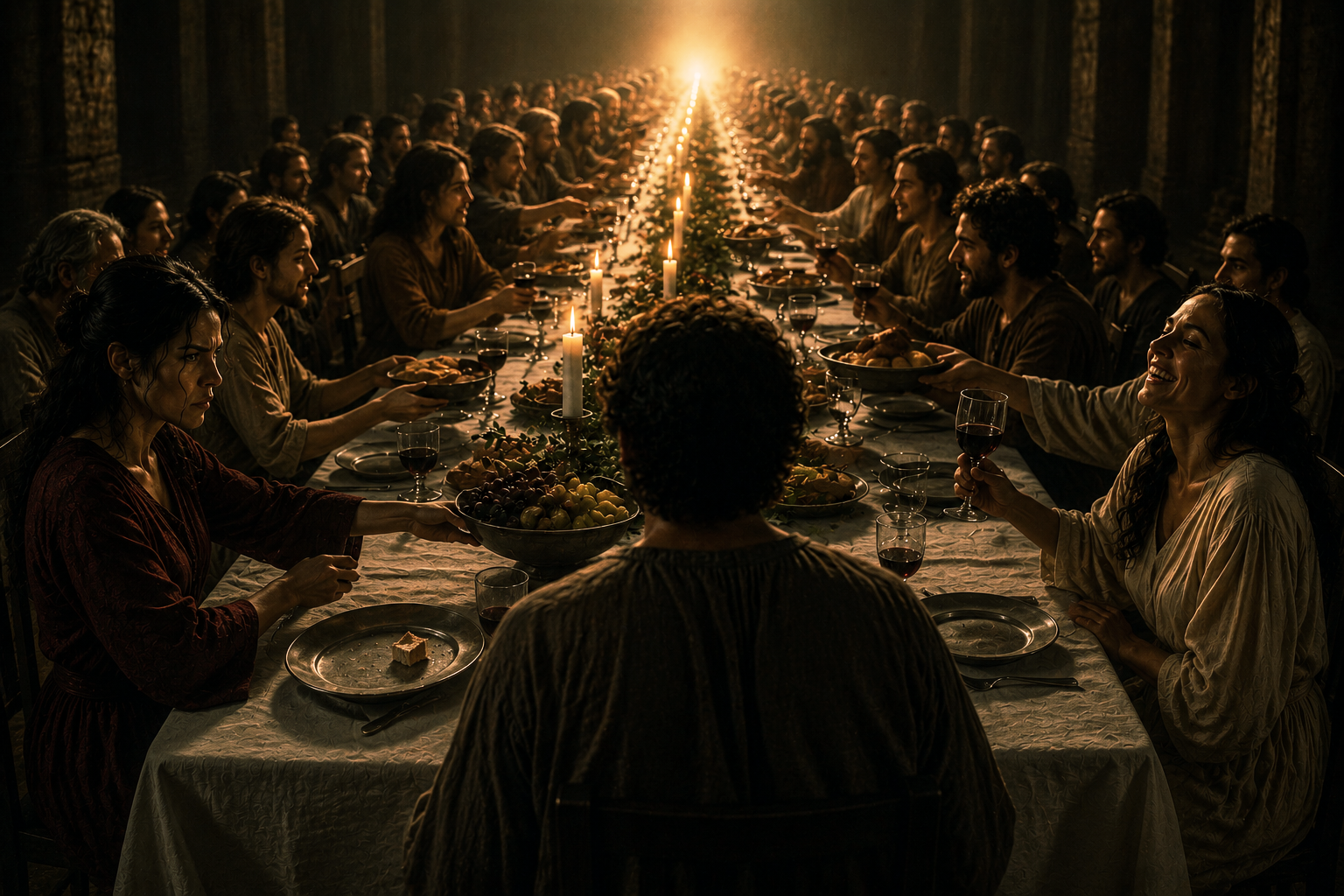
At the end of an immense banquet table, a man receives what remains after abundance has passed through countless other hands. One woman takes his last portion; another laughs without explaining herself. Through those three figures, the parable explores how inherited scarcity becomes personal blame, how people can inhabit the same event through radically different appraisals, and how an apparent breaking point may merely reveal a departure that began long before the visible conflict.23
There was a table so long that no one could see where it began.
Its white linen stretched into the distance like a river beneath crystal glasses and flickering candles. Platters of bread, fruit, and roasted meat traveled from hand to hand. Voices drifted through the room in gentle waves, rising and falling like the tide.
Somewhere beyond sight, the meal had begun.
At the very end of the table sat a man.
Not in the center.
Not among those who first received.
At the end.
Beside him sat two women.
One on his left.
One on his right.
Before the first plate ever reached him, he already carried a quiet resistance.
He had come because he was expected to come.
His body occupied the chair.
His heart had never quite taken its seat.
The platters continued their slow journey through countless hands.
Each person took what they desired.
Some took little.
Some took more.
The table remained alive with conversation as though there would always be enough.
By the time the food reached the end, only a small portion remained.
He looked at the plate.
He looked at the woman on his left.
Quietly, he separated what little was left and slid a piece toward her.
It wasn’t equal.
It couldn’t be.
There simply wasn’t enough.
The woman stared at the tiny portion.
Her expression changed.
Without a word, she reached across the table, took the remainder from his plate and pulled it toward herself.
Silence settled between them.
He looked down at the empty plate.
He had expected disappointment.
He had not expected that.
Yet somewhere deep inside, he realized he had arrived carrying a weariness that existed long before the food reached him.
He had not wanted to be there.
Not really.
The food itself hardly mattered.
What lingered was the feeling.
He had not created the scarcity.
The food had traveled through countless hands before it ever reached him.
Yet somehow, the one who held the last plate seemed to bear the weight of everything that had happened before.
When little was left, blame had settled upon the last person holding the plate.
The realization settled heavily upon him.
Slowly, he pushed back his chair.
Then...
He heard laughter.
He turned.
The woman on his right was smiling.
She laughed softly, almost as though she had forgotten there was food on the table at all.
She never looked toward the empty plate.
She never acknowledged the woman beside him.
She never entered the conflict.
She simply laughed.
He searched her face.
Was she celebrating?
Was she unaware?
Had she seen everything?
Was she intentionally ignoring it?
He could not tell.
Her laughter held neither mockery nor sympathy.
It carried no explanation.
It simply existed.
He looked back toward the woman on his left.
Her hands clung tightly to the plate.
Then he looked again toward the woman on his right.
She seemed completely unconcerned with what everyone else had been fighting over.
She wasn’t counting portions.
She wasn’t measuring fairness.
She wasn’t reaching for what remained.
She was simply present.
At that moment, he realized the two women had been sitting at the same table, witnessing the same meal, yet living in entirely different worlds.
One measured life by what remained on the plate.
The other seemed untouched by the plate altogether.
He stood between them.
Neither woman spoke.
Neither explained herself.
Around them, the gathering continued.
People kept talking.
Glasses continued to clink.
Someone laughed in the distance.
The meal moved forward as though nothing extraordinary had happened.
He looked once more at the endless table.
Then something settled quietly within him.
Sometimes the person nearest the problem is mistaken for the one who caused it.
Sometimes people inherit the consequences of choices they never made.
Sometimes they are judged, not by what they were given, but by what they had left to give.
He looked one final time toward the woman on his right.
She was still laughing.
Not louder.
Not softer.
Exactly the same.
For reasons he would never understand.
Perhaps she saw abundance where others saw scarcity.
Perhaps she had discovered something more nourishing than bread.
Perhaps she simply refused to surrender the moment to conflict.
Or perhaps her laughter had nothing to do with either of them.
He never knew.
Then he realized something else.
Long before the woman on his left had taken his portion...
Long before the laughter had caught his attention...
Long before the last plate reached his hands...
He had already begun leaving the table.
The conflict had not created his departure.
It had merely revealed it.
Years passed.
He forgot the taste of the bread.
He forgot the faces scattered along the endless table.
He even forgot the argument itself.
But he never forgot the woman who laughed.
And whenever life seated him once again at the end of another table—another disappointment, another misunderstanding, another season where little remained—he found himself returning to the same unanswered question.
What if the feast was never the food...
...but the way each person chose to inhabit the table?
Research context (editorial apparatus)
These sources illuminate psychological themes adjacent to the parable. They do not decode the dream, establish fixed meanings for its symbols, or convert a literary work into a validated psychological theory.
- Dream research provides a cautious basis for treating dream material as connected to waking experience without treating it as prophecy or universal symbolism. Schredl and Hofmann found that differences in waking activities were reflected in dream content, while emphasizing that broad versions of the continuity hypothesis remained underspecified. Michael Schredl and Friedrich Hofmann, “Continuity Between Waking Activities and Dream Activities,” Consciousness and Cognition 12, no. 2 (2003): 298–308. .
- The image of a diminishing portion resonates with experimental work showing that scarcity can redirect attention toward pressing demands while increasing neglect elsewhere. This research offers context for the parable’s narrowed focus on the final plate; it does not explain every character’s motive. Anuj K. Shah, Sendhil Mullainathan, and Eldar Shafir, “Some Consequences of Having Too Little,” Science 338, no. 6107 (2012): 682–685. .
- Appraisal research supports the parable’s broader intuition that people can encounter the same situation yet experience different emotional realities. Smith and Ellsworth found systematic relationships between people’s evaluations of circumstances—such as perceived control, responsibility, certainty, and attention—and the emotions they reported. Craig A. Smith and Phoebe C. Ellsworth, “Patterns of Cognitive Appraisal in Emotion,” Journal of Personality and Social Psychology 48, no. 4 (1985): 813–838. .
- Because the woman’s laughter remains ambiguous, research on humor is relevant only as one possible frame. In an experimental study, positive, good-natured humor was more effective than negative humor at regulating negative emotion. That finding supports the possibility of laughter as reappraisal, not the conclusion that this is what the woman’s laughter means. Andrea C. Samson and James J. Gross, “Humour as Emotion Regulation: The Differential Consequences of Negative Versus Positive Humour,” Cognition and Emotion 26, no. 2 (2012): 375–384. .
Publication history & archival record
- Original: J.C. Howard, “The Woman Who Laughed: When the Last Portion Revealed Everything,” Substack, July 15, 2026: original publication URL.
- The title, subtitle, prose, publication date, source URL, and original content image were recovered from the author’s Substack newsletter record.
- Journal citation: Howard, J. C. (2026). “The Woman Who Laughed.” (Version 1.0). The Golden Manifest Journal. .
- Publication metadata: The Golden Manifest Inc.; ORCID 0009-0008-3050-3617; CC BY-NC-ND 4.0; independent interdisciplinary parable and commentary; not peer reviewed.