Editorial abstract
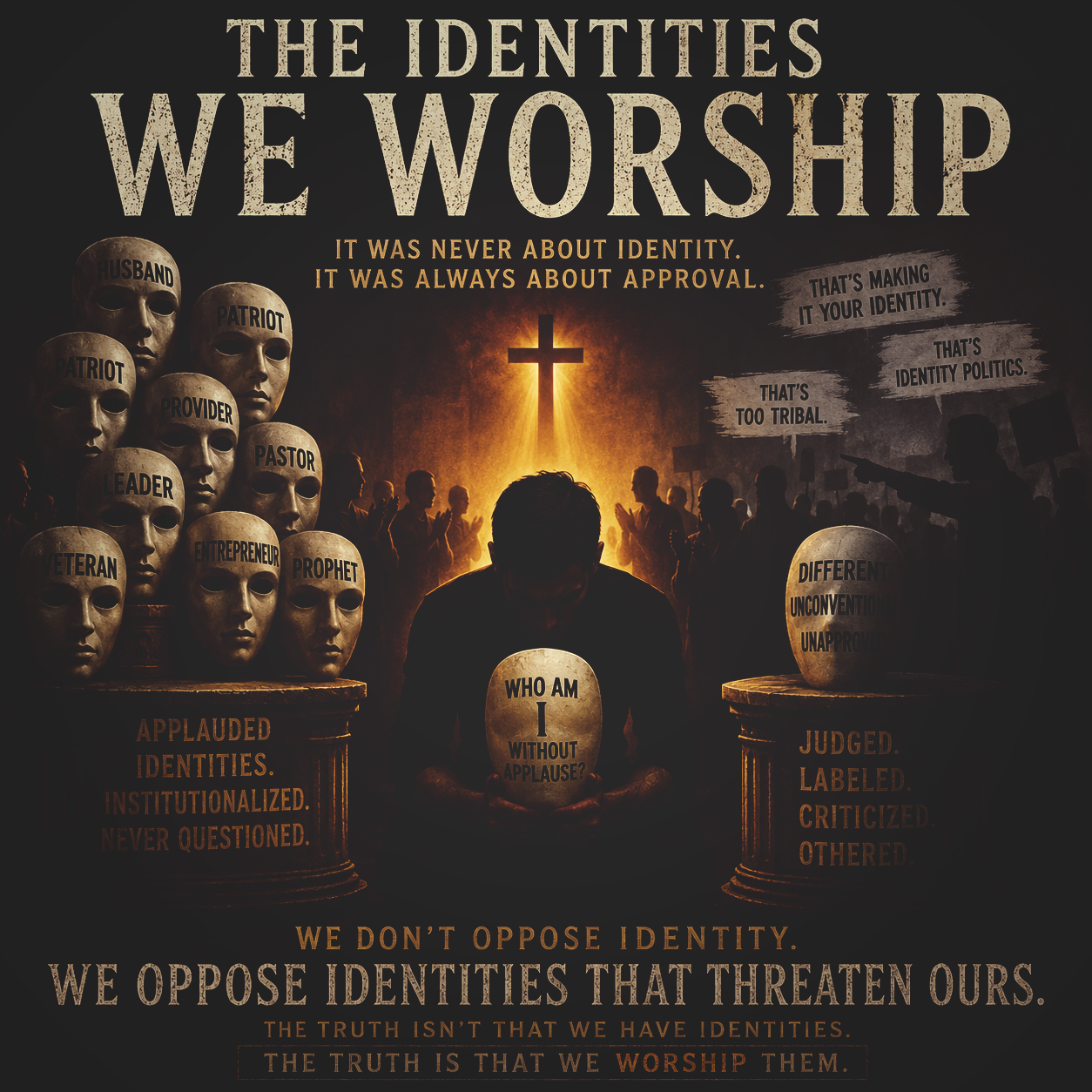
Howard argues that communities do not reject identity as such; they normalize identities that reinforce their own social order and scrutinize those that unsettle it. Using the language of social identity, in-group bias, and normative conformity, the essay turns the familiar religious injunction to place one's “identity in Christ” back upon the institutions that celebrate approved marital, familial, vocational, political, and leadership identities.
Evidence status: research supports the influence of social categorization, group identification, in-group favoritism, religious identity, and majority pressure. It does not prove that every congregation enforces the same identity hierarchy, reveal any particular person's hidden motives, or establish that all conformity is unconscious or harmful.
The Identities We Worship
One of the greatest deceptions of the modern world is not that people have identities.
It is that people believe they do not.
The same person who condemns identity politics may introduce himself as a husband, father, patriot, conservative, veteran, pastor, prophet, entrepreneur, or church leader before he ever tells you his name.
The same congregation that warns others not to “make something their identity” will spend entire weekends celebrating identities they have collectively approved.
Father’s Day.
Mother’s Day.
Men’s Conferences.
Women’s Conferences.
Marriage Retreats.
Leadership Summits.
Identity is not merely accepted. It is institutionalized.
The problem is not identity.
The problem is selective outrage.
Psychologists have long understood that human beings derive a significant portion of their self-concept from group membership. According to Social Identity Theory, developed by psychologists Henri Tajfel and John Turner, people naturally categorize themselves into groups and derive self-esteem from belonging to those groups. We do not merely possess identities; we defend them.1, 3
This explains why criticism of a group often feels like criticism of the self.
It also explains why people frequently fail to notice their own identities while obsessively examining everyone else’s.
The identities we inhabit become invisible to us.
Like water to a fish.
Like air to a bird.
Like doctrine to a church.
Research consistently demonstrates that human beings exhibit in-group bias, the tendency to favor groups they belong to while judging outsiders by a different standard. We call our own traditions wisdom and other people’s traditions bias. We call our own identities natural and other people’s identities political. We call our own communities normal and other people’s communities tribal.1
The church often participates in this contradiction while pretending it stands above it.
A man may stand on a stage and proudly announce:
“I am a husband, father, provider, and leader.”
The audience applauds.
Another person introduces themselves through a different lens, and suddenly the room becomes concerned about labels.
The issue was never labels.
The issue was approval.
If identity itself were the problem, the criticism would apply equally to everyone.
But it doesn’t.
Because most people are not opposed to identity.
They are opposed to identities that threaten their worldview.
This is why many believers can quote, “Your identity should be in Christ,” while simultaneously constructing entire ministries around every other identity imaginable.
Christian father.
Christian businessman.
Christian leader.
Christian patriot.
Christian influencer.
Christian author.
The adjective changes.
The psychological mechanism remains the same.3
The irony becomes even sharper when we consider that many of Christianity’s most influential figures would struggle to fit comfortably within today’s family-centered church culture.
The faith was shaped by prophets, wanderers, celibates, exiles, prisoners, and social outsiders.
Yet modern churches often communicate, intentionally or not, that spiritual maturity culminates in becoming a married homeowner with children and a stable career.
The result is predictable.
Single adults feel invisible.
The divorced feel defective.
The childless feel incomplete.
The unconventional feel suspect.
And all the while the institution congratulates itself for promoting biblical identity.
What we are often witnessing is not biblical identity.
It is social conformity baptized in religious language.
The most dangerous identities are rarely the controversial ones.
The most dangerous identities are the ones we never question because everyone around us shares them.
Psychology calls this normative conformity. We absorb beliefs, behaviors, and identities not because we have examined them but because our tribe rewards them.2
The crowd calls it normal.
The individual calls it conviction.
The difference is not always obvious.
Perhaps the question is not whether someone has made something their identity.
Everyone has.
The more unsettling question is this:
Which of your identities would survive if your community stopped applauding them tomorrow?
If being a husband disappeared tomorrow, who would you be?
If your political tribe vanished tomorrow, who would you be?
If your ministry title disappeared tomorrow, who would you be?
If your social status evaporated tomorrow, who would you be?
Many people spend their lives condemning the identities of others because they are terrified of discovering how much of their own identity rests upon equally fragile foundations.
The identities we criticize often reveal less about the people wearing them and more about the insecurities of those doing the judging.
Psychological & scholarly context (editorial apparatus)
These sources support bounded concepts adjacent to Howard's argument. They do not diagnose individuals, measure every church culture, or convert the essay's theological criticism into a universal psychological finding.
- Henri Tajfel, M. G. Billig, R. P. Bundy, and Claude Flament, “Social Categorization and Intergroup Behaviour.” Foundational minimal-group experiments showing that even relatively arbitrary categorization could produce in-group favoritism in allocations under the study conditions. . European Journal of Social Psychology 1, no. 2 (1971): 149–178.
- Axel Franzen and Sebastian Mader, “The Power of Social Influence: A Replication and Extension of the Asch Experiment.” A preregistered-style contemporary replication with 210 participants that found substantial conformity in line judgments and political-opinion tasks, while also showing that incentives and context matter. . PLOS ONE 18, no. 11 (2023): e0294325.
- Renate Ysseldyk, Kimberly Matheson, and Hymie Anisman, “Religiosity as Identity: Toward an Understanding of Religion From a Social Identity Perspective.” A scholarly review treating religion as both a belief system and a social identity whose group membership can shape cognitive, emotional, and intergroup processes. . Personality and Social Psychology Review 14, no. 1 (2010): 60–71.
- Sonia Roccas and Marilynn B. Brewer, “Social Identity Complexity.” A theoretical account of how people represent relationships among their multiple group identities, cautioning against treating the social self as a single undifferentiated affiliation. . Personality and Social Psychology Review 6, no. 2 (2002): 88–106.
Citation
Cite this essay
Howard, J. C. (2026). “Social Conformity Baptized: The Identities We Can't See.” (Version 1.0). The Golden Manifest Journal. .