Abstract
A statement’s survival under pressure is not a sufficient test of its truth. This essay distinguishes words that fail through incoherence, premature formation, or hostile conditions, and asks when waiting supports responsible judgment and when it preserves avoidable harm. It proposes Survivability–Truth Substitution: treating a speaker’s capacity to endure as a substitute for examining the claim’s evidence and reasoning. The argument develops the unequal costs of delay, the difference between raising a concern and announcing a verdict, and revision that remains answerable for earlier claims. Research on psychological safety, voice, stress, accountability, intellectual humility, and silencing provides context for the proposal. The framework joins protection with scrutiny; distress and persistence do not decide factual truth.
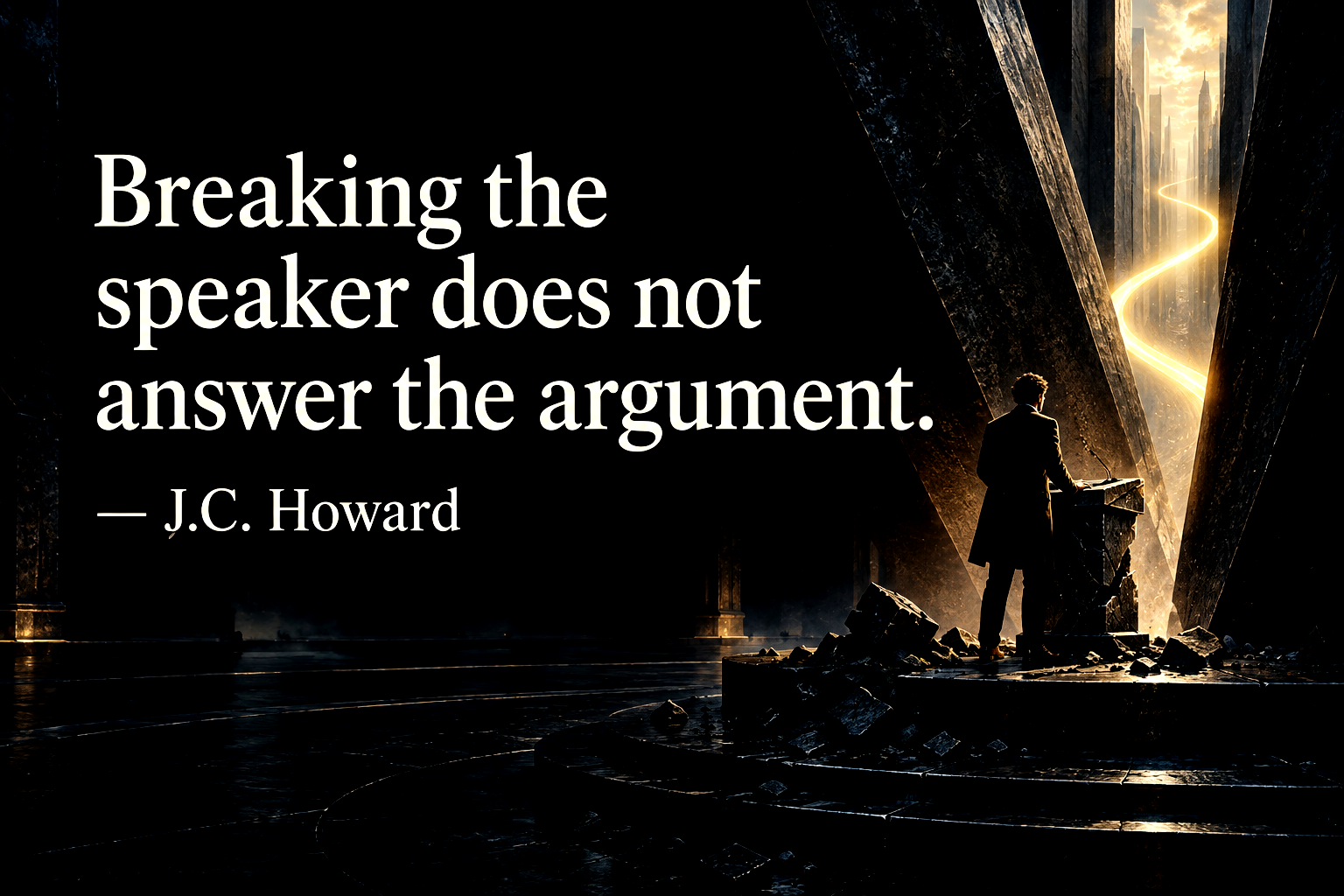
“Breaking the speaker does not answer the argument.” — J.C. Howard
Original essay
When Words Do Not Hold: Discernment, Grace, and the Danger of Rigidity
Not all words fail for the same reason.
Some words do not hold because they were careless.
Some do not hold because they were premature.
And some do not hold because the conditions surrounding them were hostile.
Discernment requires knowing the difference.
We often speak as though endurance is the only test of truth: if words collapse under pressure, they must have been false. But this assumption flattens reality. It confuses coherence with survivability and ignores the role of timing, safety, and formation.
Words are not abstract objects. They are carried by people. And people are shaped by conditions.
Sometimes words do not hold because they were not integrated. They were spoken before they had passed through behavior, consequence, or lived testing. In those cases, collapse reveals incoherence. Grace here looks like correction—inviting further formation before further speech.
Sometimes words do not hold because they were true but unfinished. Insight arrived faster than capacity. Language hardened before embodiment caught up. Under pressure, the structure fractured—not because the insight was wrong, but because it was announced before it could be carried. Grace here looks like patience, not dismissal.
And sometimes words do not hold because the environment was adversarial. Duress does not test truth; it tests safety. Words spoken in fear, surveillance, punishment, or threat may retract, distort, or disappear—not because they lack coherence, but because carrying them openly would destroy the carrier. Grace here looks like protection and restraint.
This is where judgment becomes complex.
Discernment is not the same as rigidity. Rigid people wait indefinitely for perfect certainty, additional permission, or further invitation before responding to what is already clear. They mistake delay for wisdom and silence for humility. In doing so, they sometimes avoid responsibility rather than honoring it.
Grace does not mean endless waiting.
There is a difference between allowing something to mature and refusing to engage at all. Discernment listens for coherence over time, but it also recognizes when waiting becomes avoidance—when the demand for more information is a way to avoid risk, accountability, or action.
So how do we judge?
Not by volume.
Not by confidence.
Not by speed.
We judge by patterns.
Does the person return to the same meaning when conditions change?
Does the language grow clearer, or merely louder?
Does the insight produce alignment between word and action, or fragmentation?
Does silence serve integration, or self-protection at the expense of truth?
Grace is required when formation is still happening. Accountability is required when avoidance sets in.
This is especially important in leadership and faith contexts. Some leaders speak too quickly and call it courage. Others delay indefinitely and call it discernment. Both can be failures of responsibility.
Wisdom lives between them.
Words that hold are not the ones spoken once and defended forever. They are the ones that survive revision without losing coherence. They deepen rather than calcify. They can be carried through disagreement, pressure, and change without turning brittle or evasive.
Grace, then, is not the absence of judgment.
It is judgment informed by conditions.
It asks: Was this collapse caused by incoherence, immaturity, or hostility?
It responds accordingly.
And it refuses the false binary that either everything must be declared immediately or nothing can be spoken until certainty is complete.
The task is not to announce everything.
And the task is not to wait forever.
The task is to carry words responsibly—long enough to test their coherence, gently enough to allow their formation, and courageously enough to speak when continued silence would itself become a failure.
That is how words come to hold.
Not through rigidity.
Not through haste.
But through discernment shaped by grace.
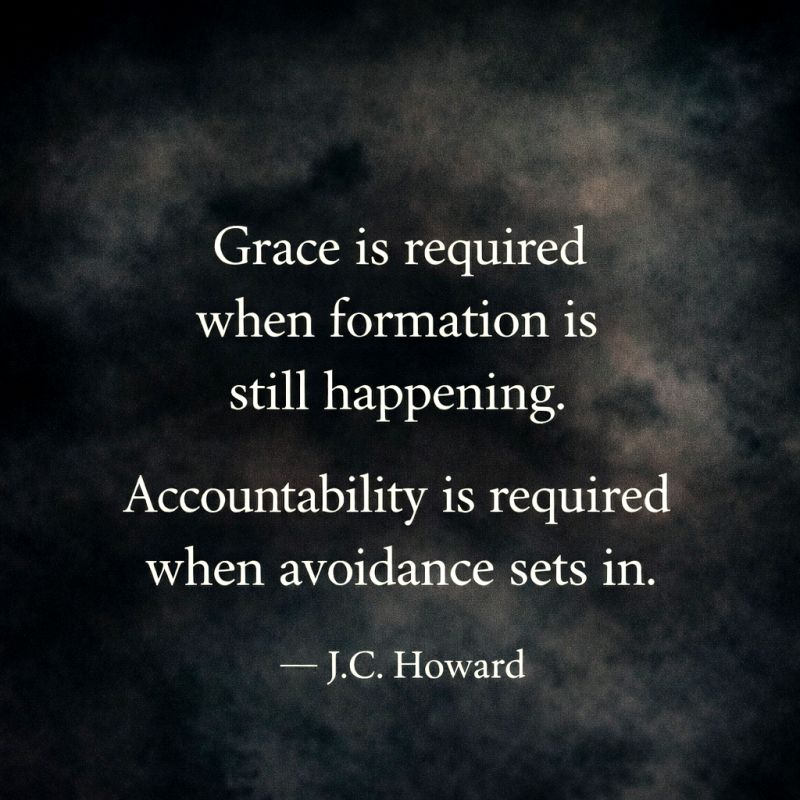
Original image from the Substack essay, retained in this edition.
When endurance becomes evidence
Further development of the original argument by J.C. Howard
Survivability–Truth Substitution
The question is not merely whether a person should speak. It is what we demand their speech must survive before we are willing to consider it. A statement may be tested by evidence. A speaker may also be tested by exhaustion, humiliation, repeated interruption, or the prospect of losing a place in the community. These tests can happen in the same room. They do not answer the same question.
I propose Survivability–Truth Substitution as a name for an error of judgment in which a speaker’s ability to keep articulating or defending a claim under prevailing social conditions is treated as a substitute for evaluating the claim’s evidence and reasoning.
The substitution occurs when “Can this person keep standing here?” quietly becomes “Was this person ever right?” It can also run in the other direction. The person who can afford to repeat a position indefinitely may acquire the appearance of credibility without supplying anything new to support it. Persistence can reflect conviction, resources, protection, or a refusal to reconsider. Withdrawal can reflect exhaustion, uncertainty, danger, or recognition of an error. Neither response interprets itself.
This is a proposed interpretive concept, not an established psychological diagnosis. Its purpose is to identify a misplaced inference. The concept asks us to examine what the claim rests on before treating the speaker’s endurance as the answer.
When the process produces the weakness it condemns
Consider a hypothetical employee who raises a concern. The employee is repeatedly interrupted, asked to defend several accusations at once, and warned that continuing could damage their future. Eventually, their account becomes less organized. The resulting confusion is then cited as the reason the concern should never have been taken seriously.
If those conditions contributed to the disruption, the process has helped produce the very weakness it now presents as independent evidence. The original concern still needs investigation. So does the process used to evaluate it. Research showing that acute stress can impair some executive functions makes this distinction plausible; it does not establish the cause of any particular person’s difficulty [3].
The same question belongs in a congregation, a family, or a public discussion. Did we examine the statement, or did we keep increasing the cost of expressing it until the person could no longer participate? Honest questions can expose errors. Threats can obstruct the examination. We need enough discipline to tell those activities apart.
Breaking the speaker does not answer the argument.
When the clock becomes the argument
A person can run out of time before an argument runs out of merit. When every unanswered claim is counted as a defeat, the clock begins doing the work that evidence should do. Discernment requires asking whether the response failed examination—or whether the conditions prevented examination from taking place.
Eugenie Scott calls the presentation of misconception after misconception, in a format that obstructs adequate scrutiny, the Gish gallop [8]. The problem is an overload of claims that exceeds the opportunity to examine them. Fast speech alone does not establish the tactic. A speaker may produce another assertion while the other person is still explaining what was wrong with the first. The exchange can reward accumulation while leaving the substance unresolved.
Brandolini’s law describes a related imbalance: correcting misinformation can require considerably more effort than producing it [9]. It is an aphorism about the unequal costs of assertion and correction, not a universal scientific law or a fixed numerical ratio. It helps explain why an unanswered statement may reflect the burden of responding rather than the strength of the statement.
My proposed Compression Advantage of Inherited Belief concerns a different source of advantage. A familiar position may arrive in rehearsed language that an audience already recognizes, while an unfamiliar argument still requires its premises and vocabulary to be explained. This advantage does not require deception, falsity, or an attempt to overwhelm. Neither inherited belief nor constructed thought is automatically more accurate. Familiarity can shorten an explanation without settling whether it is sound.
Survivability–Truth Substitution identifies the further mistake: treating the speaker’s ability to keep answering under those conditions as though it settled the claim. Needing more time does not establish correctness. Answering quickly does not establish superficiality. The question is whether the format provides a reasonable opportunity to examine the evidence. Limit the claims, allow clarification, and make room for a documented reply when the question cannot responsibly be settled in the time available. The demand for time must remain answerable to the same question as any other delay: what will the additional time make possible?
What this formulation adds
The larger territory already has a history. Miranda Fricker’s work on epistemic injustice examines how power and prejudice can harm people in their capacity as knowers [6]. Kristie Dotson analyzes practices of silencing and the vulnerability of speakers to failures in how they are heard [7]. Those contributions must be acknowledged rather than renamed as though they began here.
My formulation isolates one evaluative move within that territory: treating the outcome of a person’s struggle to remain audible as though it settled the merits of what they said. The claim’s accuracy, the speaker’s readiness, the conditions of reception, and the consequences of delay are separate questions. They influence one another, but one cannot simply stand in for all the others.
This distinction also protects the people being criticized. An allegation of hostility does not exempt a claim from scrutiny. Contradictions can matter. Evidence can disprove a conclusion. The error arises when the assessment stops with the person’s distress, disappearance, confidence, or persistence and treats that response as sufficient.
Who pays for waiting
Waiting is not equally expensive for everyone. A person with authority may call for patience while someone with less protection continues to carry the consequence. The meeting is postponed. The concern remains unresolved. The person asking for more time is not always the person paying for it.
Investigation takes time, and careless disclosure can cause real harm. Responsible delay therefore needs a purpose: something specific to examine, an explanation of what remains unknown, and a point at which the decision will be revisited. Where a credible risk calls for temporary protection, waiting should include a proportionate response while the facts are examined. Protection can be provisional without becoming a declaration of guilt.
Delay becomes ethically suspect when its stated purpose disappears and its practical effect is simply to preserve the existing arrangement. “We need more time” cannot explain itself forever. What did the additional time make possible? What changed? What cost continued accumulating while the decision remained suspended?
The silence of someone facing retaliation and the silence of someone empowered to prevent it cannot be judged without considering their different positions. Responsibility depends partly on what a person knew, what authority they held, and what action was available to them. A demand for courage that ignores those differences can become another way of transferring the burden to the least protected person.
A concern is not a verdict
There is more than one way to speak before certainty is complete. “I noticed something concerning” is a narrower statement than “I know who is responsible.” Asking for an examination does not make the same claim as announcing the result. The level of certainty required should be proportionate to what is being asserted and what the proposed response would do.
A responsible concern identifies the observation and leaves the inference visible. A public accusation carries a greater obligation to substantiate what it declares. An institution creates a dangerous choice when it demands a finished case before allowing anyone to raise a question: people are pressed to overstate what they know or to wait until the consequence has already arrived.
Imagine a pattern that might indicate a serious failure but might also have an ordinary explanation. One can preserve the observations, acknowledge both possibilities, and ask someone with the appropriate responsibility to examine them. That is speech with limits. It permits a response without pretending the investigation has already happened.
This is an ethical distinction, not a universal legal reporting standard. Specific roles can carry particular duties. Its broader principle is to speak at the level the evidence can support and match the response to the risk. Uncertainty should shape the claim we make, rather than automatically deciding that nothing can be said.
Revision that remains answerable
Returning to the same meaning can reveal conviction. It can also reveal a refusal to learn. A coherent explanation can still be wrong. The question is whether the explanation can answer what has been learned, rather than merely survive another repetition.
Responsible revision makes the movement visible: this is what I observed; this is what I inferred; this is what new evidence changed. It does not erase the earlier statement and pretend nothing happened. Neither does it require a person to defend an error merely to appear consistent.
Sometimes the central concern remains while the explanation changes. Sometimes the evidence requires abandoning the conclusion altogether. Both can be acts of integrity when the change is made openly and the consequences of earlier claims are addressed. Grace makes correction possible. Accountability makes correction answerable.
The responsibility of discernment
The framework must remain open to its own correction. To investigate Survivability–Truth Substitution, researchers could hold the evidence for a claim constant while varying information about the pressure placed on its speaker and the speaker’s response. They would need to distinguish the proposed effect from judgments about relevant inconsistencies, actual expertise, prejudice, and presentation. The name identifies a question worth examining; it does not supply the result.
For the person listening, the immediate responsibility is more ordinary. Examine the concern. Examine the conditions. Ask what further waiting is meant to accomplish. Make room for correction without making humiliation the price of being heard. The aim is judgment that can explain itself—to the person who spoke, to the person being judged, and to the people who will live with the consequence.
Research and interpretive notes
These notes add context to the original essay. The distinctions between correction, patience, and protection are an ethical framework, not a validated diagnostic test.
Conditions matter without deciding the verdict
The essay’s three explanations—incoherence, premature formation, and hostility—can overlap. A person can be mistaken and mistreated; a useful insight can arrive in language that needs revision. The sentence “Duress does not test truth; it tests safety” emphasizes the danger of treating survival under pressure as proof. It does not mean that every challenged statement is true, or that scrutiny is itself coercion. Retraction under threat establishes neither the truth nor the falsity of the original claim. Assess the evidence and the conditions of disclosure separately.
Safety and the learned cost of speaking
Edmondson’s study of 51 work teams found an association between psychological safety and learning behavior [1]. That supports attention to the setting in which people ask questions and acknowledge mistakes; it does not make safety a guarantee of accuracy. Detert and Edmondson’s four studies examined beliefs about when speaking upward is risky or inappropriate [2]. Such beliefs helped explain workplace silence and can persist beyond the circumstances in which they formed. Silence therefore requires inquiry: what consequence does this person anticipate, and what supports that expectation? Neither indifference nor present hostility can be inferred from silence alone.
Performance under pressure is not a truth test
A meta-analysis of 51 studies found that acute stress impaired working memory and cognitive flexibility on average, with more variable effects on inhibition [3]. These were cognitive-task findings, not a test of the truthfulness of people under interrogation. They support a narrower distinction: a person’s ability to organize or defend a statement can be affected by the moment in which that statement is demanded. Hesitation does not establish dishonesty, and fluency does not establish truth. A fair assessment still examines corroboration, alternatives, and the substance of the claim.
Accountability needs fair conditions
Lerner and Tetlock’s review found that accountability can reduce, preserve, or increase bias depending on its conditions [4]. Timing, the audience, and expectations about justification matter. Requiring reasons can support reflection; known audience preferences can encourage conformity, while demands to justify an existing commitment can encourage defensive explanations. The essay’s practical application is to ask for evidence, allow correction, and make the standard of judgment explicit. Protection from retaliation and responsibility for what one says can coexist.
Revision and conviction can coexist
Leary and colleagues linked intellectual humility with openness-related characteristics and, in one study, greater discrimination between stronger and weaker arguments [5]. This does not establish that every revision improves accuracy. The essay’s emphasis on coherence over time also needs a boundary: repetition can preserve an error. What matters is whether a person can explain what changed, respond to counterevidence, and distinguish confidence from certainty. A stable position is not necessarily true; a revised position is not necessarily unreliable.
Deciding when to speak
As a practical extension of the essay, distinguish reporting a concern from announcing a verdict. State what was observed, identify what remains uncertain, and choose a responsible recipient. Consider the consequences of speaking and waiting, and set a point at which the decision will be revisited. Confidentiality, incomplete evidence, and the need for a safer channel can justify delay. Indefinite waiting without a reason or review point can become avoidance. These questions apply the essay’s ethical argument; they are not a validated assessment scale. They permit action without demanding certainty or excusing overstatement.
References
[1] Edmondson, A. (1999). Psychological safety and learning behavior in work teams. Administrative Science Quarterly, 44(2), 350–383. Full article
[2] Detert, J. R., & Edmondson, A. C. (2011). Implicit voice theories: Taken-for-granted rules of self-censorship at work. Academy of Management Journal, 54(3), 461–488. Publisher record | Full-text copy
[3] Shields, G. S., Sazma, M. A., & Yonelinas, A. P. (2016). The effects of acute stress on core executive functions: A meta-analysis and comparison with cortisol. Neuroscience & Biobehavioral Reviews, 68, 651–668. Author’s full article
[4] Lerner, J. S., & Tetlock, P. E. (1999). Accounting for the effects of accountability. Psychological Bulletin, 125(2), 255–275. Author-provided full article
[5] Leary, M. R., Diebels, K. J., Davisson, E. K., Jongman-Sereno, K. P., Isherwood, J. C., Raimi, K. T., Deffler, S. A., & Hoyle, R. H. (2017). Cognitive and interpersonal features of intellectual humility. Personality and Social Psychology Bulletin, 43(6), 793–813. Publisher record and abstract
[6] Fricker, M. (2007). Epistemic Injustice: Power and the Ethics of Knowing. Oxford University Press. Publisher record
[7] Dotson, K. (2011). Tracking epistemic violence, tracking practices of silencing. Hypatia, 26(2), 236–257.
[8] Scott, E. C. (2004). Confronting creationism. Reports of the National Center for Science Education, 24(6), November–December. Author’s article
[9] Brandolini, A. [@ziobrando]. (2013). [Post introducing the bullshit asymmetry principle]. Twitter (now X). Original post
Source and edition note
The original essay and its image are preserved from the Substack newsletter record dated January 30, 2026 (UTC). Subscription prompts were removed; line wrapping, pagination, and the placement of the final period were normalized. The abstract, expanded argument, proposed concept, new quote image, research notes, references, and edition information are additions for this journal edition. The source heading, “When Words Do Not Hold: Discernment, Grace, and the Danger of Rigidity,” is retained. Survivability–Truth Substitution is introduced here as J.C. Howard’s proposed formulation, not as a claim of established historical priority or an empirically validated construct. This edition is an independent interdisciplinary essay, not a peer-reviewed research report.
Related reading: Finding Yourself: The God Continuum, by J.C. Howard.
Amazon book and preview | Apple Books
© 2026 J.C. Howard • The Golden Manifest Inc. • Version 1.0
License: CC BY-NC-ND 4.0 • Author ORCID: 0009-0008-3050-3617
Cite this essay. Howard, J. C. (2026). The Cost of Speaking Too Soon—and Waiting Too Long: How discernment fails without grace. The Golden Manifest Journal, 1(Essay 57), 1–8. .