Editorial abstract
Using the army-ant mill as a governing metaphor, this essay examines how individually sensible acts of following can produce collectively destructive patterns. Howard distinguishes information from verification and argues that repetition, confidence, and apparent consensus can become mutually reinforcing without establishing truth. McCarthyism and the 2008 financial crisis serve as historical illustrations of systems in which shared assumptions traveled faster than adequate scrutiny.
Conceptual status: “The human ant mill” is a philosophical and social metaphor, not a claim that human cognition is biologically equivalent to ant behavior. The essay's psychological core is adjacent to established research on the illusory-truth effect, processing fluency, social learning, information cascades, and self-organizing feedback. Its claim concerns perceived and socially operative reality—not the proposition that belief determines objective truth.
Every civilization has believed things that later generations would consider obvious mistakes.
Every generation quietly assumes it will be the exception.
We study McCarthyism and wonder how suspicion became evidence.
We examine the financial crisis of 2008 and ask why so few people questioned assumptions that now seem so obvious.
History repeatedly confronts us with the same uncomfortable question:
How can so many intelligent people become so confidently wrong?
Perhaps the better question is this:
What if intelligence was never the problem?
The Ant Mill
Biologists have observed a remarkable phenomenon among army ants.
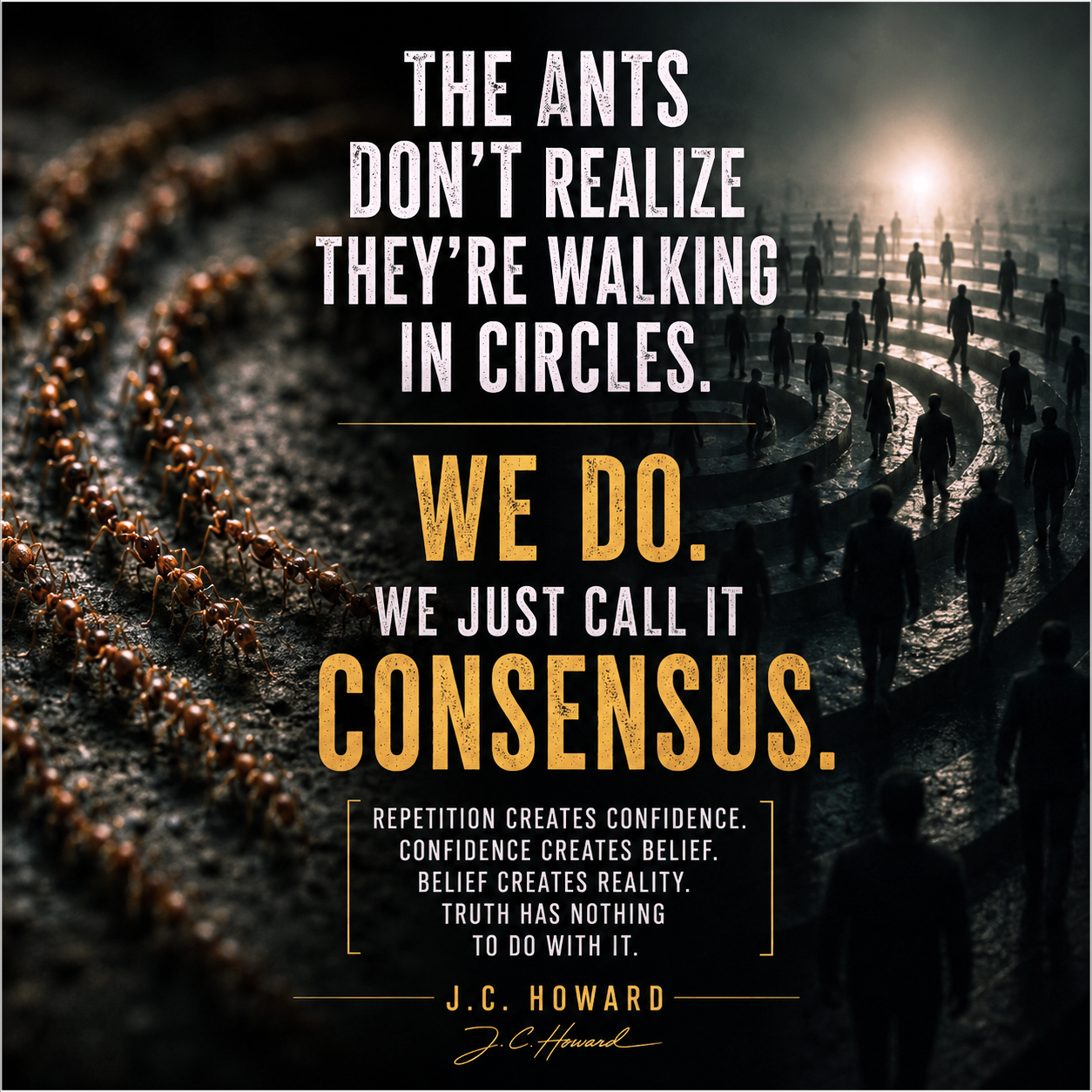
Under certain conditions, thousands of ants begin following one another in a continuous circle. Each ant faithfully follows the pheromone trail left by the one ahead. No individual ant is attempting to deceive the colony. Every ant is simply responding to the information immediately available.
The result is an ant mill—a death spiral.
The ants continue marching until they collapse from exhaustion.
The tragedy is not that one ant made a mistake.
The tragedy is that every ant continually reinforced the mistake made by the others.
Local signals
Army-ant movement can self-organize through repeated interactions and sensitivity to trail pheromones, without central direction.
Familiarity
Repeated statements are often processed more fluently and judged as more truthful—even when relevant knowledge is available.
Social reinforcement
Observing others can aggregate information, but it can also produce fragile cascades in which later decisions repeat earlier ones instead of adding independent evidence.
The Difference Between Information and Verification
Human beings like to believe we are fundamentally different.
We assume our intelligence protects us from similar patterns.
History suggests otherwise.
One of the greatest misconceptions of the Information Age is that more information naturally produces better understanding.
It doesn’t.
Information and verification are not the same thing.
Today we have access to more information than any generation before us. Search engines, podcasts, artificial intelligence, social media, books, documentaries, and twenty-four-hour news cycles place nearly limitless information at our fingertips.
Yet abundance creates a new problem.
When information becomes limitless, verification becomes harder rather than easier.
The Illusion of Consensus
We rarely ask whether something is true.
More often, we ask whether enough people believe it.
That distinction matters.
When multiple people repeat the same claim, we instinctively become more confident.
When numerous websites publish the same story, we assume independent confirmation.
When someone speaks with certainty, we confuse confidence with evidence.
Sometimes those assumptions are justified.
Sometimes they are not.
Repetition can explain popularity.
It cannot establish truth.
Feedback Loops
The ant mill reveals something profound about complex systems.
Systems do not always require malicious participants to produce harmful outcomes.
Sometimes sincere individuals simply reinforce one another.
History is filled with examples.
During McCarthyism, suspicion often spread faster than verification.
Before the financial crisis of 2008, confidence in the housing market became so widespread that questioning its assumptions seemed unnecessary.
Neither example demonstrates a lack of intelligence.
Both demonstrate how systems can amplify confidence long before they establish certainty.
The more frequently a belief is repeated, the more repetition itself begins to feel like evidence.
The Real Challenge
Perhaps information literacy has never been about finding information.
Perhaps it has always been about managing belief.
It requires asking where an idea originated instead of simply asking who repeated it.
It requires distinguishing evidence from opinion.
It requires recognizing when multiple voices are merely echoing the same source.
Most importantly, it requires the humility to proportion our confidence to the quality of the evidence rather than the familiarity of the conclusion.
Conclusion
The ants never realize they are walking in circles.
Every step convinces them they are moving in the right direction because every other ant appears to agree.
We often assume humanity is too intelligent to make the same mistake.
History suggests otherwise.
Perhaps the defining question of our time is not whether we have access to enough information.
It is whether we possess the discipline to determine which information deserves our trust.
Because ideas do not become true simply because they survive.
They often survive because they are repeated.
Which leaves me with one final question.
How do we know when consensus reflects independent verification—and when it is only the circle repeating itself?
— J.C. Howard
Scholarly context & references (editorial apparatus)
These sources support the biological phenomenon, psychological mechanisms, and historical examples surrounding the essay. They do not prove that every consensus is false, that repetition always persuades, or that human groups function exactly like ant colonies.
Brief scholarly positioning
- Self-organization
- Army-ant raid patterns can emerge from many local interactions rather than central control. Circular-mill experiments connect movement to trail-pheromone strength.
- Illusory truth
- Repeated claims tend to receive higher truth ratings than new claims. The best current synthesis describes the average effect as small but robust and meaningfully variable across conditions.
- Knowledge limits
- Experimental work found that relevant knowledge did not always protect participants from repetition-based truth judgments.
- Information cascades
- Social learning can aggregate dispersed knowledge, but it can also produce fragile and inaccurate mass behavior when observing others replaces independent information.
- Historical scale
- Official records support the essay's two examples while also showing that each involved more than repetition alone: political fear and institutional power in McCarthyism; incentives, leverage, regulation, risk management, and opacity in the financial crisis.
- Schneirla, T. C. (1944). “A Unique Case of Circular Milling in Ants, Considered in Relation to Trail Following and the General Problem of Orientation.” American Museum Novitates, no. 1253, 1–26. This early scientific treatment documented circular milling and analyzed it in relation to trail following and orientation. American Museum of Natural History record. Record verified September 6, 2026.
- Franks, N. R., Gomez, N., Goss, S., & Deneubourg, J. L. (1991). “The Blind Leading the Blind in Army Ant Raid Patterns: Testing a Model of Self-Organization.” Journal of Insect Behavior, 4, 583–607. Field analyses and circular-mill experiments linked army-ant running velocity to trail-pheromone strength and described raid structure as an emergent product of worker interactions rather than central administration. Publisher record. . Link and abstract verified September 6, 2026.
- Fazio, L. K., Brashier, N. M., Payne, B. K., & Marsh, E. J. (2015). “Knowledge Does Not Protect Against Illusory Truth.” Journal of Experimental Psychology: General, 144(5), 993–1002. The experiments found that repeated statements were processed more fluently and judged as more truthful, including cases in which participants possessed the relevant knowledge. PubMed record. . Link and abstract verified September 6, 2026.
- Ye, S., Attali, D., Ghazi, M., Cachia, A., Cassotti, M., & Borst, G. (2026). “Systematic Review and Meta-Analysis of the Evidence for an Illusory Truth Effect and Its Determinants.” Nature Communications, 17. Synthesizing 182 studies and 366 effect sizes, the authors reported a small but robust repetition-induced increase in perceived truth after correction for publication bias, while emphasizing substantial heterogeneity and boundary conditions. Publisher record. . Link and content verified September 6, 2026.
- Bikhchandani, S., Hirshleifer, D., Tamuz, O., & Welch, I. (2024). “Information Cascades and Social Learning.” Journal of Economic Literature, 62(3), 1040–1093. The review explains how learning from others can aggregate information but can also generate inaccurate decisions, fragile mass behavior, and cascades that block further learning. American Economic Association record. . Link and abstract verified September 6, 2026.
- United States Senate Historical Office. “A Declaration of Conscience.” The Senate's history recounts Margaret Chase Smith's growing skepticism after Joseph McCarthy repeatedly ignored requests for evidence supporting his accusations, alongside the fear that inhibited other senators from speaking. U.S. Senate record. Link and content verified September 6, 2026.
- Financial Crisis Inquiry Commission. (2011). The Financial Crisis Inquiry Report. Official Government Edition. The Commission identified a housing bubble fueled by low interest rates, easy credit, scant regulation, and toxic mortgages; it also documented leverage, failed risk management, opacity, and interconnected institutions. This supports the essay's critique of normalized assumptions while cautioning against treating consensus as the crisis's sole cause. Official report. Report verified September 6, 2026.
Publication history
Howard, J. C. “The Human Ant Mill.” Substack, July 12, 2026. Original source: yourpropheticscribe.substack.com/p/the-human-ant-mill. The title, subtitle, publication date, prose, and image were verified from the recovered newsletter record.
What changed for this journal edition
The original prose and image are preserved. Newsletter subscription and unsubscribe material were removed. The editorial abstract, conceptual-boundary note, research mechanism brief, scholarly positioning, source annotations, display headings, and expanded image alternative text were added for clarity, credibility, accessibility, and archival context. During author review, the incomplete closing sentence was resolved with a final question that follows the essay's argument. Journal version 1.0 is archived under DOI .