Editorial abstract
Howard examines the moment when persistent effort stops functioning as evidence of faith and becomes a way of normalizing a structurally blocked path. By juxtaposing biblical calls to perseverance with biblical language of rest, then turning to cognitive dissonance and Euler’s Königsberg bridge problem, the essay reframes repeated failure from personal insufficiency to a question about which routes a system can actually permit.
Evidence status: the cited biblical texts establish distinct calls to perseverance, action, trust, and rest, but they do not supply a universal decision rule for when to persist or disengage. Psychological research supports bounded claims about dissonance, belief perseverance, and adaptive goal adjustment; it cannot diagnose a person’s theology or determine whether a particular life goal is impossible. Euler’s result establishes impossibility for a formally specified graph. Its application to relationships, careers, and spiritual systems is an illuminating analogy, not mathematical proof about those domains.
There’s a point where effort stops feeling honest and starts feeling confusing. Not because you’ve stopped believing, but because nothing is moving the way it should. You keep showing up, staying disciplined, praying, adjusting, trying again, and still the outcome does not change. Not delayed, not developing, just unmoved. That is where the question begins to shift. Not “What else should I do?” but “What if this doesn’t work, not because I’m failing, but because it can’t?”
I was not taught to ask that question. I was taught to hold on. To wait on the promise, to believe that those who wait will mount up with wings like eagles, to not grow weary in well doing. So I stayed longer than I should have, because letting go did not feel like wisdom. It felt like unbelief. But at the same time, I kept hearing something else. Come unto me, all who labor and are heavy laden, and I will give you rest. My yoke is easy, my burden is light. There remains a rest for the people of God. Enter that rest. These were not abstract ideas. They were direct statements, and they did not describe a life of constant internal strain.1
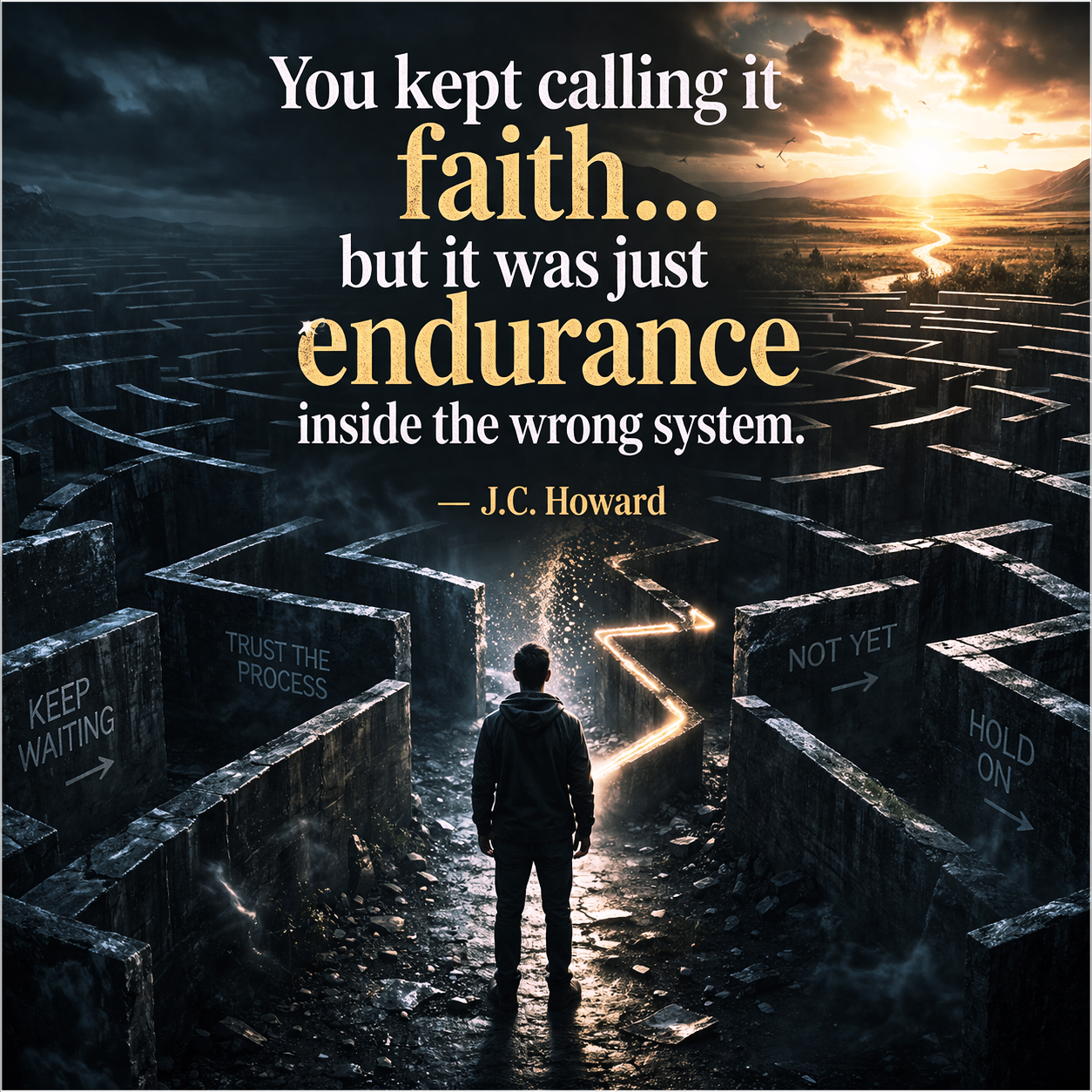
That is where the tension started to surface. Keep pushing, but stop striving. Faith without work is dead. Wait patiently, but act with urgency. Hold on, but let go. Individually, these ideas sound balanced. Lived out over time, they can become a contradiction that never resolves. What begins as faith slowly turns into tension that you learn to normalize.
There are responses to this, and I understand them because I have made them myself. Some will say this is timing, that delay is not denial, that God is developing something deeper. Others will say rest is internal, that nothing around you has to change, that you are meant to stay in the same situation while learning peace within it. And then there is the strongest argument, provision. Moments where something came through, doors opened, needs were met in ways that felt precise and real. I have experienced that. Not imagined, not forced, real.
That is why this cannot be dismissed as simple bias. But it also creates a deeper tension. Because the same framework that explains provision also explains absence. If something happens, it is God. If it does not happen, it is still God. If the door opens, it is divine. If it stays closed, it is divine timing. If you feel peace, it confirms alignment. If you feel strain, it confirms testing. At that point, the system stops being accountable to outcomes. It becomes self-sealing.
Psychology has language for this. Cognitive Dissonance describes the tension that comes from holding conflicting realities at the same time. Leon Festinger showed that when people are deeply invested in a belief, they do not easily abandon it when outcomes fail. They reinterpret the outcome instead. Not because they are irrational, but because the system has already shaped how they process what is happening.2, 3
This does not mean the experience was not real. It means the interpretation may not be complete.
There is a concept in math that reflects this in a way that is almost uncomfortable in its simplicity. The Konigsberg Bridge Problem asked whether someone could cross every bridge in a city exactly once. It looked possible. People kept trying different paths, assuming effort or strategy would eventually solve it. But Leonhard Euler showed that the issue was not effort. It was structure. The arrangement of the bridges made the outcome impossible. Not difficult, impossible. Every path would fail, not randomly, but consistently.4
That insight became foundational to Graph Theory, which studies how points and connections interact within a system. In simple terms, it is about what paths actually exist. A maze makes this clear. You can move freely, make choices, keep going, but the layout still determines where you can go and whether the outcome you want is even possible. Movement does not guarantee arrival.
That is where this stops being about math. Because the same pattern shows up in life. You can invest years into a relationship, communicate, grow, become more patient and self aware, and still never reach alignment. Not because you failed, but because the structure was never built for it. You can build a five year plan, execute it with discipline, and still feel like you are circling the same place because the framework cannot produce the outcome you imagined.
A simple example makes this clearer. Trying to sell an antique car at a regular dealership may result in little or no offer. Not because the car has no value, but because the system is not designed to recognize it. In a different environment, like a collector’s market, the same car could be valued completely differently. The value did not change. The system did.
At some point, effort stops being the explanation, and structure becomes the question. Not “Do I have enough faith to keep going?” but “Is this even built to produce what I am expecting?” That question is uncomfortable because it shifts responsibility away from effort and toward alignment.
This is where the tension between striving and rest becomes real. If rest is real, then not everything is meant to be forced. If alignment exists, then not every path leads to it. And if certain outcomes are structurally blocked, then continuing to strive within them is not always faith. Sometimes it is misalignment that has been given spiritual language.5
The path you are looking for might not exist. Not because you missed it, not because you did not try hard enough, but because it was never there within the structure you were taught to trust.
And if that’s true, then the real question is not whether you can endure it… but why you were told to
Biblical, psychological & mathematical context (editorial apparatus)
These sources establish the texts, mechanisms, and formal result adjacent to Howard’s argument. They do not adjudicate a faith tradition, diagnose any person, or establish structural impossibility in a life situation.
- The Holy Bible, New Revised Standard Version Updated Edition. Primary texts invoked or relevant to the essay include Isaiah 40:31; Galatians 6:9; Matthew 11:28–30; Hebrews 4:9–11; and James 2:17. The journal distinguishes each passage’s textual setting from the author’s theological synthesis.
- Leon Festinger, A Theory of Cognitive Dissonance. Introduces a theory of psychological pressure arising from inconsistent cognitions and responses that may reduce that pressure. Stanford University Press, 1957.
- Leon Festinger, Henry W. Riecken, and Stanley Schachter, When Prophecy Fails. A participant-observation account of one small apocalyptic group’s responses to a disconfirmed prediction; used here as a bounded historical case rather than a universal model. University of Minnesota Press, 1956. See also Lee Ross, Mark R. Lepper, and Michael Hubbard, “Perseverance in Self-Perception and Social Perception,” Journal of Personality and Social Psychology 32, no. 5 (1975): 880–892. .
- Leonhard Euler, “Solutio problematis ad geometriam situs pertinentis.” Euler’s treatment of the Königsberg bridge problem, presented in 1735 and printed in Commentarii academiae scientiarum Petropolitanae 8 (1741): 128–140. Original paper. The journal uses modern graph terminology to state the result precisely.
- Carsten Wrosch, Michael F. Scheier, Gregory E. Miller, Richard Schulz, and Charles S. Carver, “Adaptive Self-Regulation of Unattainable Goals.” Three studies examining associations among goal disengagement, goal reengagement, and subjective well-being. . Personality and Social Psychology Bulletin 29, no. 12 (2003): 1494–1508.
Citation
Cite this essay
Howard, J. C. (2026). “The Path You’re Looking For Might Not Exist.” (Version 1.0). The Golden Manifest Journal. .