Editorial abstract
Howard argues that some Christian interpretive systems convert suffering into self-confirming evidence: discomfort becomes testing, disagreement becomes persecution, and endurance becomes proof of righteousness. The essay traces how this inversion can make a belief system resistant to correction and can organize both personal identity and group reinforcement around recurring storms.
Evidence status: cognitive-dissonance theory, social identity theory, social learning, system-justification theory, and religious-coping research offer established concepts adjacent to Howard’s analysis. They do not demonstrate that Christianity as a whole perpetuates suffering, that belief constructs external reality, or that witnessing another person’s hardship necessarily validates a congregation’s worldview. The essay addresses “certain expressions of Christianity”; its broader causal and theological conclusions remain interpretive.
Most systems try to escape discomfort. They reduce it, medicate it, distract from it—because discomfort means something is off. It signals misalignment. It exposes contradiction. It forces you to stop and ask whether what you’re experiencing actually matches what you’ve been told is true. That’s how systems correct themselves.
But not all systems want correction. Some survive by redefining the signal itself.
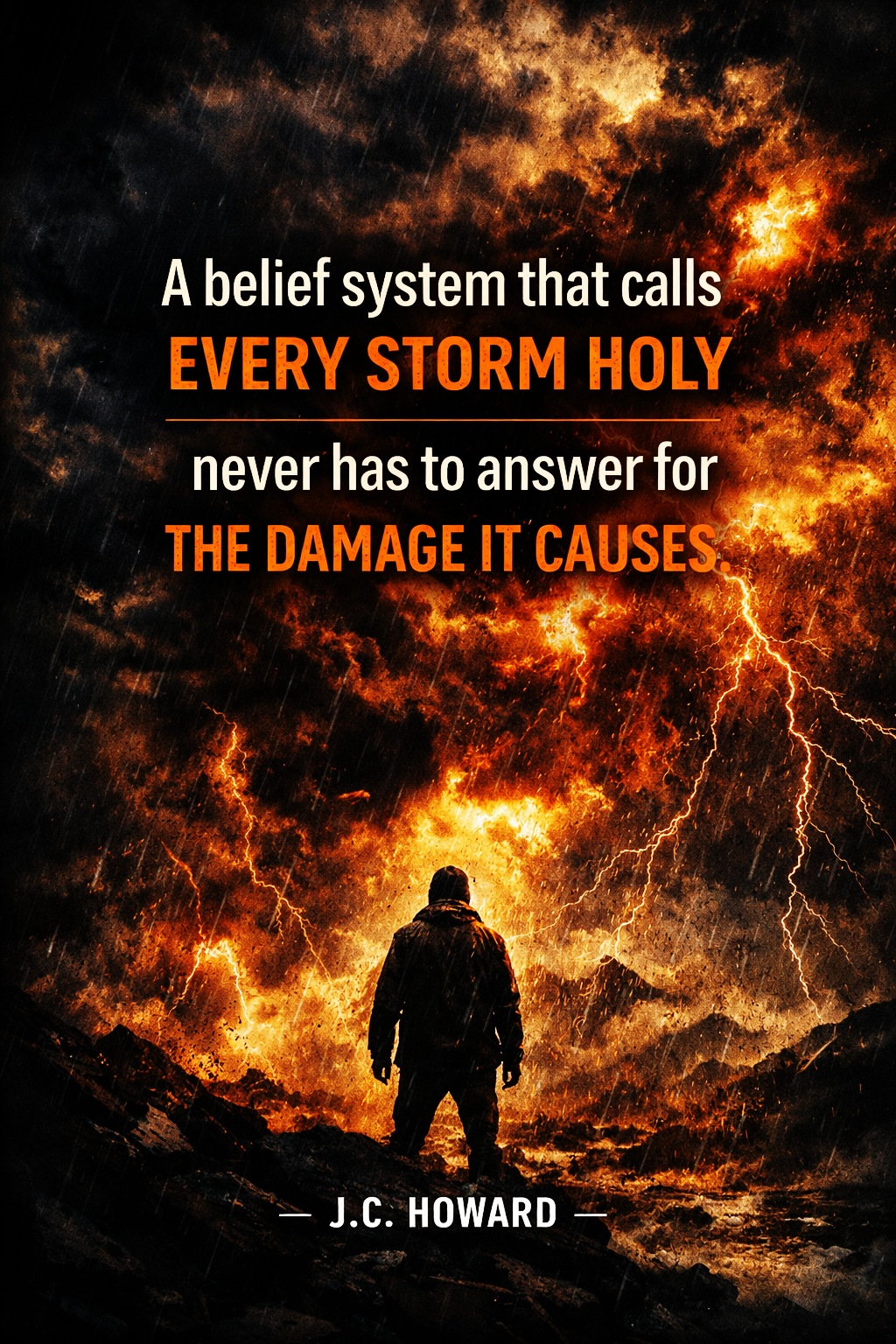
Within certain expressions of Christianity, suffering isn’t just endured—it’s glorified. It’s given meaning before it’s ever examined. Pain becomes purpose. Internal conflict becomes conviction. And storms—real emotional, psychological, and existential storms—are no longer something to understand, but something you are told to walk into, remain in, and prove something through.
You are told to stand in the storm, to rejoice in it, to trust that the intensity itself is evidence that something divine is happening. When it intensifies—when it feels like something is pressing against you, opposing you, closing in—you are given an explanation: the devil is attacking you, which must mean you are doing something right. That interpretation shifts the entire framework. The question is no longer why this feels wrong, but how to endure it better.
From that point forward, the signals begin to invert. Discomfort is no longer treated as misalignment, but as testing. Resistance is no longer contradiction, but spiritual opposition. Pressure is no longer something to examine, but something to push through. Even correction from others is not received as reflection, but reframed as persecution. What could have led to awareness becomes something to overcome.
Now the storm is no longer something to read—it is something to survive. And survival becomes proof of alignment.
There are scriptures that reinforce this framework, and they are often repeated without tension. James writes to “count it all joy” when facing trials (James 1:2–3). Peter tells believers not to be surprised by the “fiery trial” but to rejoice in it (1 Peter 4:12–13). Paul states that “we glory in tribulations” because they produce endurance (Romans 5:3–4). On their own, these passages can speak to resilience and growth through adversity. But when interpreted within a closed system, they can normalize suffering to the point that it is no longer questioned.1, 7
At that point, the storm no longer raises suspicion—it confirms alignment. The more intense it becomes, the more convinced a person is that they are exactly where they are supposed to be. The more resistance they feel, the more they believe they are being opposed for a reason. Because if the enemy is attacking, it must mean they are aligned.
This creates a closed-loop system.
Psychologically, this aligns with cognitive dissonance—the tension that arises when beliefs and experiences do not match (Festinger, 1957). In most cases, that tension leads to reevaluation. But when discomfort is reframed as something sacred, the dissonance does not lead outward into questioning. It drives inward into deeper commitment. The individual does not adjust the belief—they reinforce it.2, 3
This is further supported by the way identity forms within groups. Social identity theory explains how individuals create stability by distinguishing between in-groups and out-groups (Tajfel & Turner, 1979). When a belief system becomes central to identity, any challenge to that system feels like a personal threat. As a result, resistance is not interpreted as correction—it is interpreted as opposition.4
And this is where the structure deepens.
Because the storm is no longer just reinterpreted—it begins to be sustained.
Scripture itself points to something far more powerful than most are willing to confront—the ability of belief to shape what is experienced. The renewing of the mind, the authority of what is spoken, the insistence that faith moves and forms reality (Romans 12:2; Mark 11:23). These are not passive ideas. They don’t just influence perception—they construct it. And when those same principles are filtered through a system that expects opposition, they don’t calm the storm—they give it structure. What is believed begins to take form. What is spoken begins to solidify. And the storm is no longer just something encountered… it becomes something sustained.1
If a person is conditioned to expect opposition, they begin to perceive it everywhere. If they are taught that resistance is spiritual warfare, then disagreement becomes attack. If correction is framed as persecution, then no external input can be trusted. The system becomes self-sealing.
Now it is no longer:
“Something here might be off.”
It becomes:
“I am being opposed because I am right.” “I am annointed.”
“The devil is attacking me.”
Which, in this framework, confirms alignment rather than questions it.
At that point, the storm no longer needs to come from outside. It is sustained internally—through interpretation, expectation, and reinforcement. An identity begins to form around it: the tested, the misunderstood, the persecuted. And once that identity takes hold, every contradiction feels like validation, every challenge feels like proof, and every external voice becomes part of the storm itself.
This is where the system becomes self-sustaining.
The more pressure a person feels, the more certain they become. The more conflict they experience, the more validated they feel. The more isolated they become, the more it confirms that they are chosen. What should function as a warning becomes confirmation.
Not all suffering is meaningless. Difficulty can produce growth, and hardship can reveal truth. But not all suffering is sacred. Some of it reflects misalignment. Some of it reveals contradiction. And some of it is the result of being taught to override internal signals long enough that the difference can no longer be recognized.7
There is another layer that rarely gets acknowledged—the system doesn’t just sustain storms within individuals, it depends on them across the group. Even those who are not currently in a storm still rely on others to be. The suffering of others becomes reinforcement. It becomes evidence that the framework is real, that the testing is active, that the narrative still holds.
Psychologically, this is not accidental. Systems are maintained not only through personal experience, but through observation and shared identity. When one person is “under attack,” it reinforces the belief for everyone else. When someone is “going through trials,” it becomes proof that the system is functioning as expected. The storm doesn’t have to be yours—it just has to exist (Bandura, 1977; Jost & Banaji, 1994).5, 6
And because of that, the system never runs out of validation.
There is always someone struggling.
Always someone being tested.
Always someone in the fire.
Which means the belief never has to stand on its own.
And that is the final layer.
Not just enduring the storm. Not just calling the storm sacred. But needing the storm—because without it, the entire structure begins to collapse, and the questions that were avoided can no longer be ignored.
Psychological & scriptural context (editorial apparatus)
These sources clarify the constructs invoked by Howard and the limits of what they establish. They do not diagnose a reader or congregation, and they do not adjudicate the truth of any religious belief.
- The Holy Bible, New Revised Standard Version Updated Edition. Passages discussed or echoed in the essay include James 1:2–3; 1 Peter 4:12–13; Romans 5:3–4; Romans 12:2; and Mark 11:23. The journal distinguishes these primary texts from Howard’s interpretation of how they may function within a closed system.
- Leon Festinger, A Theory of Cognitive Dissonance. Develops the theory that inconsistency among cognitions creates pressure that people are motivated to reduce. Stanford University Press, 1957.
- Leon Festinger, Henry W. Riecken, and Stanley Schachter, When Prophecy Fails. A field study of how one small millenarian group responded after a predicted catastrophe did not occur. Its specific case is relevant to belief-preserving reinterpretation, but it cannot be generalized to Christianity as a whole. University of Minnesota Press, 1956.
- Henri Tajfel and John C. Turner, “An Integrative Theory of Intergroup Conflict.” Introduces a social-identity account of categorization, group membership, comparison, and intergroup differentiation. In William G. Austin and Stephen Worchel, eds., The Social Psychology of Intergroup Relations, 33–47. Brooks/Cole, 1979.
- Albert Bandura, Social Learning Theory. Develops a framework in which behavior and expectations can be acquired through observation, modeling, and vicarious consequences. Prentice Hall, 1977.
- John T. Jost and Mahzarin R. Banaji, “The Role of Stereotyping in System-Justification and the Production of False Consciousness.” Proposes system justification as psychological processes contributing to the preservation of existing social arrangements, even at personal or group cost. . British Journal of Social Psychology 33, no. 1 (1994): 1–27.
- Kenneth I. Pargament et al., “Patterns of Positive and Negative Religious Coping with Major Life Stressors.” Distinguishes forms of religious coping and reports that different patterns can relate differently to adjustment; it does not classify suffering itself as sacred or pathological. . Journal for the Scientific Study of Religion 37, no. 4 (1998): 710–724.
Citation
Cite this essay
Howard, J. C. (2026). “Why Christian Systems Perpetuate Suffering to Reinforce Righteousness.” (Version 1.0). The Golden Manifest Journal. .