Editorial abstract
Howard argues that Christian communities can turn marriage from covenant into compliance when spiritual belonging, gender hierarchy, sexuality, and institutional reputation are tied to marital permanence. Moving through bounded research on intimate partner violence, clergy-spouse divorce, purity culture, post-religious distress, and gender attitudes, the essay contends that pastoral credibility requires placing truth and safety ahead of preserving an ideal.
Evidence boundary: the cited research supports contextual and associational claims rather than a universal causal theory. This is an independent interdisciplinary essay and has not been peer reviewed.
The Church rarely says, “We weaponize marriage.” It doesn’t have to. It only has to make marriage feel like spiritual oxygen—so that the moment someone struggles, questions, separates, or leaves, they don’t just fear losing a relationship. They fear losing God, community, identity, and safety all at once.
That is how weaponization works. Marriage becomes less a freely lived covenant and more a leverage point—an institutional pressure system used to regulate behavior.
When I say weaponized, I mean marriage is used as a tool of control: through shame, stigma, gendered obligation, surveillance, and spiritual threat. Not every church does this. Traditional theology is not automatically abusive. Commitment is not coercion. Accountability is not domination. But a sacred ideal becomes dangerous when protecting the institution matters more than protecting the person inside it.
Religion is not a one-directional force in this story. Faith can provide meaning, courage, community, and language for resisting abuse. It can also be manipulated to delay disclosure, intensify shame, or keep harm hidden. Romina Istratii and Parveen Ali’s 2023 scoping review in the Journal of Psychology and Theology examined scholarship on intimate partner violence and faith-based responses across community and counseling settings. Their review does not prove that religion causes violence. It shows why context matters: religious beliefs, leaders, and communities may either reinforce harmful dynamics or become resources for safety and recovery.
That double capacity is the issue.
The weaponization starts long before a wedding.
Many churches construct a moral hierarchy where singleness is treated as deficiency and marriage as spiritual completion. If you are unmarried, you become a project—someone to fix, guide, or monitor. If you are married, you become proof. Marriage turns into social capital.
Once that economy exists, honesty carries risk. A struggling couple is no longer merely confronting pain; they may feel they are threatening a testimony, a ministry, a family identity, or an entire community’s moral narrative. Silence can begin to look like faithfulness because visibility feels dangerous.
Then theology enters as reinforcement.
In churches that promote rigid gender roles, marriage can become the delivery system for hierarchy. Authority is sanctified. Power imbalances are baptized as “order.” Responsibility flows downward while control flows upward.
That claim needs precision. Clarke, Wendt, and Mayer did not demonstrate that Christian doctrine, by itself, causes domestic and family violence. Their 2024 study, published in Violence Against Women, analyzed theological, policy, and public documents from the Lutheran Church of Australia. The authors identified both reforms intended to address violence and contested positions concerning gender, authority, marriage, and institutional responsibility. Their work is a focused case study, not a verdict on Christianity as a whole.
But the case study reveals the mechanism worth examining: where authority receives theological emphasis while equality, consent, and accountability remain ambiguous, institutional preservation can outrank individual safety. The same religious tradition may contain resources that enable abuse, resources that resist it, and communities struggling over which interpretation will govern practice.
This is where marriage can become a closed loop: the institution defines the structure, interprets resistance to the structure, and then treats that resistance as rebellion rather than discernment.
Divorce becomes the next pressure point.
In many church cultures, divorce is framed less as grief and more as failure. That framing can affect whether people disclose marital problems, whom they trust, and when they seek support. The point is not that every teaching about marital permanence produces silence. The point is that permanence becomes coercive when it is treated as a higher good than truth, consent, or safety.
A 2025 mixed-methods study by Lisa Oakley and colleagues examined the experiences of divorced and separated Christian clergy spouses in the United Kingdom. Twenty-seven people completed a survey and thirteen participated in follow-up interviews. This was a small, specialized sample—mostly women and largely connected to Anglican contexts—so it should not be generalized to every marriage or denomination.
Within that sample, however, expectations that clergy marriages should be exemplary acted as barriers to disclosure. Participants described unmet pastoral needs, isolation, and the loss of both marriage and church community. The study’s strongest lesson is not that every church abandons divorced people. It is that an institution’s public ideal can make private truth more expensive.
This is more than a pastoral mistake. It is a system of incentives.
Stigma does not need a locked door. Anticipated exclusion can do the work. When telling the truth may cost a person relationships, status, ministry, housing, or spiritual identity, silence can become a strategy for survival.
Then comes sexuality.
Some churches spend years conditioning people to associate desire with danger, bodies with shame, and purity with worth—then expect marriage to reverse that conditioning immediately. The wedding is treated like a switch: yesterday desire was contamination; today it is obligation.
That is not how learned shame works.
Clinical and emerging academic literature on purity culture describes associations with sexual shame, distress, avoidance, and difficulty integrating desire with personal values. But the evidence base is still developing, and public-facing clinical commentary is not the same as a controlled empirical study. The responsible claim is narrower: fear-based sexual formation can persist after marriage, and marriage alone does not automatically resolve it.
Marriage becomes weaponized again when it is presented first as the only approved container for sexuality and then as the arena in which individuals are blamed when intimacy does not function according to expectation.
The darkest form of weaponization appears when marriage is used to trap people.
When institutions treat marriage as untouchable, it can become a shield for abuse. Forgiveness language turns coercive. Restoration language overrides safety. Internal handling replaces accountability. Reconciliation is demanded before responsibility is established.
Religious leaders can also become part of the solution. The research reviewed by Clarke and colleagues describes the value of trained leaders, referral to specialist services, survivor-centered responses, and faith communities capable of supporting accountability and recovery. The contrast matters. The question is not whether religion is present. The question is what the community’s theology permits people to name, what its practices protect, and whose safety controls the response.
No pastor, counselor, spouse, or congregation should confuse reconciliation with containment. Reconciliation cannot substitute for immediate safety, independent professional support, lawful accountability, or a person’s right to leave danger. A marriage is not preserved when one person must disappear inside it.
Psychologically, coercive spiritual environments may leave people with shame, self-doubt, grief, and conflict between their moral convictions and demands presented as divine authority. These experiences are sometimes discussed under overlapping terms such as spiritual or religious abuse, religious trauma, and moral injury. The terms are related but not interchangeable. “Moral injury” concerns distress associated with violating, witnessing, or being betrayed around deeply held moral commitments; “religious trauma” is a broader and still-developing clinical concept; “spiritual abuse” names the misuse of spiritual authority, beliefs, or practices to control or harm.
Precision matters because language can clarify suffering—or turn it into another doctrine people are expected to accept without question.
Public-facing psychological discussions, including the American Psychological Association’s 2025 Monitor coverage, describe the guilt, grief, uncertainty, and reconstruction of meaning some people experience after leaving organized religion. That reporting does not establish a universal diagnosis, and leaving religion is not inherently traumatic. It does show why the loss of belief, identity, and community should not be reduced to rebellion or weakness.
So what does reform look like?
It begins when the church stops treating marriage as evidence of holiness and starts treating it as responsibility. When staying is no longer confused with loving. When counseling means safety before preservation. When truth no longer costs belonging.
It also requires social maturity. Religious norms around marriage and gender do not exist in a vacuum. They interact with labor, parenting, autonomy, and power distribution. Pew Research Center’s 2023–2024 Religious Landscape Study found an association between higher religious engagement and more traditional views about parenting and women’s workforce participation. It did not show that religiosity directly causes control inside a particular marriage. It did show that religious commitment and gender expectations remain socially connected—and that the pattern contains substantial diversity.
That diversity is important. Traditional belief is not a confession of abuse. Egalitarian language is not proof of safety. A church should be judged neither by its slogans nor by the labels it chooses, but by what happens when a person says, “I am afraid,” “I do not consent,” “I need help,” or “I need to leave.”
The strongest defense of marital permanence is that covenant asks people not to abandon one another when love becomes difficult. That defense deserves respect. Relationships cannot survive if every discomfort becomes grounds for disposal. Communities can help couples tell the truth, repair harm, bear responsibility, and endure seasons that require patience.
But endurance is only virtuous when it remains morally free. Covenant cannot require the surrender of personhood. Accountability must apply to the powerful as rigorously as it applies to the vulnerable. And a theology of sacrifice that is demanded from only one person is not sacrifice. It is extraction wearing sacred clothes.
If the church wants credibility, it has to stop protecting an ideal at the expense of the people entrusted to it.
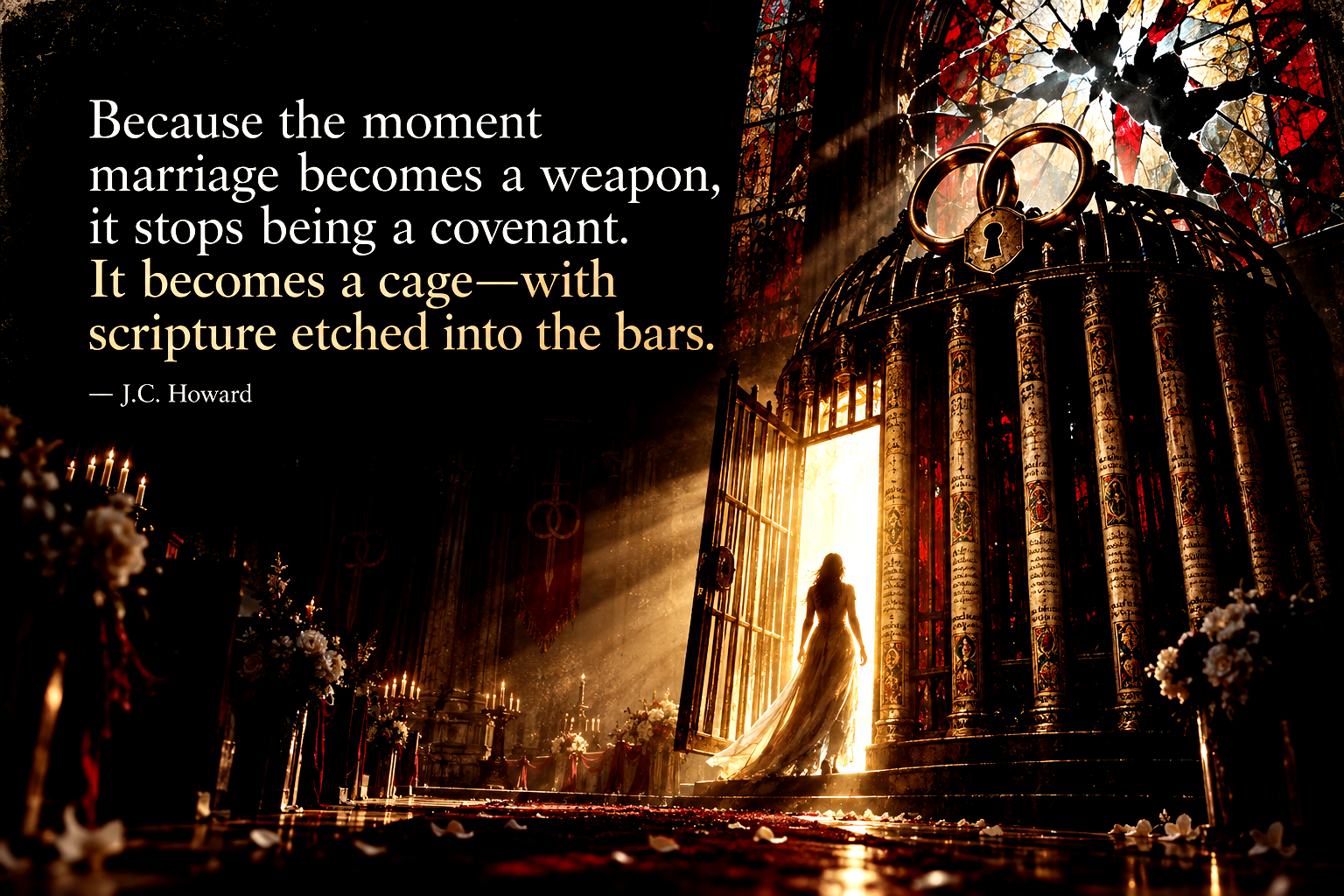
Because the moment marriage becomes a weapon, it stops being a covenant.
It becomes a cage—with scripture etched into the bars.
References & further reading
- American Psychological Association. (2025, June 1). Rebuilding a full life after walking away from organized religion. Monitor on Psychology. Source.
- Clarke, J., Wendt, S., & Mayer, W. (2024). Exploring the theological context to domestic and family violence. Violence Against Women, 31(10), 2482–2504. .
- Istratii, R., & Ali, P. (2023). A scoping review on the role of religion in the experience of IPV and faith-based responses in community and counseling settings. Journal of Psychology and Theology, 51(2), 141–173. .
- Oakley, L., Ann, L., Vaughan, S., Carroll, J., & Lafferty, M. (2025). ‘Great expectations’ versus ‘reality checks’: U.K. Christian clergy spouses’ experiences of divorce and separation and implications for pastoral care. Pastoral Psychology, 74, 867–884. .
- Smith, G., Cooperman, A., Alper, B., Mohamed, B., Rotolo, C., Tevington, P., Nortey, J., Kallo, A., Diamant, J., & Fahmy, D. (2025). Religion and views on gender, parenting and workforce participation in America. Pew Research Center. Source.
- Council for Relationships. (2024, September 5). Purity culture and sexual shame: A closer look. Source.
- Thwaites, C. (2025). Evangelical Christian purity culture and its impact on young people (Doctoral dissertation). White Rose eTheses Online. Source.
- Griffin, K. R. (2025). An examination of the purity culture beliefs scale and related outcomes (Doctoral dissertation). UNLV Theses, Dissertations, Professional Papers, and Capstones. Source.
Revision record (incorporated in this edition)
- Corrected the Istratii source. The essay now names Istratii and Ali, the full article title, and the Journal of Psychology and Theology.
- Matched claims to study design. Oakley and colleagues’ work is identified as a small mixed-methods study, with its sample limits stated in the prose.
- Reduced causal overreach. Clarke, Wendt, and Mayer are accurately described as conducting a document analysis focused on the Lutheran Church of Australia—not proving that Christianity causes violence.
- Separated source strength. Public-facing clinical sources are clearly distinguished from primary empirical studies, and the developing purity-culture evidence base is not overstated.
- Clarified clinical terms. Spiritual abuse, religious trauma, and moral injury are distinguished rather than treated as interchangeable diagnoses.
- Qualified the Pew inference. The revision describes an association between religious engagement and traditional gender attitudes, while acknowledging diversity and rejecting individual-level causal claims.
- Added the strongest counterargument. The essay now recognizes the value of commitment, traditional belief, community accountability, and faith-based resources for safety and change.
- Added a safety boundary. Reconciliation is explicitly separated from immediate safety, specialist support, lawful accountability, and a person’s right to leave danger.
Citation
Cite this essay
Howard, J. C. (2026). “Holy Matrimony or Holy Control?” (Version 1.0). The Golden Manifest Journal. .