Editorial abstract
Howard places divine declarations in selected Hebrew Bible passages beside the self-emptying language of Philippians 2 and the serving posture of Jesus. The essay asks whether this tension can illuminate a movement from identity assertion toward self-transcendence—and whether modern religious institutions have privileged dominance over the humility they profess to follow.
Evidence status: the literary and theological contrast is provocative, but it is not a clinical finding about God, a complete account of either Testament, or a settled interpretation of kenosis. The psychology sources require narrower attribution than the original prose sometimes gives them.
Christianity insists on one of its most uncompromising claims: God is one. Yet when we read scripture without the filters of inherited doctrine, we encounter something unsettling. The voice of God in many passages of the Hebrew scriptures sounds strikingly different from the posture embodied by Jesus in the New Testament. One declares supremacy. The other empties himself.
If these voices belong to the same divine reality, then the contrast cannot simply be dismissed. It must be confronted.
In the Hebrew scriptures, God frequently speaks in language that asserts identity, power, and exclusive authority. The voice is not merely confident; it is emphatically self-declarative.
“I, the Lord your God, am a jealous God.” (Exodus 20:5)
“I am the Lord, and there is no other; apart from me there is no God.” (Isaiah 45:5)
“My glory I will not give to another.” (Isaiah 48:11)
These declarations are not subtle. They establish supremacy and demand loyalty. The psychological tone is unmistakable: the voice insists upon its uniqueness, its authority, and its exclusivity. In modern psychological language, these traits resemble what researchers describe as identity assertion, a fundamental feature of ego formation in human consciousness. The ego, in psychological theory, is the structure through which identity stabilizes itself by asserting boundaries and authority over its environment (Freud, 1923/1961).
This does not automatically mean these passages describe a flawed or narcissistic deity. Rather, they demonstrate something important about identity itself. Identity declares itself. It establishes boundaries. It announces, “I am.”
And in scripture, God does exactly that.
Then Jesus appears.
And everything shifts.
Instead of asserting divine status, Jesus repeatedly distances himself from personal authority and redirects attention away from himself. The posture is radically different.
“The Son can do nothing by himself; he can do only what he sees the Father doing.” (John 5:19)
“The Father is greater than I.” (John 14:28)
“The Son of Man did not come to be served, but to serve.” (Matthew 20:28)
If the Hebrew scriptures present a voice that proclaims identity, Jesus embodies something almost opposite. The apostle Paul captures this paradox in one of the most striking theological statements in the New Testament:
“Though he was in the form of God, he did not consider equality with God something to be grasped, but emptied himself.” (Philippians 2:6–7)
The Greek term used here is kenosis, meaning self-emptying.
Psychologically, this posture resembles what modern researchers describe as self-transcendence, the capacity to move beyond the ego-centered perspective toward a wider identification with others and with reality itself. Psychologists studying human flourishing have repeatedly observed that the healthiest forms of consciousness often involve a movement beyond rigid ego-identification toward empathy, service, and relational awareness (Frankl, 1963; Maslow, 1969).
Jesus embodies this movement completely.
He does not assert divine privilege.
He relinquishes it.
He does not demand recognition.
He washes feet.
He does not cling to authority.
He submits to execution.
If we place these two portraits side by side, the contrast becomes impossible to ignore.
God declares: “I will not give my glory to another.”
Jesus kneels and washes the feet of fishermen.
God proclaims: “There is no other.”
Jesus tells his followers: “Whoever wants to be first must be the servant of all.”
And yet Christianity insists these two expressions belong to the same divine reality.
The early Christian tradition struggled with this tension long before modern readers noticed it. The famous Christ hymn in Philippians suggests that Jesus reveals something about God that the human mind rarely expects: that ultimate power may express itself not through domination, but through voluntary self-limitation.
Philosophers and theologians have called this the paradox of divine humility. If God possesses absolute power, then the ability to relinquish power may represent an even greater form of strength. Power that must constantly assert itself may not be the highest power after all.
Psychology supports this insight. Studies of leadership, moral development, and identity formation consistently show that individuals operating from secure identity structures often demonstrate greater humility, empathy, and openness. In contrast, fragile identities tend to rely on exaggerated displays of dominance or exclusivity to maintain stability (Kegan, 1982; Dweck, 2006).
Seen through this lens, the biblical contrast may reveal something profound about consciousness itself.
The voice of God in many passages resembles the assertion of identity.
The life of Jesus demonstrates the transcendence of identity.
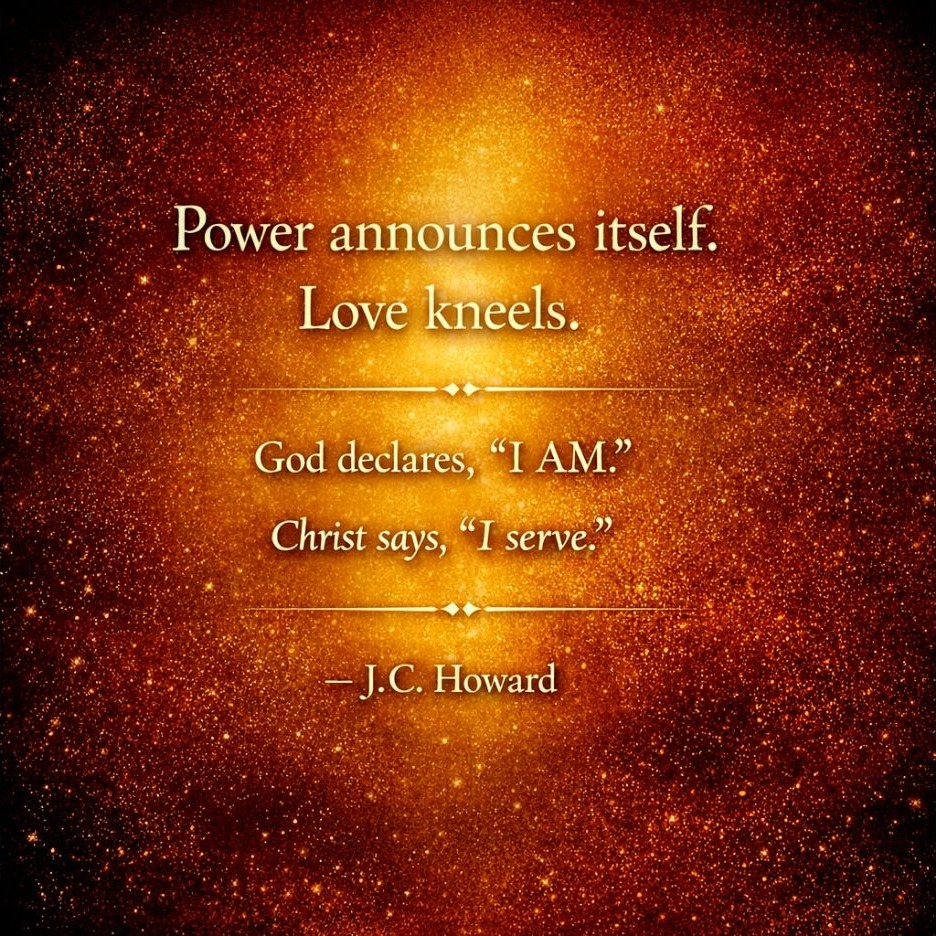
One declares I AM.
The other lives I give myself.
Both appear within the same tradition.
The tension between them is not necessarily a contradiction. It may represent two dimensions of a deeper reality.
Human beings experience the same duality. We develop an ego to navigate the world. Identity provides stability, agency, and survival. Without it, psychological functioning collapses. Yet spiritual traditions across cultures repeatedly describe another movement beyond the ego: a state of compassion, service, and interconnected awareness (James, 1902/2002).
The biblical narrative may be dramatizing this transformation.
God establishes identity.
Jesus reveals what happens when identity is surrendered.
If Christianity’s claim is true that humans are made in the image of God (Genesis 1:27), then this duality may also exist within us. We possess the capacity to assert ourselves, defend ourselves, and define ourselves. But we also possess the capacity to transcend ourselves, to give, to serve, and to love beyond self-interest.
The paradox of God and Christ may not simply describe theology.
It may describe the architecture of consciousness itself.
Which raises an uncomfortable question for modern Christianity.
If the central figure of the faith embodies radical humility, service, and self-emptying love, why do so many religious institutions emphasize dominance, certainty, and control?
The contrast between God’s declarative voice and Christ’s emptying life forces a decision. One can emphasize power, identity, and supremacy, or one can follow the path of humility and surrender that Jesus embodied.
Christianity claims both come from the same source.
But only one of them hangs on a cross.
Editorial evidence notes
- Frame the contrast as selected portraits. The Hebrew Bible also portrays mercy, grief, covenantal care, and divine self-restraint, while the New Testament also attributes authority, judgment, and exaltation to Jesus. The essay is strongest as a deliberate juxtaposition, not a complete Old-Testament/New-Testament binary.
- Avoid psychological diagnosis of God. “Ego,” “identity assertion,” and “self-transcendence” can serve as analogies for literary or theological interpretation. They cannot clinically diagnose a deity or establish the psychology of an ancient text’s divine speaker.
- Correct the account of Freud’s ego. In Freud’s structural model, the ego mediates among the id, superego, and external reality. Describing it mainly as asserting boundaries and authority is an interpretive extension, not a definition established by The Ego and the Id.
- Qualify kenosis. Philippians 2:7 uses the verb ekenōsen, “emptied himself”; kenosis is the later theological noun. Interpreters debate what this emptying entails, and the hymn itself immediately explains it through taking the form of a slave and human likeness.
- Read the Johannine sayings together. John 5:19 and 14:28 express dependence or subordination, but the same Gospel also contains strong unity and authority claims. A credible Christological argument should acknowledge both strands.
- Narrow the flourishing claim. Frankl and Maslow are foundational voices on meaning and self-transcendence, but they do not by themselves establish that movement beyond ego-identification is universally the “healthiest” form of consciousness.
- Replace the leadership generalization. Kegan and Dweck do not directly establish the broad claim that secure identities produce humility while fragile identities produce dominance and exclusivity. Either add targeted empirical sources or present the sentence as a hypothesis.
- Avoid supersessionist implications. Clarify that the essay is not contrasting a supposedly egoistic Jewish God with an ethically superior Christian revelation. Both sets of texts arise within Jewish traditions, and both contain diverse portrayals of power, mercy, humility, and judgment.
- Soften the final dichotomy. Power and humility are not necessarily mutually exclusive in the biblical texts. The sharper question is how power is exercised, limited, or transformed through service.
References recovered from the original edition
- The Holy Bible, New Revised Standard Version Updated Edition. National Council of Churches, 2021. Cited passages.
- Carol S. Dweck, Mindset: The New Psychology of Success. Random House, 2006. Publisher page.
- Viktor E. Frankl, Man’s Search for Meaning. Beacon Press, recovered edition dated 1963. Publisher page.
- Sigmund Freud, The Ego and the Id. W. W. Norton, 1961; original work published 1923. Publisher page.
- William James, The Varieties of Religious Experience. Modern Library, recovered edition dated 2002; original work published 1902. Public-domain edition.
- Robert Kegan, The Evolving Self: Problem and Process in Human Development. Harvard University Press, 1982. Publisher page.
- Abraham H. Maslow, Toward a Psychology of Being. 2nd ed., recovered reference dated 1969. Archive record.
Editorially suggested context
- Read Philippians 2:6–11 as a complete unit. The movement from divine form through slave form, death, and exaltation is essential to interpreting the hymn’s account of power and self-emptying.
- Compare major critical commentaries. Add at least one current scholarly commentary on Philippians and one on John so the essay can distinguish its theological proposal from disputed exegetical claims.
- Add targeted psychology research if retained. Claims about secure identity, humility, dominance, and self-transcendence should be supported by empirical studies designed to measure those constructs, not only broad popular or developmental works.
Citation
Cite this essay
Howard, J. C. (2026). “The Ego of God and the Emptying of Christ.” (Version 1.0). The Golden Manifest Journal. .