Editorial abstract
Howard revisits Matthew 5:39 through the right-cheek detail and the honor-shame setting of the ancient Mediterranean world. Drawing on Walter Wink’s influential interpretation, the essay argues that turning the other cheek can be read as nonretaliatory resistance that refuses both violent escalation and humiliating submission.
Evidence status: the nonviolent-resistance reading is a serious and influential interpretation, but the precise backhand gesture and its social meaning are reconstructed rather than stated in Matthew. The article should distinguish plausible historical interpretation from settled historical fact.
Few teachings in the Christian tradition have been quoted more often—and misunderstood more deeply—than the instruction to “turn the other cheek.” The phrase has become shorthand for passive submission, a moral command to quietly endure mistreatment. It is frequently invoked to encourage patience, tolerance, or even silence in the face of wrongdoing. Yet when examined within its historical and cultural setting, the statement may point to something far more subversive.
The saying appears in the Gospel of Matthew during the Sermon on the Mount:
“But I say to you, do not resist an evil person. But whoever slaps you on the right cheek, turn the other to him also.”
—Matthew 5:39 (NRSV)
At first glance, the statement appears to demand non-resistance. However, scholars of ancient Mediterranean culture note a critical detail in the verse: the right cheek.
The Cultural Meaning of the Right Cheek
In the first-century Mediterranean world, social life operated through a rigid honor-shame system. Public gestures communicated status, power, and humiliation. Anthropologists and historians have documented how insults were often performed symbolically through gestures rather than purely physical violence (Malina & Rohrbaugh, 2003).
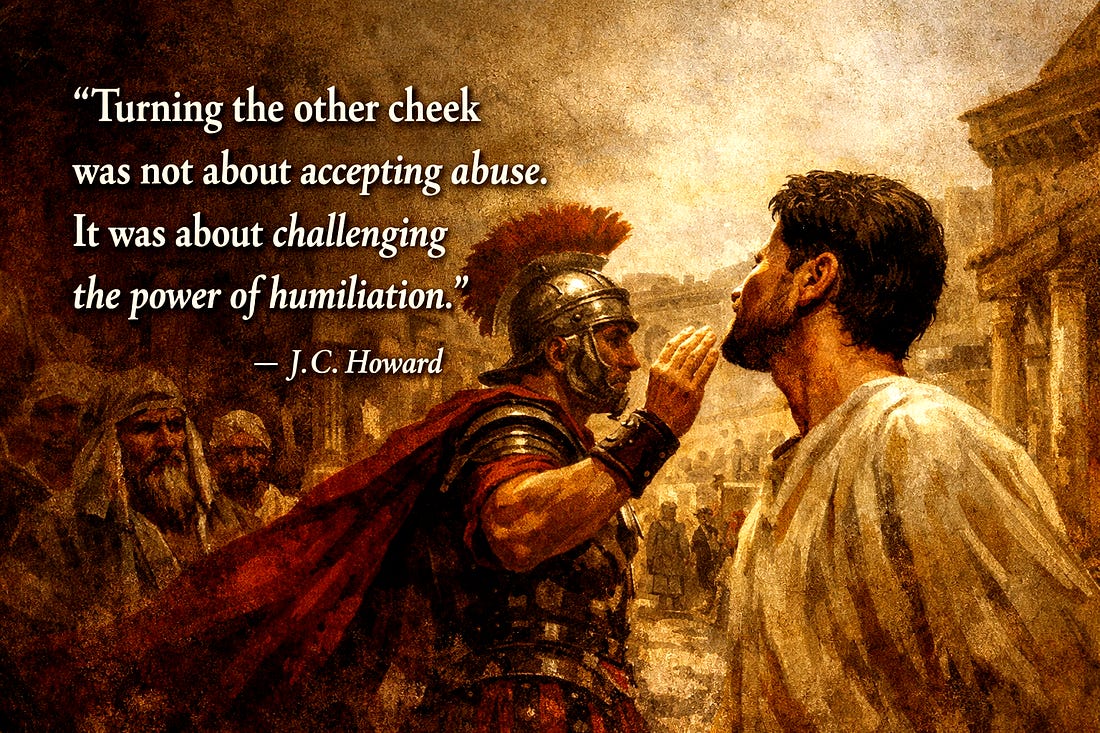
Because most people were right-handed, striking someone on the right cheek would normally require a backhanded slap. In that society, a backhanded slap carried a specific meaning: it was an insult used by someone of higher status against someone considered socially inferior—such as a master toward a servant or a Roman officer toward a subject.
Biblical scholar Walter Wink argues that this detail transforms the entire meaning of the passage. The gesture was not primarily about causing injury; it was about public humiliation and status enforcement (Wink, 1998). The act communicated, “Know your place.”
If this cultural framework is correct, then the statement about turning the other cheek was not simply an invitation to endure violence. It addressed the ritual of humiliation itself.
A Disruption of the Honor System
Within that honor-shame culture, the response of turning the other cheek created a social disruption. The aggressor could not easily repeat the same insult. The symbolic hierarchy—master above servant—became unstable in that moment.
In this interpretation, the instruction represents a form of nonviolent resistance rather than passive surrender. It refuses retaliation while simultaneously refusing humiliation.
This perspective aligns with broader teachings in the Sermon on the Mount, where Jesus repeatedly challenges social assumptions about power, honor, and retaliation. Statements such as loving enemies and blessing persecutors invert conventional responses to conflict.
The teaching does not glorify abuse. Instead, it undermines the system that sustains humiliation.
Psychology of Power and Humiliation
Modern psychology sheds additional light on the social dynamics behind humiliation. Research in social psychology shows that public humiliation functions as a mechanism for enforcing social hierarchy and group dominance (Lindner, 2006).
When a dominant individual humiliates another person, the act signals superiority not only to the victim but to observers. The humiliation reinforces group structure.
However, psychologists also note that nonviolent refusal to accept humiliation can disrupt these dynamics. When individuals refuse to respond within the expected hierarchy—neither retaliating nor submitting—the power script breaks down.
This pattern appears repeatedly in nonviolent resistance movements throughout history. Scholars studying figures like Mahatma Gandhi and Martin Luther King Jr. have noted similar strategies of moral resistance that expose unjust power structures without perpetuating cycles of violence (Sharp, 2012).
The response challenges the legitimacy of the aggressor rather than escalating the conflict.
A Teaching Misapplied
Over time, cultural distance from the ancient world caused the symbolic context of the passage to fade. What originally functioned as a challenge to social humiliation became interpreted as a command to quietly endure mistreatment.
The difference between these interpretations is profound.
One interpretation encourages passive endurance of abuse.
The other reveals a strategy of dignified resistance without retaliation.
Understanding the historical backdrop does not eliminate the ethical difficulty of the teaching. But it shifts the conversation away from submission toward transformative responses to power and violence.
The statement about turning the other cheek may therefore belong to a larger pattern in the teachings of Jesus—one that exposes the hidden assumptions beneath social systems of power.
Rather than reinforcing humiliation, the teaching may have been designed to quietly dismantle it.
And perhaps that is why the smallest detail in the verse—the mention of the right cheek—has captured the attention of historians and scholars for generations.
Sometimes the key to understanding an ancient text lies in the cultural gestures its original audience understood instinctively.
Editorial evidence notes
- Central distinction. The contrast between passive endurance and dignified nonretaliation is the essay's clearest and most consequential claim.
- Influential reconstruction, not textual detail. Walter Wink and related interpreters infer a backhanded slap from the right-cheek detail. Matthew does not identify the hand, the aggressor's status, or a master-servant setting.
- Interpretive range. The nonviolent-resistance reading is serious and influential, but not the only scholarly reading. Other interpretations emphasize renunciation of retaliation, radical generosity, pacifism, or refusal to answer insult in kind.
- Rabbinic comparison. Mishnah Bava Kamma 8:6 distinguishes compensation for ordinary and backhanded blows. Because the Mishnah was compiled later, it is comparative evidence for the humiliating force of gestures, not direct proof of Jesus' precise setting.
- Psychological scope. Lindner's work provides a broad account of humiliation and conflict; it does not independently establish every claim about observer effects, group hierarchy, or the psychology of this Gospel scene.
- Historical movements. Gandhi, King, and Gene Sharp illustrate how disciplined nonviolent action can expose unjust power. Their methods do not prove that Matthew 5:39 originally encoded the same tactic.
- Pastoral safety. This interpretation must never be used to pressure a person to remain in danger, conceal abuse, or forgo legal, medical, or community protection.
- Closing scope. The right-cheek detail has attracted influential interpretation, but claims about what readers have missed 'for generations' should be understood as rhetorical rather than a documented survey of reception history.
References recovered from the original edition
- The Holy Bible, New Revised Standard Version Updated Edition. National Council of Churches, 2021. Matthew 5:39.
- Evelin Lindner, Making Enemies: Humiliation and International Conflict. Praeger Security International, 2006. Publisher page.
- Bruce J. Malina and Richard L. Rohrbaugh, Social-Science Commentary on the Synoptic Gospels. 2nd ed., Fortress Press, 2003. Book record.
- Gene Sharp, From Dictatorship to Democracy: A Conceptual Framework for Liberation. Albert Einstein Institution, recovered edition dated 2012. Recovered PDF link.
- Walter Wink, The Powers That Be: Theology for a New Millennium. Doubleday, 1998. Publisher page.
Editorially suggested context
- Mishnah, Bava Kamma 8:6. A later rabbinic comparison distinguishing penalties for ordinary and backhanded blows. It can support the claim that modes of striking carried different levels of humiliation, with the chronological limitation stated clearly.
- Compare multiple Matthean commentaries. Add at least one major critical commentary that does not depend on Wink so readers can see where the nonviolent-resistance interpretation sits within the broader scholarly debate.
Citation
Cite this essay
Howard, J. C. (2026). “Turning the Other Cheek: What Jesus Was Really Confronting.” (Version 1.0). The Golden Manifest Journal. .