Editorial abstract
Howard examines a tension between religious trust and scriptural instructions to test, discern, and mature in thought. The essay argues that communities can transform simplicity from a freely chosen posture into a social expectation that discourages inquiry, then asks readers to distinguish peace grounded in understanding from peace maintained by non-examination.
Evidence status: the cited passages establish distinct biblical calls to humility, trust, mature thinking, discernment, and testing. Organizational and cognitive research supports the narrower claims that interpersonal climate can affect whether people ask questions, that human communication depends on both trust and vigilance, and that reasoning can be shaped by preferred conclusions. These sources do not prove that the passages form an explicit biblical contradiction, that all religious communities suppress questions, or that any person’s faith is conditioned rather than chosen.
What if the version of “faith” you were taught
was never meant to be examined?
Scripture tells you to become like a child.
Then in the same breath… it tells you to grow up in your thinking.
To trust without leaning on your own understanding.
Yet also to test everything placed before you.1
So which is it?
A faith that doesn’t question…
or a faith that is commanded to?
Not refined.
Not tested.
Just… accepted.
Somewhere along the way, simplicity became sacred.
And questioning quietly became rebellion.
We were told to have “childlike faith.”
But no one clarified the difference between trust… and intellectual surrender.
Because a child doesn’t just trust.
A child doesn’t challenge.
And that’s where the paradox begins.
Not what is true…
but what is safe to believe out loud.
This is where the paradox tightens.
Scripture calls for discernment, testing spirits, seeking wisdom.1
Yet in practice, many communities reward the absence of friction.
A smooth belief.
An unquestioned alignment.
A mind that doesn’t disrupt the structure.
Because questions don’t just seek answers.
They expose cracks.
And not every system is built to survive that.
So the believer stands at a crossroads most never acknowledge.
Remain “simple”… and be affirmed.
Or become aware… and risk being misunderstood.
Not because awareness is wrong.
But because awareness introduces variables the system can’t easily control.
And here’s the uncomfortable truth:
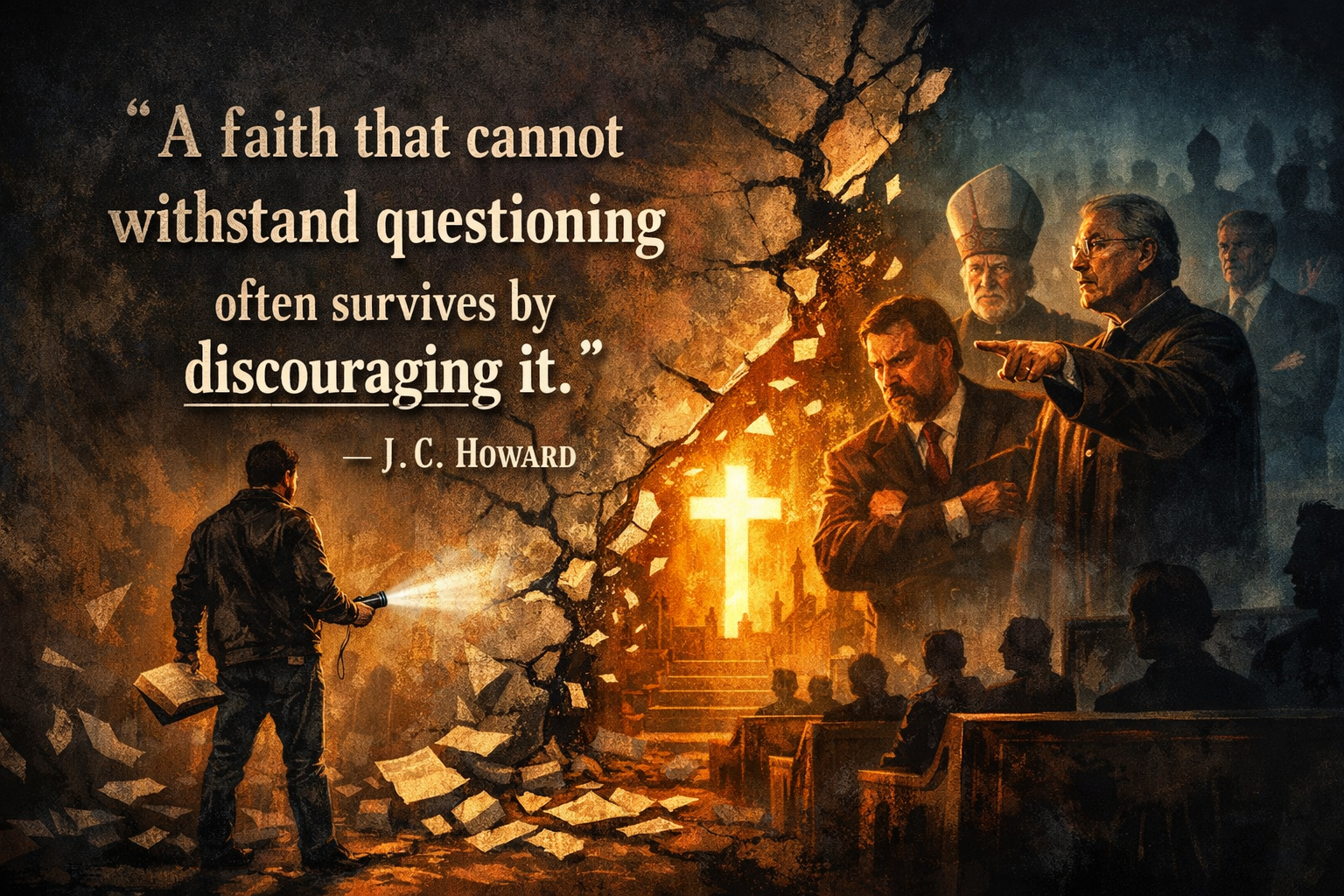
A faith that cannot withstand questioning
often survives by discouraging it.
Not always intentionally.
But effectively.
So the question isn’t whether simplicity is good.
It’s whether your simplicity was chosen…
or conditioned.
Because there is a difference between peace that comes from understanding
and peace that comes from never looking deeper.
And only one of those can survive the moment
you finally do.
Biblical & psychological context (editorial apparatus)
These sources establish the relevant texts and bounded psychological mechanisms adjacent to Howard’s argument. They do not adjudicate the truth of a faith tradition or diagnose any reader, congregation, or leader.
- The Holy Bible, New Revised Standard Version Updated Edition. Primary texts invoked or relevant to the essay include Proverbs 3:5–7; Matthew 18:1–5; 1 Corinthians 14:20; 1 Thessalonians 5:19–22; James 1:5; and 1 John 4:1. The journal notes distinguish the language and context of these passages from the author’s theological synthesis.
- Amy C. Edmondson, “Psychological Safety and Learning Behavior in Work Teams.” A field study linking team psychological safety with learning behavior while emphasizing its interpersonal and organizational setting. It is relevant to climates for questioning but does not directly study religious communities. . Administrative Science Quarterly 44, no. 2 (1999): 350–383.
- Dan Sperber, Fabrice Clément, Christophe Heintz, Olivier Mascaro, Hugo Mercier, Gloria Origgi, and Deirdre Wilson, “Epistemic Vigilance.” Proposes that people depend extensively on communication while using cognitive mechanisms to guard against accidental or intentional misinformation. . Mind & Language 25, no. 4 (2010): 359–393.
- Ziva Kunda, “The Case for Motivated Reasoning.” Reviews evidence that motivation can influence reasoning through selective access to beliefs, rules, and evidence, while conclusions remain constrained by what a person can justify. . Psychological Bulletin 108, no. 3 (1990): 480–498.
- Mark R. Leary, Kate J. Diebels, Erin K. Davisson, Katrina P. Jongman-Sereno, Jennifer C. Isherwood, Kaitlin T. Raimi, Samantha A. Deffler, and Rick H. Hoyle, “Cognitive and Interpersonal Features of Intellectual Humility.” Empirically examines recognizing that one’s beliefs and opinions may be incorrect and its associations with open-minded evaluation. . Personality and Social Psychology Bulletin 43, no. 6 (2017): 793–813.
Citation
Cite this essay
Howard, J. C. (2026). “The Hidden Cost of Unquestioned Faith.” (Version 1.0). The Golden Manifest Journal. .